How UK players move money through online casinos in 2026
 Available in US
Choosing a payment method at a UK online casino is a choice about how money moves in and how it moves back out. Credit cards have been banned for gambling since 14 April 2020, and the cashier at every GB-licensed operator runs an ID-and-source-of-funds check before the first deposit. What is left is a narrower list than it once was: debit cards, bank transfers via Faster Payments, e-wallets, and a handful of pre-pay options. The method a player picks decides whether a payout lands in minutes or in working days, and whether the cashier’s anti-fraud rules touch a bank statement or stop at the wallet. This page sets out the methods, the rails underneath them, and the licence conditions that apply whichever route a player takes.

Data current as of 23 September 2026 and verified against the Gambling Commission’s public register of remote casino operating licences.
Table of Contents
- Settlement windows and what shapes a payout’s clock
- The licensed landscape at a glance
- The fundamentals of funding a UK casino
- Jurisdiction and what a Commission licence obliges
- Safer gambling around the way you pay
- Virgin Games — Gamesys Operations Limited’s white-label UK casino
- Betfred — the Petfre (Gibraltar) Limited licence on the Commission register
- Betfair — PPB Games Limited’s Commission-licensed casino
- Sky Vegas — Bonne Terre Gaming Limited’s UK casino brand
- Gala Bingo — one of LC International Limited’s casino licences
- 32Red — Platinum Gaming Limited’s longest-running casino
- Casumo — Recro Limited’s Commission-licensed UK casino
- Midnite — Dribble Media Limited’s standalone casino brand
- PokerStars — Stars Interactive Limited’s casino beyond poker
- Jackpotjoy — the sister UK casino under Gamesys Operations Limited
- What the 10x wagering cap means in turnover
- Frequently asked questions
Settlement windows and what shapes a payout’s clock
The payment method a player picks does two jobs at the cashier. It moves money in, and it dictates how money comes back out. Both halves are governed by the Gambling Commission’s licence conditions and by the rails the money actually travels on, which is why a withdrawal to a debit card rarely lands in the same hour as a withdrawal to an e-wallet.
Faster Payments and the bank-transfer rail
The standard UK bank-transfer rail is the Faster Payments Service, run by Pay.UK since 2008. It is open around the clock, and most transfers land in seconds, with a published upper bound of two hours and a per-transaction limit of £1,000,000 — though banks routinely tighten that ceiling for their own customers. The Bank of England oversees the system’s safety and stability rather than operating it; Pay.UK runs the scheme. For an online casino, Faster Payments is the mechanism most GB-licensed operators use to settle casino withdrawals back to a player’s current account, because every UK bank participates in the scheme and the cost per transaction is low enough to make small payouts economical.
This is where the operator’s own clock starts. Once a player requests a payout, the casino’s payments team has to clear its internal queue: anti-money-laundering checks, source-of-funds where the deposit thresholds are crossed, the player’s identity already on file. Only then does the instruction go out to Pay.UK. The rail itself is fast. The operator’s queue in front of it is what costs the player time.
The Faster Payments ceiling also matters for high-value withdrawals. The scheme’s £1,000,000 per-transaction cap is far above what a UK casino payout typically runs at, so the rail is rarely the bottleneck. The ceiling most players actually feel is the bank’s own: individual banks can and do impose lower limits on their customers, which is worth knowing when a payout is on the larger side.
Cards and contactless wallets at the cashier
Debit cards are the most common deposit method at a GB-licensed casino. Credit cards have been banned for gambling since 14 April 2020, including credit cards routed through e-wallets, and the Gambling Commission estimated at the time that around 800,000 UK consumers had used them to gamble in 2018. A survey around the same period found that 22 per cent of online gamblers funding play with credit cards were classed as problem gamblers — the figure the regulator pointed to when it brought the ban in.
Apple Pay sits on top of the card network rather than replacing it. The wallet tokenises the underlying debit or credit card, generating a dynamic security code per transaction; the merchant never sees the long card number. The wallet launched in the United States on 20 October 2014, supported UK-issued cards from 14 July 2015, and uses near-field communication at the contactless terminal for in-store purchases. For an online casino deposit, the wallet sits behind whatever card the customer has loaded into it — which means a credit card in the wallet still falls under the Gambling Commission’s ban, because the wallet is a pass-through, not a substitute.
Authentication at the cashier is biometric. On iPhones with Face ID, a purchase is authenticated by a double-click of the side button. On Touch ID models, the Home button plays the same role. Apple requires a supported card from a participating issuer, and the wallet is not available in every market. Two regulatory matters sit behind the product. In November 2024 the US Consumer Financial Protection Bureau brought large non-bank digital wallets, including Apple Pay, under bank-like federal oversight. The European Commission opened a probe in 2020 into whether Apple had abused its control of the iPhone’s NFC hardware to lock rival payment apps out of contactless payments — a probe that ran for several years before parts of it were settled.
E-wallets, pre-pay vouchers and the smaller providers
E-wallets split into two groups: large consumer brands such as PayPal, Skrill and Neteller, and digital wallets run by smaller payments companies. AstroPay sits in the second group. It was founded in 2009, is headquartered in Uruguay, and operates as a global digital wallet offering online payments, virtual and physical debit cards, and peer-to-peer transfers. In 2016 the company spun off its payment-processing business as dLocal, a separate company now listed in its own right.
The wallet’s UK entity, Larstal Limited, is authorised by the Financial Conduct Authority under the Electronic Money Regulations 2011. AstroPay’s Isle of Man subsidiary is licensed by the Isle of Man Financial Services Authority for money transmission, its Brazilian entity is authorised by the Brazilian Central Bank as an electronic currency issuer, and its Danish arm is authorised by the Danish Financial Supervisory Authority. The wallet serves users across Argentina, Australia, Brazil, Canada, Colombia, Denmark, Spain, the United Kingdom, the United States and Uruguay, which is why a UK-facing casino cashier can offer it without the wallet itself doing a separate licence dance per market.
Paysafecard and similar pre-pay vouchers sit at the other end of the e-money spectrum. A player buys a code at a shop and redeems it at the cashier without sharing bank details. The voucher is an e-money product; the casino still has to verify the player behind the code before a withdrawal can be made. The friction the voucher removes at deposit is the friction the cashier reintroduces at withdrawal, because the verification rules apply whichever way money moves.
Payment method characteristics
| Method | Processing Speed | Typical Limits |
|---|---|---|
| Debit Card | 2–5 working days | 1–3 days |
| Faster Payments | Instant/2 hours | Up to £1M |
| E-wallets | Near-instant | High |
Cards are the slowest of the standard methods. A debit-card withdrawal has to ride the card network’s settlement rails, which clear in batches rather than in real time. Two to five working days is a typical window at a GB-licensed site. E-wallets are usually the fastest, because the wallet itself holds the funds and the rail between the casino and the wallet is direct. Bank transfers sit between the two: Faster Payments is technically instant, but the operator’s pending period and the player’s bank’s own processing window eat into the headline speed.
A licensed operator can quote a payout time on its terms page, but that time starts when the casino releases the funds, not when the player clicks withdraw. The working number for a player is the total elapsed time between clicking withdraw and the money being spendable. That depends as much on the operator’s queue and the player’s bank as it does on the rail, which is why a “fast withdrawal” headline at one brand can be slower than a “pending 24 hours” headline at another.
The licensed landscape at a glance
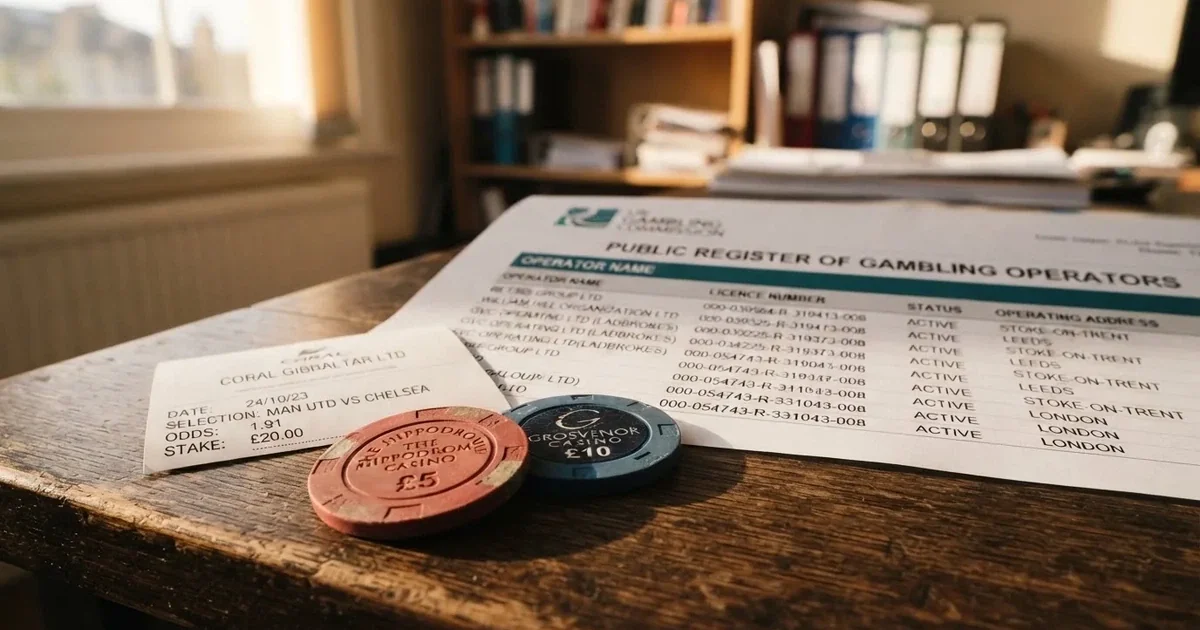
The Gambling Commission’s public register lists every business holding an active remote casino operating licence, and against each one the domains it actually runs. On 18 September 2026 the register held 139 such licences, and its domain list contained 1,065 active and 361 white-label entries — a white-label site trades under another company’s licence, so the player is dealing with the licence holder named on the register, not the brand on the page.
The ten operators below are the GB-licensed brands reviewed later in this page. All hold a Commission remote casino licence, all are bound by the same player-protection code, and none has supplied research-confirmed information about which specific payment methods its cashier supports beyond the standard GB offer — debit card, bank transfer, and a selection of e-wallets. What the table compares is the licence relationship that sits behind each brand.
| Brand | Licence holder and GB remote casino licence | Domain status on the register |
|---|---|---|
| Virgin Games | Gamesys Operations Limited, 038905-R-319430-022 | White-label |
| Betfred | Petfre (Gibraltar) Limited, 039544-R-319290-010 | Active |
| Betfair | PPB Games Limited, 039411-R-319335-010 | Active |
| Sky Vegas | Bonne Terre Gaming Limited, 065519-R-339675-002 | Active |
| Gala Bingo | LC International Limited, 054743-R-330863-014 | Active |
| 32Red | Platinum Gaming Limited, 045322-R-324275-019 | Active |
| Casumo | Recro Limited, 061549-R-336718-002 | Active |
| Midnite | Dribble Media Limited, 042647-R-321653-022 | Active |
| PokerStars | Stars Interactive Limited, 039108-R-319334-026 | Active |
| Jackpotjoy | Gamesys Operations Limited, 038905-R-319430-022 | Active |
Two patterns stand out. Virgin Games is the only white-label domain on the list — the page is run by Gamesys Operations Limited, which also runs Jackpotjoy under the same account (38905) and the same remote casino operating licence (038905-R-319430-022). The other nine are active domains of their own licence-holding companies. The licence holders differ in corporate structure: Betfred’s is incorporated in Gibraltar (Petfre (Gibraltar) Limited); the others are UK companies running UK-facing sites. A remote casino licence number on the register has the form account-R-number-suffix, where the leading six digits repeat the licence holder’s account number and the “R” marks a remote licence.
The fundamentals of funding a UK casino
The cashier at a GB-licensed casino is built around three rails. The first is the debit-card network — Visa Debit, Mastercard Debit, sometimes Maestro on legacy cards — taking deposits in real time and withdrawals through the same card’s settlement system. The second is the UK bank-transfer rail, which for almost every player now means Faster Payments: an instant transfer in, a payout back to the player’s current account in seconds once the operator releases the funds. The third is the licensed e-money route — PayPal, Skrill, Neteller, plus a handful of specialist wallets — which sits between the player’s bank and the casino and is governed by the Electronic Money Regulations 2011 in the UK.
Pay-by-phone deposits — billing the deposit to the player’s mobile bill — are a fourth option at some sites, with the usual £10 daily ceiling on most networks. Paysafecard and similar pre-pay vouchers add a fifth: a player buys a code at a shop and redeems it at the cashier without sharing bank details. Each route has its own verification flow, but the cashier’s job is the same in every case — accept money from a verified player, hold it in segregated client funds, and release it back to the same player on request.
Two rules cut across the choice. The first is the credit-card ban covered in the section on settlement windows: a player cannot fund a gambling account with a credit card, and a credit card loaded into an e-wallet is treated the same way. The second is the ID-and-source-of-funds check that every GB-licensed operator has to run before the first deposit clears — the licence condition explained in the section on jurisdiction. A player who cannot produce the required documents — name, address, date of birth — does not get to deposit at all.
The same logic applies at withdrawal. The cashier must return money to the same player who deposited it, on the same method where the operator’s policy allows it. The Commission does not forbid the operator sending a withdrawal to a different payment method, but the operator’s own anti-money-laundering rules usually do — that is why the cashier typically defaults to refunding the deposit method first. The choice a player makes at deposit is therefore the choice the cashier remembers at withdrawal.
Jurisdiction and what a Commission licence obliges
The Gambling Commission is the regulator for online casino gambling in Great Britain (England, Scotland and Wales). It issues operating licences under the Gambling Act 2005, supervises the holders, and publishes a public register of who holds which licence. The register can be searched online and downloaded as CSV or Excel; on 18 September 2026 it listed 139 businesses holding an active remote casino operating licence. Each licence number carries the licence holder’s six-digit account number, the letter R for remote, a running number, and a suffix — so 038905-R-319430-022 is Gamesys Operations Limited’s remote casino operating licence, account 38905, suffix 022.

A remote casino operating licence is the only licence a casino needs to take online customers in Great Britain. Operators based in Curaçao, Malta or Gibraltar do not get a pass: since the Gambling (Licensing and Advertising) Act 2014, any operator taking customers in Great Britain needs a Commission licence wherever it is incorporated. A Curaçao or Maltese licence is not a substitute. The Commission’s view is that the player is the protected party, not the operator’s corporate seat.
What the licence obliges is set out in the Licence Conditions and Codes of Practice (LCCP), the social responsibility code, and the Remote Technical Standards. The conditions that matter at the cashier include:
- Minimum age 18, with name, address and date of birth verified before the first deposit or any play (since 7 May 2019). Anonymous play has been unlawful at a GB-licensed site since that date, when the Commission brought the identity-verification requirement into the licence conditions; a casino that lets a player deposit without checking the documents first is breaking the licence, not bending it.
- Segregated client funds: player balances held separately from operating capital.
- Game-cycle stake limits: £5 for players aged 25 and over (from 9 April 2025) and £2 for players aged 18-24 (from 21 May 2025). The limit applies to a single game cycle, not to a single spin.
- A minimum 2.5-second interval between slot spins, in force since 31 October 2021.
- A ban on auto-play and on losses disguised as wins.
- A requirement for the operator to prompt the customer to set a financial limit before the first deposit (in force from 31 October 2025). There is no state-set deposit ceiling; the limit is the player’s choice.
- Wagering requirements capped at 10x the bonus amount (in force since 19 December 2025). Mixed-product bonuses — get a free bet on sport, get casino spins — are banned.
- GAMSTOP, the national online self-exclusion scheme, as a condition of every online licence since 31 March 2020.
Beyond those, the Commission’s LCCP and the social responsibility code govern advertising, the safer-gambling stack at the cashier (reality checks, time-outs, operator-level self-exclusion), and financial vulnerability checks against public data at £150 net deposits in a rolling 30-day period (from 28 February 2025). The Commission’s wider financial risk-assessment framework has been announced but is not yet in force, so the £150 trigger is the live rule.
Two enforcement powers are worth knowing about. The Commission can revoke or suspend a licence, which is what happens to operators that breach the safer-gambling code. It can also disrupt illegal sites — cease-and-desist notices, payment and hosting referrals, search-engine delisting — but it has no power to order ISPs to block unlicensed sites. Providing gambling to people in Great Britain without a licence is an offence under section 33 of the Gambling Act 2005; the player is not the target of the penalty, but what the player loses on an unlicensed site is the protection — no GAMSTOP, no Commission complaints route, no approved ADR.
Tax sits apart from the licence conditions. Players pay no tax on gambling winnings in the UK. Operators pay Remote Gaming Duty, raised from 21% to 40% from 1 April 2026 — a model rate that does not directly change what a player pays at the cashier, but explains why licensed operators price their offers to cover the duty. The actual rate a player sees is on the operator’s terms page; the duty itself is between the operator and HMRC.
Safer gambling around the way you pay
Every licensed route into a UK casino account is gated by safer-gambling checks, and the cashier is the first place those checks bite. They apply whichever method the player picks, because they sit on the operator’s licence rather than on the rails the money travels on.
GAMSTOP is the largest of those gates. It is the national online self-exclusion scheme, mandatory for every online licence since 31 March 2020. A player who has registered with GAMSTOP cannot open an account, deposit, or play at any GB-licensed site for the chosen period — six months, one year or five years. The exclusion cannot be cancelled early. The cashier cannot override the GAMSTOP check; the operator’s system refuses the registration at source.
Deposit limits sit one level below. There is no statutory ceiling on how much a player can deposit, but every licensed operator must prompt the customer to set a financial limit before the first deposit (in force from 31 October 2025). The limit is the player’s choice, but the prompt is mandatory; an operator that does not prompt is in breach. A player can set a daily, weekly or monthly limit, raise it only after a cooling-off period, and lower it any time. The cashier enforces the limit before the deposit lands — which is why a method that feels “instant” at the deposit moment, such as Apple Pay or Faster Payments, is still subject to the same limit a slower method would face.
Financial vulnerability checks sit below that. Since 28 February 2025 an operator has to run a check against public data once a player’s net deposits cross £150 in a rolling 30-day period. The check looks at publicly available information — court records, insolvency registers, the like — and flags players who may be in financial difficulty. A flag triggers a follow-up with the player; it does not, on its own, stop play. For the player, the practical question is what the cashier records as a “deposit”: Apple Pay, Google Pay, PayPal and Paysafecard all count, regardless of the rail underneath, because the check is on the player’s net position at the casino, not on the source of funds.
Self-exclusion at the operator level sits alongside GAMSTOP. A player who wants a break from one brand can self-exclude at that brand alone, typically for six months or longer. Time-outs — a cooling-off period of 24 hours to several weeks — sit below that. Reality checks (in-session pop-ups that show time spent and net position) and the Commission’s ban on auto-play complete the safer-gambling stack at the cashier.
The protection does not follow the player offshore. An unlicensed site is not part of GAMSTOP, has no obligation to offer deposit limits, and is not subject to the Commission’s vulnerability-check regime. The cashier on an unlicensed site works the same way technically, but the safer-gambling scaffolding does not. A player who wants the protection has to stay inside the licensed market.
The payment method does not change the safer-gambling cover, but it does change the friction. A pre-pay voucher removes the bank statement from the loop and stops a player topping up with one click. An e-wallet adds a layer between the bank and the casino. A debit card attached to an overdraft opens a credit line the cashier cannot see. None of these changes the operator’s safer-gambling obligations, and a player who needs the operator’s intervention will get it regardless of the rail. What the rail changes is how easy the cashier is to top up — and for a player trying to slow down, friction is the point.
Virgin Games — Gamesys Operations Limited’s white-label UK casino
Virgin Games sits on the Gambling Commission’s register as a white-label domain of Gamesys Operations Limited. The account number is 38905, the remote casino operating licence is 038905-R-319430-022, and the suffix 022 indicates this is one of several active permissions Gamesys holds under the same licence family. The brand on the page is Virgin Games; the regulated party on the register is Gamesys.
For the player at the cashier, that structure has three practical effects. The regulated party on the other side of the deposit button is Gamesys, not Virgin — any complaint, dispute resolution, or ADR claim runs against Gamesys’s licence, not against the brand. The same Gamesys licence also covers Jackpotjoy, which appears later in this page under the same account number and the same licence number. The two brands share the safer-gambling code, the same GAMSTOP integration, the same identity-verification rules, and the same segregated client funds.
The white-label status itself is a public fact, readable in a CSV download from the Commission’s register — the register’s domain list records each website against the licence account that runs it, with a status of Active, Inactive or White Label. Virgin Games is the only white-label entry in this comparison; the other nine are active domains of their own licence-holding companies.
The verdict for a player weighing Virgin Games against Jackpotjoy is that the licence is identical. The choice between them is the product, the look, and the welcome offer. The regulatory cover is the same Gamesys Operations Limited licence either way.
Betfred — the Petfre (Gibraltar) Limited licence on the Commission register
Betfred operates as an active domain under the account of Petfre (Gibraltar) Limited. The account number is 39544, the remote casino operating licence is 039544-R-319290-010, and the suffix 010 indicates this is the company’s primary active permission. The Gibraltar incorporation of the operating company explains a structure that catches some players off guard: a familiar UK high-street bookmaker sits under a corporate parent registered offshore.
For the player, the offshore seat is incidental. The Gambling Act 2005 requires any operator taking customers in Great Britain to hold a Commission licence, wherever it is incorporated, and Betfred holds one. The Commission supervises the licence from its London office; the player’s protection — segregated client funds, GAMSTOP, deposit limits, ADR — runs through that licence, not through the Gibraltar corporate seat. A player reading the small print at the cashier is dealing with Petfre (Gibraltar) Limited as the regulated party, but the regulator that matters is the Commission.
The test of legitimacy for a Betfred player is the register entry, not the corporate seat. The Commission’s domain list marks Betfred as Active against account 39544. That is what a £250 deposit is supervised under, whether the operating company behind the licence is in London or in Gibraltar.
Betfair — PPB Games Limited’s Commission-licensed casino
Betfair maintains an active status on the register under PPB Games Limited. The account number is 39411, the remote casino operating licence is 039411-R-319335-010. PPB Games Limited is the casino arm of the operation — a separate company from the betting exchange — and the casino product the player sees at the cashier runs against this licence alone.
For the player, the split between the exchange and the casino is the practical point. The casino runs on its own Commission licence, with its own safer-gambling code, its own segregation of client funds, and its own ADR route. A complaint about the casino product goes to PPB Games Limited, not to the wider group. A player who has self-excluded from the exchange via GAMSTOP is excluded from the casino too, because GAMSTOP covers the player rather than the product, but the cashier’s regulatory cover is the casino licence, not the exchange one.
For a player weighing the casino product at Betfair against the casino products on this list, the practical point is that the casino runs on a separate Commission licence, not on the licence of the betting exchange that shares the brand. The Commission’s supervision falls on PPB Games Limited’s licence against the LCCP, the social responsibility code, and the Remote Technical Standards. The player does not see any of that, but the protection runs through it.
Sky Vegas — Bonne Terre Gaming Limited’s UK casino brand
Sky Vegas appears as an active site managed by Bonne Terre Gaming Limited. The account number is 65519, the remote casino operating licence is 065519-R-339675-002. Bonne Terre is the dedicated casino licence holder for the Sky Vegas brand — a single-purpose operating company running a single casino site.
For the player, the dedicated structure means the licence’s full compliance burden sits with one company doing one thing. There is no overlap with other casino brands, no shared cashier infrastructure, no shared bonus wallet, and no cross-brand safer-gambling carry-over. The Commission’s entry for account 65519 covers this site alone. A self-exclusion at Sky Vegas does not affect other brands because Bonne Terre holds no other Commission licences, and a deposit limit at Sky Vegas is a deposit limit at this site only.
For a player who values clear segregation between brands — a limit set at Sky Vegas stays at Sky Vegas — that single-purpose structure is what the licence delivers. The cashier’s regulatory cover is Bonne Terre Gaming Limited’s licence, full stop.
Gala Bingo — one of LC International Limited’s casino licences
Gala Bingo is operated by LC International Limited and maintains active status on the register. The account number is 54743, the remote casino operating licence is 054743-R-330863-014. LC International is a multi-brand operator, and the same company holds several Commission licences covering different brands. Gala Bingo is one of them.
For the player, the multi-brand structure has two practical effects. First, the safer-gambling controls — GAMSTOP, deposit limits, vulnerability checks — are run centrally across LC International’s brands, so a self-exclusion or limit set at one of the group’s other sites carries over to Gala Bingo. Second, complaints and ADR run through LC International as the regulated party, not through Gala Bingo as a brand. The cashier’s regulatory cover is LC International’s licence, full stop.
A player who already has a deposit limit set at another LC International brand will find the same limit applied here. A player who wants a brand-by-brand approach to safer-gambling needs to know that this operator does not offer one. The Commission’s register entry for account 54743 names LC International Limited, and that is the company behind every brand on the licence.
32Red — Platinum Gaming Limited’s longest-running casino
32red is registered under the active status of Platinum Gaming Limited. The account number is 45322, the remote casino operating licence is 045322-R-324275-019, and the suffix 019 indicates this is one of Platinum Gaming’s older active permissions. The company is a dedicated casino operator rather than a multi-brand group.
For the player at the cashier, the dedicated structure means the compliance burden sits with one company focused on casino product. There is no cross-brand carry-over, no shared bonus wallet with a sportsbook, and no overlap with bingo or poker skins. Platinum Gaming holds the safer-gambling responsibility; complaints, dispute resolution, and segregation of client funds all run through account 45322.
For a player who wants the regulatory cover to match the casino product on the page — one company, one licence, one set of safer-gambling controls — that match is what the register entry confirms. The brand name on the page is 32Red; the regulated party behind the cashier is Platinum Gaming Limited.
Casumo — Recro Limited’s Commission-licensed UK casino
Casumo is managed by Recro Limited and maintains its active register status. The account number is 61549, the remote casino operating licence is 061549-R-336718-002. Recro is the UK-facing operating company for the Casumo brand, with its own Commission licence independent of any other casino brand.
For the player, the independent licence means the cashier at Casumo runs against Recro’s compliance burden alone. Segregated client funds, GAMSTOP, deposit limits, vulnerability checks, and ADR are all routed through account 61549. There is no shared cashier, no shared bonus wallet, and no cross-brand limit. A self-exclusion at Casumo is a self-exclusion at Casumo, and a deposit limit at Casumo is a deposit limit at Casumo.
The Commission’s register entry for this brand is a single line, and the player dealing with the cashier is dealing with Recro Limited as the regulated party. For a player who wants the regulatory cover to be the same as the brand on the page — one company, one licence, no parent — that is what the licence delivers.
Midnite — Dribble Media Limited’s standalone casino brand
Midnite is listed on the register as an active domain of Dribble Media Limited. The account number is 42647, the remote casino operating licence is 042647-R-321653-022. Dribble Media is a smaller operator on the register, with a single active remote casino licence and a single casino brand.
For the player, the smaller scale means the same regulatory cover, just with a single brand’s compliance burden behind it. Dribble Media Limited holds the safer-gambling responsibility, runs the GAMSTOP integration, segregates client funds, and answers complaints through ADR. The Commission’s register entry for account 42647 covers this site alone.
A self-exclusion at Midnite is a self-exclusion at Midnite, and a deposit limit is a deposit limit at Midnite. There is no cross-brand carry-over because there is no other brand on the licence. The cashier’s regulated party is Dribble Media Limited, full stop. For a player who values a smaller operator with a single Commission licence behind a single brand, the register entry is the test.
PokerStars — Stars Interactive Limited’s casino beyond poker
PokerStars is listed on the register as an active domain of Stars Interactive Limited. The account number is 39108, the remote casino operating licence is 039108-R-319334-026. Stars Interactive is the operating company behind the PokerStars brand, with the casino product running on this Commission licence alongside the poker client.
For the player, the practical point is that the casino cashier at PokerStars runs against the Stars Interactive casino licence, with its own safer-gambling code, its own segregation of client funds, and its own ADR route. A player who has self-excluded from poker via GAMSTOP is excluded from the casino too — GAMSTOP covers the whole player, not the product — but the cashier’s regulatory cover is this casino licence, not a poker one.
A complaint about a casino withdrawal at PokerStars goes to Stars Interactive Limited, not to a poker operating company. The Commission’s supervision falls on this licence against the LCCP, the social responsibility code, and the Remote Technical Standards. For a player who came to PokerStars for poker and is now looking at the casino product, what matters is that the casino at this brand runs on the Stars Interactive casino licence, not on a poker one.
Jackpotjoy — the sister UK casino under Gamesys Operations Limited
Jackpotjoy is listed on the register as an active domain of Gamesys Operations Limited. The account number is 38905, the same remote casino operating licence as Virgin Games — 038905-R-319430-022. The two brands share Gamesys as the operator, the licence, and the regulatory cover.
For the player, that means the cashier at Jackpotjoy runs against the same compliance burden as Virgin Games. Safer-gambling controls, segregation of client funds, vulnerability checks, and ADR all run through Gamesys. A complaint at Jackpotjoy is a complaint at Gamesys Operations Limited, and a deposit limit at one is a deposit limit at both — the limits and self-exclusions travel with the licence, not the brand.
A player choosing between Jackpotjoy and Virgin Games is choosing between the products and the welcome offers on two skins of the same operator. The Commission’s register entry for account 38905 covers both brands under a single remote casino operating licence, and that is the regulatory cover the cashier runs against whichever brand the player picks.
What the 10x wagering cap means in turnover
The Gambling Commission’s bonus code, in force since 19 December 2025, caps wagering requirements at 10x the bonus amount. That is the ceiling; an operator can set lower, but cannot set higher. The change replaces a market where 30x, 40x or even 50x bonuses were common — the kind of requirement that turned a small welcome bonus into a week of grinding at the cashier.
For a £25 bonus, the required turnover is £250. For £50, £500. For £100, £1,000. For £200, £2,000. The relationship is linear: every pound of bonus attracts £10 of qualifying play. The turnover figure is the total amount that has to be wagered before any bonus-related winnings can be withdrawn — it is not a deposit, and it is not the size of a single spin; it is the cumulative sum of bets during the bonus period.
Two things the cap does not change. It does not change the stake per round: a player putting £1 through the bonus at a time has to make 250 bets to clear a £25 bonus; a player putting £5 through at a time has to make 50. The bonus is cleared faster by staking more per round, slower by staking less. It also does not change the volatility of the games played during the bonus period, which is where most of the actual cost to the player sits. The 10x cap reduces the wagering bill; the cost of playing through the bonus is set by what the player bets and how often they win.
The Commission’s change runs alongside the ban on mixed-product bonuses — get a free bet on sport, get casino spins — that came in at the same time. The point of both is to limit how much of a deposit can be tied up in a bonus. For a player reading the small print, the rule of thumb is: required turnover = bonus × 10. For the £25 to £200 band typical of UK casino welcome offers, that means £250 to £2,000 of qualifying play before any winnings become withdrawable.
Frequently asked questions
Are credit cards banned for UK online casino deposits?
Yes. Since 14 April 2020 the Gambling Commission has banned credit cards for any form of gambling in Great Britain, including credit cards loaded into e-wallets. Debit cards and bank transfers are unaffected by the ban. A credit card in an e-wallet’s funding source is treated the same way as the card itself.
Which payment methods are the safest at a UK-licensed casino?
The safest method is one that does not share bank details with the cashier — pre-pay vouchers such as Paysafecard, or e-wallets such as PayPal and Skrill. The method does not change the regulatory cover, but it does limit what a compromised cashier can do. A debit card attached to an overdraft opens a credit line the cashier cannot see.
Does Paysafecard work for deposits at UK-licensed casinos?
Most GB-licensed casinos accept Paysafecard for deposits. The voucher is an e-money product, so the cashier still has to verify the player’s identity before a withdrawal can be made. The voucher does not bypass the ID-and-source-of-funds check; it only bypasses sharing a bank card at deposit.
Do withdrawals settle at the same speed across every payment method?
No. E-wallets and Faster Payments bank transfers are the fastest routes once the operator releases the funds. Debit-card withdrawals take two to five working days because the card network clears in batches rather than in real time. The operator’s pending period sits in front of the rail, which is where most of the variation actually comes from.
Is ID verification required before the first deposit?
Yes. The Commission’s licence conditions require every GB-licensed casino to verify a player’s name, address, and date of birth before the first deposit or any play. A cashier that lets a player deposit without checking the documents is in breach of the licence, not bending it. The check has been mandatory since 7 May 2019.
Published by the jackpotslotsuk team.