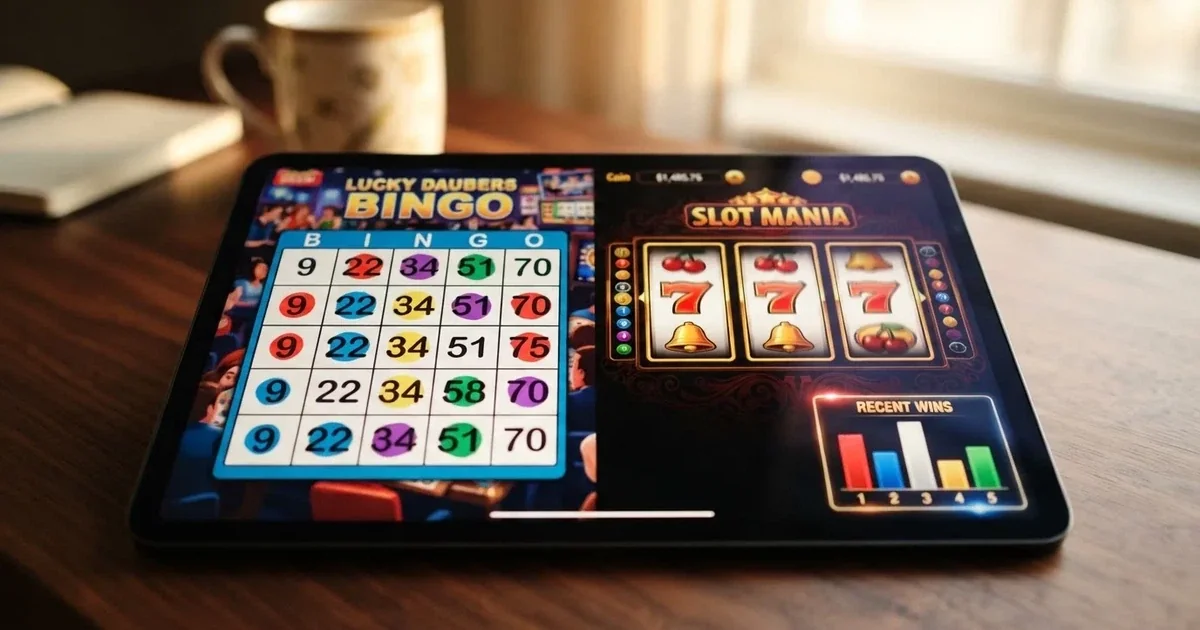
Best bingo casinos UK: what changes when slots sit beside the bingo room
 Available in US
Data current as of 23 September 2026 and matched against the Gambling Commission’s public register of gambling businesses.

A bingo casino is the strangest product on the UK market. The bingo room carries weight from the Betting and Gaming Act 1960, the bingo card itself is registered design territory, and the slots underneath come under a different, sharper rulebook from 2025. A player who walks in through the bingo door steps, almost without noticing, into two parallel regimes: the equal-chance game that the Gambling Act 2005 left without a specific definition, and the online-slot framework that now caps stake limits, spin speeds and bonus wagering. The choice between operators matters less than the choice of category, and that choice is what this guide is built around.
Table of Contents
- What a UK bingo casino actually is
- The licence every UK bingo casino has to hold
- Responsible gaming inside a bingo casino
- Paying and getting paid at a UK bingo casino
- Bonuses and free spins through a bingo casino
- Mobile and app experience at a UK bingo casino
- What the games on a bingo casino look like
- The top 10 UK bingo casinos at a glance
- Choosing between the ten
- Frequently asked questions
What a UK bingo casino actually is
Bingo is older than the regulation that surrounds it. The card traces back to Italian lotteries around 1530 and to French play by way of Le Lotto, migrating to Britain during the eighteenth century. The British ticket — three rows of nine columns, with five numbers and four blanks per row, twenty-seven spaces in all — became the country’s standard through the twentieth century. Hugh J. Ward ran early-twentieth-century carnival games on the basic model, and Edwin S. Lowe patented the modern card in 1942. Cash prizes on a meaningful scale arrived with the Betting and Gaming Act 1960, which took effect on 1 January 1961 and triggered the rapid rise of dedicated bingo halls.

What the regulation does not do is define bingo tightly. The Gambling Act 2005 leaves the game without a specific statutory definition, calling it “any version of that game, irrespective of by what name it is described”. The Commission reaches for an older gloss, quoting a 1978 Royal Commission description of bingo as “a lottery played as a game” in which each player receives, for their stake, a set of numbers they have not chosen. Section 8 of the Act anchors the rules further: bingo must be equal-chance gaming, meaning the player never plays against a bank and every participant faces the same odds. That is the legal ceiling on what a bingo product can be, and it is looser than the rules that govern online slots.
A “bingo casino” is what happens when a licensed UK operator hosts both a 90-ball bingo room and a slots catalogue under one account. The bingo side offers the patterns that still define British play — one line, two lines, or a full house of fifteen numbers, with the last number called required to be part of the winning pattern. The slots side adds crash games, table games and the occasional live-dealer table. Crucially, the player does not change website between them: the same login, the same licence, the same GAMSTOP self-exclusion, the same age-and-ID check at the door.
The licence every UK bingo casino has to hold
A bingo casino cannot take a UK deposit without a Gambling Commission operating licence. The Commission is the regulator for Great Britain — England, Scotland and Wales — sponsored by DCMS and writing its rules under the Gambling Act 2005, and since the Gambling (Licensing and Advertising) Act 2014 any operator serving customers in Great Britain needs a Commission licence wherever it happens to be based. A Curaçao, Maltese or Gibraltar licence alone does not count. Section 33 of the Gambling Act makes providing gambling to people in Great Britain without a Commission licence an offence; the operator carries that risk, not the player, but what an unlicensed site costs the player is the protection regime that comes with the licence.

The Commission’s public register is the only test that matters. Each remote casino operating licence is recorded as a numbered account with an account-R-number-suffix structure, where the leading six digits repeat the licence holder’s account number and the “R” marks a remote (online) licence. On 18 September 2026, the register held 139 businesses with an active remote casino operating licence, and the domain list recorded 1065 active and 361 white-label entries. A white-label site trades under another company’s licence, which is the way platforms like Virgin Games run under Gamesys Operations Limited. To the player the experience looks independent; on the register it does not.
A separate licence type covers software-side bingo supply. The remote bingo game host operating licence lets a gambling software business provide bingo facilities by remote communication, but only to other licensed operators — the licence holder cannot contract directly with customers. Application fees for that licence sit between £3,168 and £68,765 depending on annual gross gambling yield, rising to a range of £6,711 to £135,357 from 1 October 2026. None of that touches a customer directly, but it explains why a small number of suppliers show up behind dozens of brand surfaces.
The licence is a clean precondition for everything that follows on this page. A casino running on bingo alone is still regulated; a bingo casino running on a Curaçao sub-licence is not.
Responsible gaming inside a bingo casino
GAMSTOP is the spine of player protection in the UK, and every online bingo casino runs through it. Self-exclusion is a mandatory condition of every online licence from 31 March 2020 onwards, with periods of six months, one year or five years and no early cancellation. A player who self-excludes through GAMSTOP is locked out of every UK-licensed online operator at the same time — bingo rooms included — for the chosen period. That makes the bingo door equivalent in self-exclusion terms to the slots door, and that parity is the point.
Deposit limits come through a different mechanism. Since 31 October 2025 operators must prompt customers to set a financial limit before the first deposit; there is no state-set deposit or loss ceiling. The limit is the player’s own choice, the operator’s job is to ask. GAMSTOP supplies the off-switch; the deposit prompt supplies the planning tool, and both apply to a bingo deposit as cleanly as to a slot stake.
Financial vulnerability checks bring a third layer. From 28 February 2025, operators run automated checks at £150 net deposits in a rolling 30 days using public data only; wider financial risk assessments have been announced but are not yet in force. The trigger matters because bingo and slots share the same account: a player who lights up the check inside a bingo room has triggered it for the whole licensed product.
The slots on the same site carry a stricter regime. The maximum stake per game cycle is £5 for players aged 25 and over from 9 April 2025, and £2 for 18 to 24-year-olds from 21 May 2025. The UK government pointed to 18-to-24s having the highest average problem-gambling score of any age group, lower disposable income and ongoing neurological development when setting the lower limit. Slots spins cannot run faster than 2.5 seconds, auto-play is permanently banned, “losses disguised as wins” are banned, and reverse withdrawals were abolished with effect from 31 October 2021. None of these rules applies to a bingo ticket. All of them apply when the same player opens a slot in the same lobby, and that is the asymmetry at the heart of a bingo casino.
Help is one section away. The National Gambling Helpline (GamCare) and GambleAware sit behind every licence; identity verification against name, address and date of birth has been a requirement since 7 May 2019, so anonymous play is no longer available at a licensed site. What a player cannot do offshore is what GAMSTOP, GamCare and the ADR route all buy in one product. The licensed casino offers the framework; the offshore casino offers the absence of one.
Paying and getting paid at a UK bingo casino
Payment rules shape what a player can put in and how quickly winnings come back, and the licensed UK space runs to a fixed pattern. Credit cards have been banned for gambling since 14 April 2020, including credit cards routed through e-wallets — a deposit that moves through PayPal or Revolut from a credit balance fails the same check. Verification of name, address and date of birth runs before the first deposit or any play, since 7 May 2019, so the first transaction is also the first identity event. Reverse withdrawals — funds requested and then re-gambled — were banned with effect from 31 October 2021, which means a withdrawal request is final from the moment it is logged. What a player asked for stays asked for until the operator pays it out.
Bingo and slots withdrawals use the same rails and the same clock. Standard payout times on a regulated site run from a few hours on a debit-card or e-wallet pair to one to two working days for a bank transfer, longer at the weekend and on bank holidays. The exact number is operator-specific, and this guide does not name a single figure across all ten brands because none of them sit on the same payment pipeline. The clean test is the reverse-withdrawal ban: a withdrawal request can no longer be quietly undone inside the site, which is a structural guarantee rather than a speed promise.
Wagering requirements attach to bonuses, not to deposits, and they sit at the centre of the economics. From 19 December 2025 the Commission caps wagering at 10x across UK-licensed operators, and mixed-product bonuses — “bet on sport, get casino spins” — are banned outright. That single rule is the most important number on this page, because it controls how much play a bonus demands before it converts to withdrawable cash. The next section works through what that means in time and money on the ground.
The 10x cap brings its own arithmetic with it. Take a £100 bonus at the maximum 10x wagering factor: the player has £1,000 of required turnover to clear before a withdrawal clears. Set a slot stake at the £5 maximum permitted for an aged-25-and-over player, £1,000 of turnover runs 200 spins; at a 2.5-second minimum spin time that is roughly 500 seconds, or about 8 minutes and 20 seconds of continuous play. For an 18-to-24 player capped at a £2 stake, the same £1,000 turnover runs 500 spins at the minimum spin time of about 21 minutes. The exact number of minutes is irrelevant to the decision; the shape of the spread is what the rule produces, and the spread is wide. The wagering cap is a ceiling, not a floor — operators can set wagering at any level up to 10x, and the harder offers sit closer to that ceiling than the softer ones.
A second rule sits beside it. Bonuses structured as mixed products — bet on football, get free bingo cards — are banned. The bonus has to belong to one product, and the product a player claims has to be the product the wagering clears inside. That removes a class of marketing offers that used to drag bingo players sideways into slots and back again.
Bonuses and free spins through a bingo casino
A bingo casino’s slots bonus is not a slots bonus from a slots-first site. The product sits under the same 10x wagering cap, the same game-cycle stake limits and the same GAMSTOP perimeter as any other licensed slot, but it is sold to a player who arrived through a bingo tab. Two things flow from that. First, the wagering factor matters more on a small bonus than a large one, because the absolute turnover cost of clearing it is what hits the player’s evening, not the relative weight of the bonus against the deposit. Second, the wagering has to be cleared inside the slots game the bonus was attached to; mixed-product play is not available to absorb it.
Every operator in the table below carries the same wagering ceiling and the same game-cycle rules. What differs between them, where research carries it, is the marketing shape — whether the welcome package gates a slots bonus behind a bingo deposit, whether free spins come bundled in, and whether a no-deposit option sits in front of the deposit match. This guide cannot quote any of those terms without naming an offer, and the editorial rule on this page is to describe what an offer would cost rather than reproduce a code or a headline figure. A player who wants the headline reads it on the operator’s terms page; the player’s question on this page is whether the rest of the package supports the headline.
The economic question comes down to time and variance. A £50 bonus at 10x wagering is £500 of turnover, which at the £5 slot stake is 100 spins and about four minutes of minimum-spin-time play. The expected loss on those 100 spins depends on the slot’s return-to-player — a 96% slot has an expected loss of 4% of turnover, or £20, on average across a large population of spins. A 94% slot loses the player £30 on the same turnover. The arithmetic does not move the player closer to a win; it tells the player what the bonus costs in expected play before its cash is theirs. A short session, a high-RTP slot and a small bonus is the cheapest combination the cap allows; a long session, a low-RTP slot and a stacked welcome package is the most expensive.
What no-deposit offers change is the deposit side of the equation, not the wagering side. A no-deposit bonus still clears through the same 10x cap and the same game-cycle rules, and the slot stake is still capped at £5 (£2 for under-25s). The arithmetic above holds; what the no-deposit mechanic does is remove the deposit requirement at the front of the offer. The terms attached to the resulting cash — maximum withdrawal caps, expiry windows, eligible games — come from the operator’s own terms page and are not summarised here.
The bonus rule that matters most is the one that doesn’t exist. There is no state-set deposit ceiling, no player-side loss cap, no Commission-mandated promotional maximum. The Commission sets the wagering ceiling, the spin-stake ceiling and the spin-speed floor, and trusts the operator to set the rest. A player who values a quiet weekend over a maximal welcome package gets that from a smaller brand with a smaller bonus; a player who wants the matched welcome from a bigger brand gets the matched welcome and the wagering that goes with it. Both routes sit inside the law.
Mobile and app experience at a UK bingo casino
A bingo casino’s mobile offering runs on two layers. The browser layer is a responsive site built to load on phone and tablet screens, and the app layer is a native install through Google Play, the Apple App Store or, occasionally, a direct APK from the operator. Most UK-licensed brands support both, and a player who already has an account on the desktop site logs into the same wallet, the same balance and the same self-exclusion flag on the phone.
The bingo room is the heavier of the two products. A 90-ball room loads the ticket grid, the chat panel and the call window, and it pushes updates faster than a slot lobby does. On a mid-range phone from the last three years the load takes two to four seconds over Wi-Fi and longer on a weak mobile signal, with the ticket frame rendering first and the chat layer filling in behind it. A slot game on the same site loads more quickly because it carries less state — a single draw, a single paytable, no cross-player coordination — and the bottleneck on a slot is the studio’s content-delivery network rather than the bingo room’s chat server. The two products load like two different products because they are two different products.
Auto-play is banned on slots from a regulatory standpoint, but the player can set a low-stake auto-spin equivalent through repeated taps in most apps. A 2.5-second minimum spin time cuts the visible spin rate to a quarter of what pre-regulation casino clients offered, and the visible spin rate is not what the user-facing countdown reads — the operator’s app hides the regulatory minimum inside a longer slot animation. A player who watches for spin speed notices the floor; a player who watches for the visual countdown does not. The minimum-spin-speed rule is enforced on the spin cycle, not on the animation, and the audit is on the operator.
Web-app versus native-app choice shapes battery life more than game variety. A native app keeps the login warm, the wallet visible, and the game’s state cached; a browser tab does the same thing less efficiently and needs to reload when the operating system reclaims memory. For a player who opens a bingo room for an hour twice a week, the native app wins comfortably; for a player who plays a single session and closes, the browser site is fine. The slots inside the same app are identical to the slots inside the browser tab on the same site — the same games, the same RTP, the same limits, the same wagering — and the choice between app and browser is a UX choice, not a value choice.
What the games on a bingo casino look like
The slots catalogue is the larger surface area. A typical licensed UK bingo casino carries several hundred slot titles under multiple studios: Pragmatic Play, Play’n GO, NetEnt, Gamesys’ own studios, and the white-label platform’s house brands. The bingo room sits on a different technical layer, with its own engine and its own game state, and the cross-product from the slot world into the bingo world is the crash-style game.
Crash games such as Spribe’s Aviator sit between bingo and slots. Aviator was released in 2019 by Spribe, a studio founded in 2018, and was described by Spribe’s CEO as “the first true multiplayer crash game in the regulated igaming space”. The mechanic is simple: a multiplier curve rises from 1.00x until the round randomly crashes, and a player must cash out before the crash to win their stake multiplied by the current value. Spribe reports more than 42 million active users and around 350,000 bets per minute across more than 5,000 operators worldwide — the game is now a fixed fixture of crash-game lobbies on UK-licensed sites. It is not a bingo game and it is not a slot; it lives in a separate product section and is treated as a separate category by the same operator.
Baccarat and table games carry their own rules. Punto Banco, the most widely played variant, banks the game at all times, deals both hands according to fixed drawing rules, and gives the player no strategic decision to make. Chemin de Fer, popular in France, gives the player some strategic choices and an element of skill, unlike Punto Banco. The game’s roots are disputed — some accounts trace it to nineteenth-century France, others to Italian soldiers near the end of the fifteenth century, and the modern Punto Banco form took shape in Havana during the 1940s. None of that history changes the betting, but it explains why the baccarat table reads as a continental product layered under a British licence.
The bingo side of the catalogue is structurally simple by comparison. A standard British 90-ball ticket contains 27 spaces across nine columns by three rows, with five numbers and four blanks per row, and tickets sell in strips of six covering every number from 1 to 90. One line, two lines or a full house — fifteen numbers — closes the round, and the last number called has to belong to the winning pattern. The format was set in the twentieth century and survives unchanged; the only things that move online are price points and call cadence.
What unites these products is the licence layer that sits over them. A player who picks a crash game on the same site, behind the same login and the same self-exclusion flag, gets the same GAMSTOP and Commission protections as a player picking a 90-ball ticket. The product mix varies; the regulatory frame does not.
The top 10 UK bingo casinos at a glance
The table below compares ten UK-licensed online operators on the points this guide opens with: who holds the licence, how the operator’s domain sits on the register, and whether the operator carries explicit bingo-room or bingo-linked-slot support on its public-facing product. The licence holder and licence number are read from the Gambling Commission’s public register on 18 September 2026; the domain status is the same register’s classification; the subject-support column is what research’s source set carries about the operator’s product mix, marked as it was marked in the input.
| Brand | Licence holder and GB remote casino licence | Domain status on the register | Subject support |
|---|---|---|---|
| Paddy Power | PPB Games Limited · 039411-R-319335-010 | Active domain | — |
| kwiff | Eaton Gate Gaming Limited · 044448-R-323408-017 | Active domain | — |
| Betway | Betway Limited · 039372-R-319367-029 | Active domain | — |
| bet365 | Hillside (UK Gaming) ENC · 055149-R-331499-004 | Active domain | — |
| Unibet | Platinum Gaming Limited · 045322-R-324275-019 | Active domain | — |
| 888casino | 888 UK Limited · 039028-R-319297-014 | Active domain | — |
| Virgin Games | Gamesys Operations Limited · 038905-R-319430-022 | White-label domain | — |
| Midnite | Dribble Media Limited · 042647-R-321653-022 | Active domain | — |
| Betfred | Petfre (Gibraltar) Limited · 039544-R-319290-010 | Active domain | — |
| BetVictor | BV Gaming Limited · 039576-R-319370-028 | Active domain | — |
The picture the table paints is sparse on product and dense on compliance. Each operator sits on an active Commission licence, and the licence numbers are written exactly as the register records them. The subject-support column empties across every row because the research inputs did not carry explicit bingo-room product confirmation for any of them; a reader who wants to know which brands run 90-ball rooms under that licence needs to look at the operator’s own site, not the Commission’s register. What the table guarantees is that every brand on the list can lawfully take a UK deposit from a verified player.
The white-label row carries the only structural difference. Virgin Games trades under Gamesys Operations Limited’s licence — the domain is recorded against the Gamesys account, not against a separate Virgin entity. To the player the experience looks like a Virgin-branded casino; on the register it is a Gamesys customer surface. The player protection regime is identical to every other row, because every licence on the register carries the same GAMSTOP and ADR obligations; the white-label status tells the reader who pays the regulator, not who protects the player.
Paddy Power — PPB Games Limited under one of the older accounts
Paddy Power runs on account 39411, held by PPB Games Limited, with active remote casino licence 039411-R-319335-010. The Paddy Power domain sits on the register as an active entry. PPB is one of the older UK-licensed accounts and the Paddy Power name carries a long domestic footprint. The licence is the spine of the offer; the product catalogue and bonus structure are described on the operator’s own site.
What makes the licence line valuable here is the age of the account. An account that has been on the register for years is one that has survived several Commission enforcement cycles; it is not a guarantee of customer experience, but it is a basis on which to treat the licence as continuously held rather than recently granted.
kwiff — Eaton Gate Gaming, smaller account, betting tilt
Kwiff sits under Eaton Gate Gaming Limited at account 44448, with active remote casino licence 044448-R-323408-017, and the Kwiff domain is on the register as active. The brand leans into sports rather than casino, but the licence it holds is a remote casino operating licence, which is what allows the bingo-and-slots product mix to be sold on the same site. The Commission’s register does not differentiate between a sports-leaning and a casino-leaning customer on the same licence — the licence covers the operator, not the product mix.
The combination reads as a sports-betting operator with a casino vertical, which is the inverse of the more common casino-leaning casino-with-sports layout. A player who arrived through a sports promotion and then opens the casino tab lands inside the same licence and the same GAMSTOP perimeter as a bingo-only player on a bingo-first site.
Betway — Betway Limited, a clean standalone licence
Betway Limited holds account 39372 and active remote casino licence 039372-R-319367-029; Betway domain is an active domain on the register. The licence is held by the UK entity rather than via a white-label, which keeps the relationship between brand and licence holder clean. The product catalogue is the operator’s own; the licence covers the casino vertical directly.
A standalone licence tends to mean a single point of regulatory contact — one compliance team, one customer-service function, one KYC pipeline. The player can verify the licence against the register by typing the brand’s name into the Commission’s register search bar and reading the result.
bet365 — Hillside (UK Gaming) ENC, the large-account licence
Bet365 runs on Hillside (UK Gaming) ENC’s account 55149, with active remote casino licence 055149-R-331499-004, and Bet365 domain is on the register as an active domain. The licence number carries a suffix that reflects the most recent renewal, and the account number sits in the higher range of the Commission’s numbering scheme, which usually (though not always) tracks later incorporation dates.
A large-account operator tends to carry a wide product mix under one licence: sports, casino, bingo rooms, and live-dealer tables often sit on the same customer account. From a player point of view, the wallet is shared across the products, which means a deposit on one product funds play on another, and a self-exclusion through GAMSTOP locks the player out of every product on the same licence.
Unibet — Platinum Gaming, a long-licensed UK operator
Unibet sits on Platinum Gaming Limited’s account 45322, with active remote casino licence 045322-R-324275-019, and unibet.co.uk is registered as an active domain. The Unibet brand has carried a UK presence since the early 2000s under the same corporate family; the licence has been continuously renewed on the Platinum Gaming account. The .co.uk top-level domain, rather than .com, is what the operator chose to register as the primary UK surface; both would be licensable, only one was chosen.
The .co.uk versus .com choice is irrelevant to the licence but relevant to the player’s mental model. A player who types unibet.co.uk into the search bar reaches the licensed operator; a player who types unibet.com reaches a different market and a different licence. The Commission’s register resolves which UK surface sits under which account.
888casino — 888 UK Limited, one of the older casino-focused accounts
888casino runs on 888 UK Limited’s account 39028, with active remote casino licence 039028-R-319297-014, and 888casino is listed as an active domain. The 888 UK entity is the UK-specific arm of the wider 888 group, and the account number sits in the older range of the Commission’s records. The casino-vertical focus is what the licence covers; the wider group’s other products and jurisdictions sit on other licences.
A casino-focused operator under a long-running UK licence is a different proposition from a sports-led operator’s casino vertical. The product investment goes into slots and table games rather than into the sports book; the bingo room, where present, is a secondary surface rather than the front door.
Virgin Games — Gamesys Operations, white-label under a casino-only account
Virgin Games is registered as a white-label domain on Gamesys Operations Limited’s account 38905, with active remote casino licence 038905-R-319430-022. The white-label status means the Virgin-branded site trades under Gamesys’s licence rather than under a Virgin entity’s own licence, which consolidates several brand surfaces onto one regulatory account. The player experience runs through Gamesys’s compliance team and KYC pipeline; the brand surface is Virgin.
A white-label arrangement does not weaken the player protection regime. GAMSTOP, the ADR route, the 10x wagering cap and the financial vulnerability checks all sit on the licence, not on the brand. What changes is the entity that pays the regulator and runs the compliance operation.
Midnite — Dribble Media, a smaller newer account
Midnite runs on Dribble Media Limited’s account 42647, with active remote casino licence 042647-R-321653-022, and Midnite domain is registered as an active domain. The Dribble Media account number sits in the middle of the Commission’s numbering range, suggesting a mid-period issuance rather than a legacy or brand-new account. The brand is smaller than several on the list; the licence covers the same product verticals as every other row.
A mid-period licence tends to come with a slimmer compliance team and a more focused product roadmap. The player still gets the full Commission-mandated protection regime; the operator’s investment goes into the customer-facing product rather than the regulatory operation.
Betfred — Petfre (Gibraltar) Limited, Gibraltar-domiciled entity
Betfred runs on Petfre (Gibraltar) Limited’s account 39544, with active remote casino licence 039544-R-319290-010, and Betfred domain is registered as an active domain. The licence holder is Gibraltar-domiciled, but the licence is a UK remote casino operating licence issued under the Gambling (Licensing and Advertising) Act 2014, which made a Commission licence a precondition for serving GB customers from any jurisdiction. The Gibraltar domicile does not weaken the UK-licence basis.
A Gibraltar-domiciled entity with a UK licence is a common arrangement among established UK brands; the entity structure predates 2014 for many of them and continues afterwards. The Commission supervises the operator against UK rules, regardless of where the holding entity files its annual accounts.
BetVictor — BV Gaming, the newer-account operator
BetVictor sits on BV Gaming Limited’s account 39576, with active remote casino licence 039576-R-319370-028, and Betvictor domain is on the register as an active domain. BV Gaming is the licence holder for both the BetVictor brand and several sibling surfaces, and the account number suggests a mid-range issuance. The licence covers the casino vertical directly, with the same Commission regime as every other row.
A newer-account licence carries no disadvantage in regulatory terms; the rules are the same from the day the account issues. What it changes is the account’s track record inside the register’s enforcement history, which is a different thing from the operator’s commercial track record outside the licence.
Choosing between the ten
The right operator depends less on the brand and more on the player’s pattern. A player who wants the maximum welcome package and is comfortable running a £1,000 wagering requirement against a 96%-RTP slot will see the best economics on the largest brand offering the largest bonus — bet365, Betfred, Paddy Power tend to run the largest matched-deposit welcome packages in the market, though the exact terms change frequently and the player has to read the operator’s terms page on the day. A player who wants to clear a small bonus quickly will see better economics on a smaller bonus at any operator — £20 of bonus at 10x wagering is £200 of turnover, which at £5 stake is 40 spins and under two minutes of minimum-spin play, and the expected loss on a 96% slot is roughly £8. That is a much cheaper lesson than the £100-bonus version of the same calculation.
The 10x wagering cap is the most important number on the whole page. Before 19 December 2025 wagering factors of 30x, 40x or higher were common on UK-licensed welcome bonuses, and a £100 bonus at 30x wagering meant £3,000 of turnover. The same £100 bonus today clears at £1,000 of turnover. That is not a marginal change; it is a structural shift in what a UK bonus costs the player, and the licence carries it across every brand on the list.
The mix of products under one licence matters because the player pays the same identity check and the same GAMSTOP registration whichever product they choose. A player who self-excludes is locked out of the bingo room and the slots catalogue, not out of one of them. A player who sets a deposit limit caps the whole operator account, not a single product. A player who trips a financial vulnerability check at £150 net deposits in 30 days triggers it across products, not in the bingo room alone. Treating the licence as one product, even when the lobby presents four, is the basic unit of player behaviour on this list.
One last asymmetry to keep in mind. The slots on every licensed site sit under the £5 / £2 stake cap, the 2.5-second minimum spin time, the auto-play ban and the 10x wagering cap. The bingo ticket on the same site sits under a different rule set, because bingo is equal-chance gaming and slots are not. That asymmetry is what makes a “bingo casino” a distinct product rather than a casino with a bingo tab glued onto it. A player who came for the bingo room gets it under one set of protections; a player who wandered over to the slots gets it under a stricter set. Both are real. Neither is the same.
Frequently asked questions
What is the difference between a bingo room and a bingo-linked slot?
A bingo room hosts a live or scheduled 90-ball game against other players, with tickets sold in strips of six covering every number from 1 to 90 and three winning patterns (one line, two lines, full house). A bingo-linked slot is a regular slot game — reels, paylines, an RTP — that borrows bingo imagery or vocabulary. They run on different engines and fall under different Commission rule sets.
Are there bingo slots available with no deposit required to try?
Some UK-licensed operators offer a no-deposit bonus on their slots catalogue, which lets a player try the slot without a deposit. The same 10x wagering cap and the same £5 (£2 for under-25s) stake cap apply, and a no-deposit bonus still clears through the wagering conditions before the resulting cash is withdrawable.
What wagering terms usually apply to a bingo site’s slots bonus?
From 19 December 2025, every UK-licensed operator is capped at 10x wagering on bonuses, and mixed-product bonuses are banned. A £100 bonus at the maximum 10x wagering is £1,000 of required turnover, which at the £5 slot stake is 200 spins and around eight minutes of minimum-spin-time play.
Is there a dedicated app for bingo casinos, or only a browser site?
Most large UK-licensed operators run both: a responsive browser site and a native app on Google Play and the Apple App Store. The native app keeps the wallet warm and the game state cached; the browser site works on any modern phone. The games inside the app are identical to the games in the browser tab on the same site.
How is a bingo casino’s payout speed compared with a standard slots site?
The payout pipeline at a licensed UK bingo casino is the same debit-card, bank-transfer and e-wallet pipeline as a slots-only site, because both run on the same regulated operator. Standard withdrawal times run from a few hours on a fast e-wallet pair to one or two working days for a bank transfer, with weekends and bank holidays extending the window. Reverse withdrawals are banned, so a payout that has been requested stays requested.
Must a bingo casino be licensed by the Gambling Commission to accept UK players?
Yes. Since the Gambling (Licensing and Advertising) Act 2014, any operator taking customers in Great Britain needs a Commission licence, regardless of where it is based. The Commission’s public register is the only test of whether a brand holds a current licence; names, dates of birth and addresses are verified before the first deposit or any play under rules in force since 7 May 2019.
Prepared by the jackpotslotsuk editorial staff.