
What’s on the wheel: live casino game shows on UK-licensed sites in 2026
 Available in US
Data current as of 23 September 2026, verified against the Gambling Commission’s public register of licence holders and its domain list.
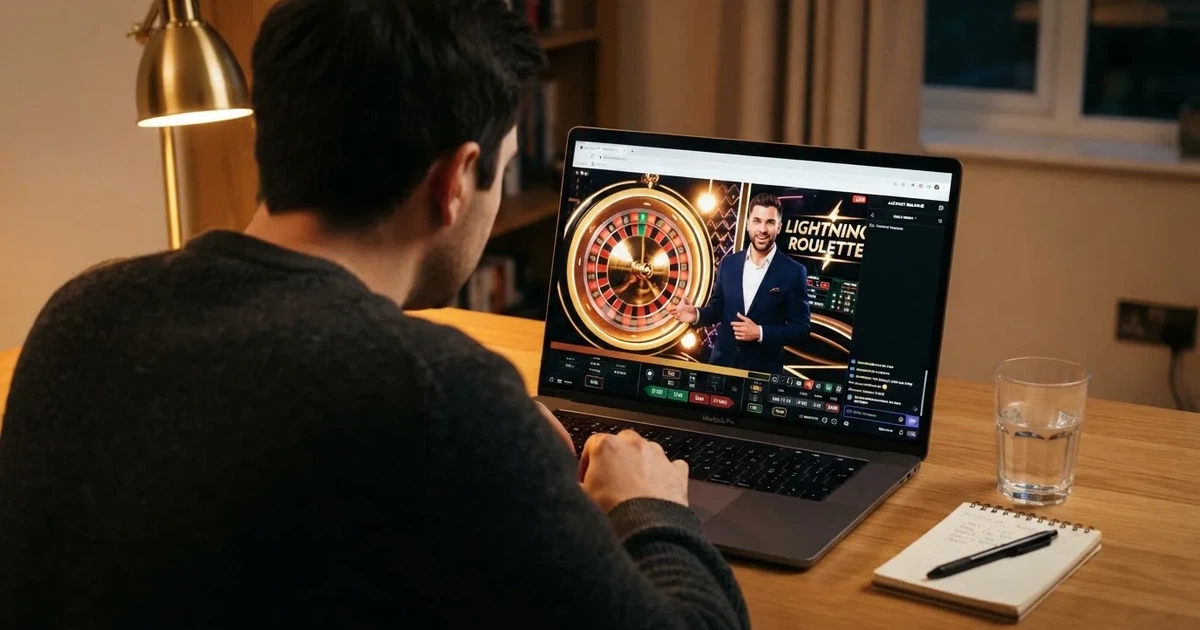
Table of Contents
- Paytables, wheels and crash curves: how the formats actually run
- The UK live-game-show landscape: ten licensed sites compared
- The 10x wagering cap in practice
- Fundamentals: how live game shows sit inside the UK online casino
- Jurisdictional frame: the Gambling Commission licence and what it obliges
- What a UK licence does for safer play
- Common questions about live casino game shows on UK sites
Paytables, wheels and crash curves: how the formats actually run
A live casino game show is a studio product in which a real host stands in front of a real apparatus. Most often that is a vertically mounted money wheel; sometimes a wheel with a board game attached to it; sometimes a multiplier curve climbing a screen. Players bet, in real time, against a published paytable on what the next spin, draw or flight produces. The category, as it sits at UK-licensed sites, is younger than most of the games around it.
Evolution’s own timeline places the start of the live game show category with Dream Catcher in 2017. Before that the studio had been in live dealer table games for over a decade. After that it accelerated. MONOPOLY Live and Deal or No Deal Live followed in 2019. Crazy Time arrived in 2020. Funky Time, the 1970s disco-themed wheel, launched in 2023. In 2020 Evolution also acquired NetEnt and Red Tiger, two slot-first studios, folding their content into the same distribution rails the live product already used. The category line, in other words, is one studio-led sequence, not a market-wide trend.
Dream Catcher is the cleanest illustration of the format. The wheel has 54 segments. Fifty-two are numbered — 1, 2, 5, 10, 20 or 40 — and each number’s payout reflects its frequency on the wheel: more common numbers pay less, rarer numbers pay more. The remaining two segments are 2x and 7x multipliers. If the wheel lands on a multiplier, the spin is “stacked”: the wheel is spun again and any winning bet on the next number is multiplied by 2 or 7. That is the entire mechanic. There is no skill, no decision tree after the bet, no second draw. The bettor chooses a segment or a set of segments; the wheel decides.
Crazy Time is the same idea turned up several notches. The wheel sits inside a larger set of bonus rounds — Cash Hunt, Pachinko, Coin Flip, and Crazy Time itself — each with its own board and its own moves the host makes on behalf of the game. The bet selection happens before the spin; everything after is studio production. MONOPOLY Live is the wheel attached to a 3D MONOPOLY board the game walks around after a qualifying spin, a branded collaboration rather than an Evolution-original mechanic. Funky Time replaces the money-wheel aesthetic with a 1970s disco set and reuses the same general structure. Deal or No Deal Live, the third of the 2019 launches, is the same wheel-with-bonus-rounds shape under a different television licence. The lineage is short, the variations are wide, and almost all of it sits on the rails one studio laid down.
There is a second shape on the same shelves: the crash game. Aviator, developed by Spribe — a studio founded in 2018 — is the most cited example. It was released by Spribe in 2019 and the studio’s CEO has described it as ‘the first true multiplayer crash game in the regulated igaming space’. The mechanic is genuinely different. A multiplier curve rises from 1.00x and the round randomly crashes at some point along it. Players place a bet and must cash out before the crash to win their stake multiplied by the current value; if the round crashes first, the stake is lost. There is no wheel, no host operating a fixed apparatus in the same way. The visible product is a graph on a screen and a chat window running next to it, and the social element is part of the appeal: players see each other’s bets and cash-out points in real time. On Spribe’s own figures, Aviator has reported more than 42 million active users and processes around 350,000 bets per minute across more than 5,000 operators worldwide. Whether those global figures reach a UK-licensed site in the same proportion is a separate question; the Commission’s product standards apply to crash games the same way they apply to wheel-based game shows.
The older live format, the one live game shows grew out of, is baccarat. Punto Banco, the variant now played in almost every live casino, developed in Havana in the 1940s; in Punto Banco the casino banks the game at all times and both hands are dealt out according to fixed drawing rules, so the player makes no strategic decisions. Chemin de Fer, the variant that took baccarat through 19th-century France, gives players strategic choices and includes an element of skill; the two variants are often confused. Live game shows as a category sit closer to baccarat than to roulette in one respect: there is no real strategy for the player to apply, and the house edge is set by the apparatus and the paytable, not by what the player does at the table. The apparatus is now a wheel, a board, or a curve, not a shoe of cards.
What the paytables look like in detail is a matter of studio choice. The Commission does not standardise game-show RTP figures the way it has standardised slot spin speeds; what it does require, from 17 January 2025, is that online gaming products — including live game shows — display a player’s net spend and net time in play, must not use winning-style auditory or visual effects to celebrate a return less than or equal to stake, and must observe the same autoplay ban and minimum 2.5-second cycle as online slots. The product sits inside the same regulatory box as online slots now, even though the wheel is in front of a host rather than running through a random number generator in the player’s browser.
That is the live game show shelf at a UK-licensed site: a small number of titles, almost all of them from one studio, with one or two crash-style outliers, played in real time against a published paytable. The next question, the one this page answers in the section below, is which UK-licensed sites carry them.
The UK live-game-show landscape: ten licensed sites compared
The ten operators below are all listed on the Gambling Commission’s public register against a remote casino operating licence as of 18 September 2026. Every one of them is therefore entitled to offer online casino product, including live game shows, to customers in Great Britain. What each of them actually shows under its live or game-shows tab is a different question, and not one the register answers.
| Brand | Licence holder and remote casino operating licence | Domain status on the register | Subject support |
|---|---|---|---|
| Virgin Games | Gamesys Operations Limited (account 38905), 038905-R-319430-022 | White label | — |
| Betfred | Petfre (Gibraltar) Limited (account 39544), 039544-R-319290-010 | Active | — |
| Betfair | PPB Games Limited (account 39411), 039411-R-319335-010 | Active | — |
| Sky Vegas | Bonne Terre Gaming Limited (account 65519), 065519-R-339675-002 | Active | — |
| Gala Bingo | LC International Limited (account 54743), 054743-R-330863-014 | Active | — |
| 32Red | Platinum Gaming Limited (account 45322), 045322-R-324275-019 | Active | — |
| Casumo | Recro Limited (account 61549), 061549-R-336718-002 | Active | — |
| Midnite | Dribble Media Limited (account 42647), 042647-R-321653-022 | Active | — |
| PokerStars | Stars Interactive Limited (account 39108), 039108-R-319334-026 | Active | — |
| Jackpotjoy | Gamesys Operations Limited (account 38905), 038905-R-319430-022 | Active | — |
The subject support column is empty on purpose. The Commission’s register lists a licence holder and its domains; it does not publish what each domain carries on its live casino tab. The wider figures from the same register — 1,065 active and 361 white-label domain entries against 139 active remote casino operating licences — give the reader some context on how thin the typical licence is in product terms (almost ten domains per licensee), but they do not name which licensee runs which game-show studio’s feed. Below the table, each operator is described on what the register does say.
Virgin Games — a white-label of Gamesys’s licence
Virgin Games is listed on the register as a white-label domain of account 38905, Gamesys Operations Limited. White label is a category the register uses: the domain trades under another company’s licence rather than holding one of its own. The licence number — 038905-R-319430-022 — is the same number that sits under another operator on this list, and the player funds and the complaints route both end up at the same licensee. A player who registers at Virgin Games is registering with Gamesys as the regulated entity. The “Virgin” is a brand licence; the gambling licence is Gamesys’s.
That distinction matters because every safer-gambling protection discussed later in this page — GAMSTOP, the financial vulnerability checks, the mandatory deposit-limit prompt, the ADR route — attaches to the licence holder, not to the brand on the masthead. What the brand carries on its live casino tab is for the player to check on the brand’s own product pages; the regulator’s record stops at the licence.
Betfred — Gibraltar parent, Commission licence
Betfred is listed as an active domain of account 39544, held by Petfre (Gibraltar) Limited, with the licence 039544-R-319290-010. Petfre is the Gibraltar-registered parent of the Betfred business — a structure that recurs across this list, where the parent is incorporated in another jurisdiction while the operating licence remains the Commission’s. Since the Gambling (Licensing and Advertising) Act 2014 a Gibraltar or Maltese corporate registration is not a substitute for a Commission licence; the Betfred offering in Great Britain is licensed by the Commission or it is unlicensed, and the register entry confirms the first.
The Betfred operation is one of the larger UK bookmaker chains. On the live casino product side, what a player finds under that tab is a question for the brand; the register confirms only that Betfred is entitled to offer it. For a player who already has a Betfred sportsbook account, the relevant question is which live game shows the casino tab carries — and that is on the operator’s product pages, not on the Commission’s register.
Betfair — casino arm of the exchange brand
Betfair, listed as an active domain of account 39411, runs under PPB Games Limited, with the remote licence 039411-R-319335-010. PPB Games is the regulated corporate behind the Betfair exchange brand in Great Britain. The Commission’s register treats Betfair as a casino operator in its own right for licensing purposes; the brand association with sports betting and exchange wagering does not change what the licence covers. Live casino product is in scope of a remote casino operating licence; whether Betfair carries the same game-show titles as the rest of the list is not something this page can confirm from the register alone. The product tabs on a multi-product operator often share back-end systems, but they are licensed through the same Commission account.
Sky Vegas — Bonne Terre’s regulated casino shell
Sky Vegas runs on account 65519, Bonne Terre Gaming Limited, licence 065519-R-339675-002. The Bonne Terre entity is the regulated corporate; “Sky” enters as a brand licence from the broadcaster. Sky Vegas is one of the cleaner illustrations of the white-label-style structure on this list: a regulated operator (Bonne Terre) carries a commercial brand (Sky) into the UK remote market under the Commission’s licence. The brand association with Sky’s broadcasting carries through to the marketing, but the regulated entity is Bonne Terre and the safer-gambling protections are Bonne Terre’s responsibility.
Gala Bingo — under the LC International multi-brand licence
Gala Bingo sits under account 54743, LC International Limited, with the licence 054743-R-330863-014. LC International is also the corporate owner of Ladbrokes and Coral, two of the larger UK high-street bookmakers. The fact that three retail-facing brands — Gala, Ladbrokes, Coral — share one licensee is worth noting because the Commission’s enforcement actions, complaints and ADR processes for all three end up at the same door. A player who plays Gala’s bingo, Ladbrokes’ sportsbook and Coral’s casino is, for regulatory purposes, playing with one entity. The live game show shelf on Gala Bingo may not be identical to the live game show shelf on Ladbrokes or Coral; the register does not distinguish between products within one licence.
32Red — Platinum Gaming’s heritage casino brand
32Red is listed as an active domain of account 45322, Platinum Gaming Limited, licence 045322-R-324275-019. Platinum Gaming is a longer-established operator within the UK-licensed casino market, and 32Red’s casino heritage predates the current wave of game-show products. The “32Red” brand is the visible shell; the regulated corporate is Platinum Gaming, and the licence attached to the domain is the one any complaints route ends up at. A player who values a casino-only operator over a multi-product one has, on the Commission’s record, a licensed option.
Casumo — Recro’s gamified-casino licence
Casumo is held by Recro Limited (account 61549) under licence 061549-R-336718-002. Recro is a smaller corporate entity than several of the others on this list, and Casumo’s brand identity sits in the gamified-casino category rather than the retail-betting one. As with the other entries, the register tells a reader that Casumo is entitled to offer online casino product, and nothing about which game-show studios it carries on its live tab. The licence does not distinguish between tabs.
Midnite — Dribble Media’s casino-licensed sportsbook
Midnite sits under Dribble Media Limited, account 42647, licence 042647-R-321653-022. Dribble Media is a smaller operator than most on this list by corporate vintage, and Midnite’s brand identity sits closer to the sportsbook product than to the casino product. On the Commission’s record, a player who lands on Midnite’s casino tab is dealing with a casino operator that is also licensed for other products — and the live game show shelf on the operator’s site is the only place to check what is actually offered there.
PokerStars — Stars Interactive’s poker-rooted casino
PokerStars runs on Stars Interactive Limited (account 39108), licence 039108-R-319334-026. Stars Interactive is the regulated corporate for both poker and casino in the UK; the .uk domain reflects the Commission’s licensing of a separate UK-facing property. The casino tab at PokerStars is a casino tab on a poker-rooted platform, and that lineage shows up in the operator’s overall product mix. The Commission’s record does not distinguish between tabs; it covers the operator.
Jackpotjoy — same Gamesys licence as Virgin Games
Jackpotjoy is the second operator in this comparison running under the same Gamesys Operations Limited licence as Virgin Games. The register lists Jackpotjoy as an active domain of account 38905, Gamesys Operations Limited, licence 038905-R-319430-022. Where Virgin Games is marked as white label, Jackpotjoy is marked as active; both use the same licence number, and both fall under the same regulated entity for safer-gambling purposes. A player registered at Jackpotjoy and a player registered at Virgin Games are, for the Commission’s purposes, playing with the same licensee. The shared licence is the cleanest illustration on this list of why the brand is the wrapper and the licence is the entity that delivers the protections.
The 10x wagering cap in practice
From 19 December 2025, no UK-licensed casino bonus can carry a wagering requirement higher than 10x. Mixed-product bonuses — the “bet on the football, get casino spins” packages — were banned on the same date. The 10x cap is a hard ceiling; a 35x or 50x bonus that was common before that date is no longer possible at a licensed site.
What the cap costs a player is best read as a band. Assuming only the bonus amount is wagered, a £10 bonus carries £100 of qualifying turnover, a £50 bonus carries £500, a £100 bonus carries £1,000, a £250 bonus carries £2,500, and a £500 bonus carries £5,000. The turnover number is the volume of play required before the bonus-derived portion of a withdrawal can be cashed out; the cost of that volume, and whether the volume ends in profit at all, depends on what is being bet through and at what return, and is a separate calculation. The arithmetic here is the same across the market; the condition that changes the result is the bonus size.
The “bonus” in marketing language is the figure the player sees first. The wagering requirement is the figure they only meet when they try to withdraw. The Commission’s 10x cap narrows the gap between those two numbers, but it does not close it. A £250 bonus still asks for £2,500 of bets before the bonus portion is withdrawable, and the house still has an edge on every one of those bets. The cap is a ceiling, not a refund. The player choosing a bonus on the licensed market in 2026 has narrowed the wagering range they need to think about; they have not narrowed the underlying edge the operator keeps.
Fundamentals: how live game shows sit inside the UK online casino
The UK remote casino market is not one shelf. On 18 September 2026 the Commission’s public register listed 139 businesses holding an active remote casino operating licence. Those 139 licensees held 1,065 active domain entries and a further 361 white-label domain entries between them. The single product category of live game shows sits within a market of more than ten times as many domains — and on a Commission licence that covers everything else the operator runs.
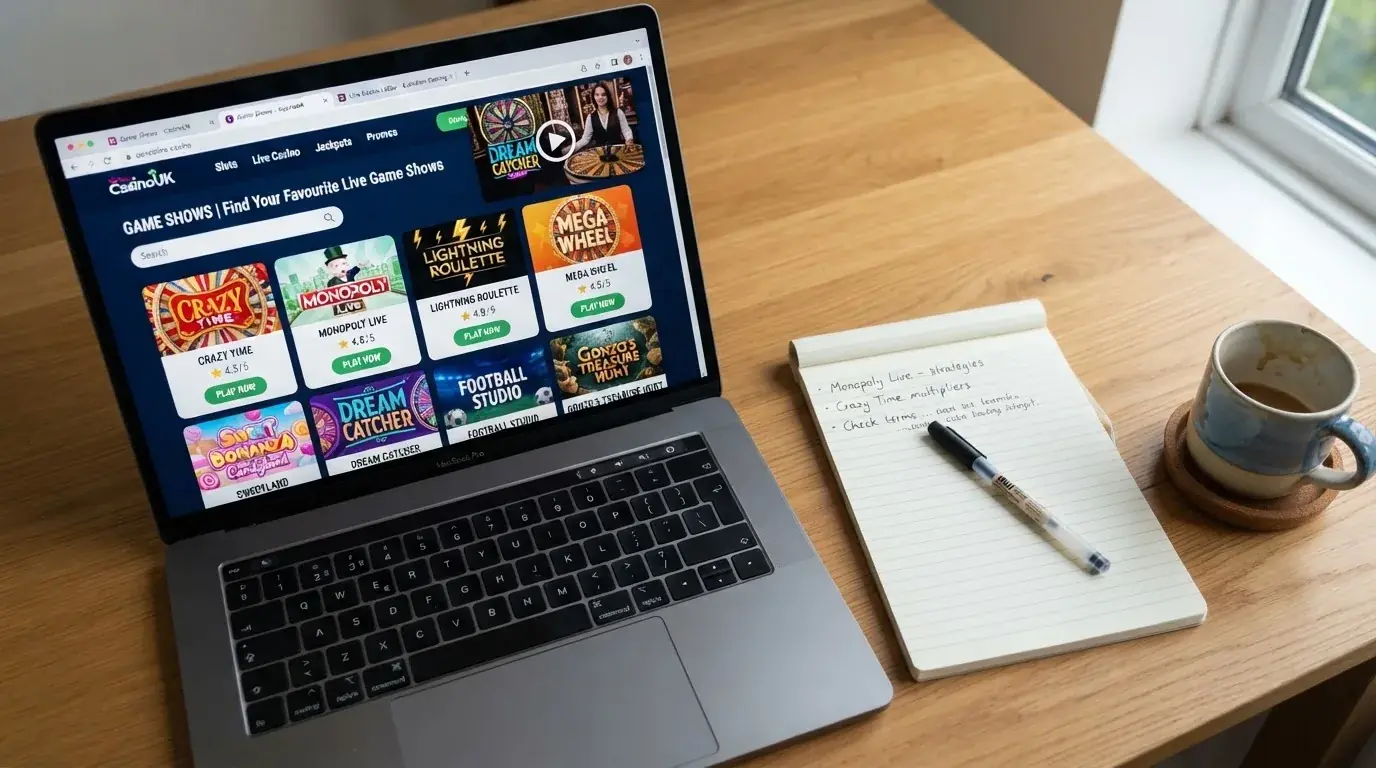
A reader thinking of live casino game shows as a separate vertical is, in one sense, right: the format is recent, the studios are concentrated, and the product is presented differently from slots and table games. In another sense the shelf is small. Almost every live game show a UK player can name is produced by one of two studios — Evolution (Dream Catcher, MONOPOLY Live, Crazy Time, Funky Time, Deal or No Deal Live) and Spribe (Aviator). The studio pipeline feeds into many licensed operators; what each operator does with it varies. A player on operator A’s Crazy Time tab and a player on operator B’s Crazy Time tab is, in practice, playing the same game with the same paytable; what differs is the bonus terms, the safer-gambling tools layered around it, and the licence the player is registering under.
Regulatory milestones for live game shows
| Date | Requirement | Impact on Game Shows |
|---|---|---|
| 17 Jan 2025 | Remote Technical Standards | Net spend/time displays, autoplay ban, no audio celebrations on losses |
| 09 Apr 2025 | Slot stake limit (£5+) | Mandatory limit of £5 per spin for players 25+ |
| 21 May 2025 | Slot stake limit (£2) | Mandatory limit of £2 per spin for players 18-24 |
| 19 Dec 2025 | 10x wagering cap | Bonus wagering requirements cannot exceed 10x |
The wider UK online casino is a more varied market than the live game show shelf suggests. Bingo, slots, table games, sportsbook integrations, poker rooms and crash games all sit on the same Commission’s licence. The “online casino” tag covers them all. A player on Virgin Games’ live tab, on PokerStars’ live tab, or on a Ladbrokes-corporate live tab is, for the purposes of safer-gambling tools, on the same Commission licence as a player using any other product on that operator’s site. The licence does not care which tab the player opens.
The market also has a clear directional trend on safety. The Commission extended slot-style rules — autoplay ban, minimum 2.5-second spin cycle, no celebratory audio on losses disguised as wins, mandatory display of net spend and net time — to live game shows from 17 January 2025. The slot stake limit of £5 for adults 25 and over (from 9 April 2025) and £2 for 18-to-24-year-olds (from 21 May 2025) is a slot-specific measure; the underlying principle — slowing the product down, making the spend visible, removing the noise that disguises a loss — has been carried across to game shows. The 10x wagering cap is the bonus-side expression of the same direction. Each of these measures dates from the last few years; together they describe a market that has been moving, deliberately, in the same direction.
The two practical conclusions to draw from the shape of the market are these. First, the studio pipeline is concentrated, so the game-show titles on different operators’ live tabs are likely to overlap heavily — the differences on offer are about the operator’s product mix, not about which Evolution title it has access to. Second, the licensing structure is fragmented — many licences, many domains, several white-label and shared-licence arrangements — so the meaningful comparison between operators is the licence holder, not the brand. The register entries on this page are written with that in mind: Gamesys for Virgin Games and Jackpotjoy, LC International for Gala Bingo, Platinum Gaming for 32Red, and so on.
Jurisdictional frame: the Gambling Commission licence and what it obliges
The Gambling Commission, sponsored by the Department for Culture, Media and Sport, regulates gambling in Great Britain (England, Scotland and Wales) under the Gambling Act 2005. Northern Ireland runs on its own regime and is not covered by the Commission’s licence. Since the Gambling (Licensing and Advertising) Act 2014, any operator taking customers in Great Britain needs a Commission licence wherever the operator is based; a Curaçao, Maltese or Gibraltar corporate registration does not, on its own, allow an operator to take GB customers. Providing gambling to people in Great Britain without a Commission licence is an offence under section 33 of the Gambling Act 2005.

The Commission’s public register is the test of whether a brand is licensed. A remote casino licence number has the form account-R-number-suffix: the leading six digits repeat the account number, the “R” marks a remote (online) licence, and the suffix is a sequential tag distinguishing the specific licence from earlier iterations on the same account. The 054743-R-330863-014 number attached to LC International on this page is one example of the form — account 54743, “R” for remote, suffix 014. A player who reads a licence number on a casino’s footer and wants to verify it can copy the number straight into the Commission’s register search.
The licence obliges the operator to a specific set of conditions. Identity is checked before the first deposit or any play — name, address and date of birth — and that has been mandatory since 7 May 2019. Anonymous play is therefore impossible at a licensed site. Auto-play has been banned for online slots since 31 October 2021. A slot spin may not complete faster than 2.5 seconds. Reverse withdrawals — the option to put money back into play after requesting it — were banned at the same time. From 17 January 2025 the same Remote Technical Standards were extended to other online gaming products, including live game shows: the same minimum cycle, the same auto-play rules, the same ban on auditory or visual effects that “celebrate” a return no greater than stake, and the same requirement to display a player’s net spend and net time in play on screen.
The stake limits sit on slots specifically. Online slots carry a maximum stake of £5 per game cycle for players aged 25 and over (from 9 April 2025) and £2 for players aged 18 to 24 (from 21 May 2025). The Commission does not set a state-wide deposit or loss ceiling; it does require operators to prompt a customer to set a financial limit before the first deposit, and that requirement has been in force since 31 October 2025. The 18-to-24 stake tier exists for a specific reason: the UK government has stated that 18-to-24 year olds have the highest average problem gambling score of any age group, citing that alongside lower disposable income and ongoing neurological development.
On the bonus side, wagering requirements above 10x are banned, and mixed-product bonuses are banned, both from 19 December 2025. Credit cards have been prohibited for gambling since 14 April 2020, including credit cards funded through e-wallets. The combined effect of these measures is that the marketing noise around bonus size — the headline-grabbing “£100 bonus” — is now sitting under a much tighter regulatory ceiling than it was five years earlier.
A player who registers with any operator on this page is inside the same regulatory box: identity check before first deposit, mandatory deposit-limit prompt, mandatory display of net spend and net time, no credit card funding, no 10x-plus wagering requirement, no autoplay on slots and game-show-format products, no celebratory sound on a loss disguised as a win. The licence makes the box; the operator has to deliver it; the Commission’s enforcement team audits whether they do. The Licence Conditions and Codes of Practice (LCCP) are the formal statement of what that box contains, and any breach is enforceable through the Commission’s compliance and enforcement actions.
What a UK licence does for safer play
GAMSTOP is the national online self-exclusion scheme, and since 31 March 2020 it has been a mandatory condition of every online operating licence. A player who self-excludes through GAMSTOP cannot open an account at any UK-licensed operator for the chosen period — six months, one year or five years — and the period cannot be cancelled early. The same exclusion applies across every product the operator runs, including live casino game shows. The choice a player makes through GAMSTOP is the strongest single safer-gambling lever available to them; it applies across the licensed market rather than at a single brand.
Financial vulnerability checks run on a rolling 30-day basis at £150 of net deposits, using public data only. The wider financial risk assessments the Commission has signalled are announced but not yet in force; the £150 trigger is the active threshold. The safer-gambling tools below that threshold still apply: deposit limits, time-outs, reality checks, session time displays, self-exclusion via the operator directly. A player does not need to hit the £150 mark to use these tools; the operator has to offer them at every level.
Help is available outside the operator. GamCare runs the National Gambling Helpline. GambleAware funds treatment and education across Great Britain. The Commission’s own pages signpost both. A player in difficulty is not dependent on the operator they registered with to find those routes; they are public, and they are independent of the casino.
Tax is a related point. Players pay no tax on gambling winnings in the UK. Operators pay Remote Gaming Duty, which is being raised from 21% to 40% from 1 April 2026. The duty change is on the operator side; the player side is unchanged. A player reading about Remote Gaming Duty should not confuse the operator-side tax with anything they themselves owe; in the UK, gambling winnings for the player are untaxed.
On an unlicensed site, none of this exists. The Commission’s enforcement actions target operators that take GB customers without a licence — cease-and-desist notices, search-engine delisting, payment and hosting referrals — but the Commission has no power to block an unlicensed site at ISP level, and the player who plays on one has no recourse through the Commission’s complaints route, no ADR, no GAMSTOP coverage, and no protection when the operator decides not to pay. There is no penalty aimed at the player; the cost is the absence of the protection the licensed market provides. That asymmetry is the reason the licensing test matters more than any of the product-side comparisons on this page.
Common questions about live casino game shows on UK sites
What is a live casino game show, and how is it different from a table game?
A live casino game show is a studio product: a host presents a real apparatus, and players bet against a published paytable on the next spin or round. A table game uses cards or a wheel under casino rules, with no host running broadcast production. The Commission’s standards distinguish the two for some technical requirements.
Are live casino game shows streamed from a real studio?
They are streamed from real studios. The host stands in front of a physical apparatus — a wheel, a board, cards, or, in crash games, a visible multiplier curve on a screen — and the video feed is what the player watches. Bets go through the operator’s interface in parallel.
Do UK-licensed sites publish the return-to-player or house edge for live game shows?
UK-licensed sites must publish the return-to-player for the games they offer, and a live game show’s paytable is in the title’s help or rules panel. The Commission’s register does not publish RTPs. A player looking for the figure for a specific title finds it in the rules panel on the operator that runs it.
Can a casino bonus be used to play a live casino game show?
It depends on the bonus terms. Most UK-licensed bonuses are written around slots and weight differently other products; the terms say what fraction of each £1 bet counts toward the wagering requirement. Since 19 December 2025 the wagering requirement cannot exceed 10x. What share of that turnover can come from a live game show is in the bonus terms.
Are live casino game shows covered by the same Gambling Commission licence as slots at the same operator?
Yes. A remote casino operating licence covers the operator’s online casino product as a whole: slots, table games, live casino, live game shows, and crash games all sit under the same licence for the Commission’s purposes. Safer-gambling tools, deposit limits, GAMSTOP, and identity checks apply across all of them on the same operator.
Written by the editors at jackpotslotsuk.