Credit card casino sites in the UK: what the licensed market actually looks like in 2026
 Available in US
Current as of 23 September 2026, checked against the Gambling Commission’s public register of remote casino licences.

The frame on this page is a quiet one. Britain banned credit card gambling in April 2020, and the question of which UK casino accepts a credit card today sounds, at first reading, like a question the regulator has already answered: none of them, because none of them lawfully can. That reading is half right and half wrong. The half that’s right is the legal one: a card issued as a credit product, used to fund a wager at any remote operator serving British customers, is the transaction the Gambling Commission made unlawful six years ago. The half that’s wrong is the practical one, because the way a deposit reaches a casino account has not stood still since 2020 — and a player who arrives at a deposit screen wanting to pay with the card in their wallet is asking a different question from the one the rule answered.
What they are usually asking is: can I use the Visa or Mastercard I already carry, the way I pay for anything else online, at the casino sites licensed in Britain. The answer depends on which card that is, and on which bank issued it, more than it depends on the casino. A debit card is fine. A credit card is not, whether the casino would take it or not. The detail in between — the bank-side blocks, the e-wallet workarounds that the rule still covers, the £5 and £2 slot stake caps that apply regardless of how the account was funded — is what the rest of this page walks through.
Table of Contents
- How a deposit actually arrives at a UK-licensed casino
- The £5 and £2 stake caps: what every UK-licensed slot now runs on
- Limits on deposits and the rules the player sets
- What a UK-licensed casino looks like on the Gambling Commission register
- ID checks, GAMSTOP and the protected space a UK licence creates
- Bank-side blocks: how the deposit fails before it reaches the casino
- What this page compares
- Brand-by-brand: what the licence buys and what the catalogue adds
- The 10x wagering cap and what it does to a bonus
- What the 10x cap means for time and cost
- Why the offshore comparison reads the way it does
- What the comparison leaves out
- Choosing between the ten
- Settlements, fees and what a player actually pays
- Responsible gambling: what the licence requires the operator to do
- What changes and what stays the same
- Where to check the licence yourself
- Frequently asked questions
How a deposit actually arrives at a UK-licensed casino
A UK-licensed casino credits a deposit almost as soon as the bank clears it. That is the practical headline of the payments shelf, and it holds whether the funding source is a debit card, an e-wallet, or a bank transfer. A Visa Debit or Mastercard Debit deposit typically posts in seconds. A bank transfer through Faster Payments takes longer on the first attempt — there is usually a one-off verification step where the casino asks the player to confirm a small deposit made from their account, after which subsequent transfers settle in minutes. The settlement time on the way in is not where the wait lives.

The wait lives on the way out. A withdrawal back to the same debit card generally clears within minutes to a few working days; the operator’s internal processing window is the ceiling, and that window varies by brand. The operator’s own pending period before a withdrawal is released sits on top of the card network’s own settlement time, so a withdrawal that the operator releases in under an hour may still take a further business day to land in the bank account. None of that is specific to credit cards — the same timeline applies to debit cards and to most e-wallets. The difference credit cards introduce is not in speed but in legality, which is the shelf the regulatory cluster is about.
There is a separate question that surfaces inside this one: what about paying with a credit card through an e-wallet. The Gambling Commission covered that route in the original 2020 ban. An e-wallet funding a wager at a remote casino is still subject to the credit card ban unless the e-wallet provider can demonstrate, to the Commission’s satisfaction, that it blocks credit card funding of gambling transactions at the e-wallet level. In practice no major e-wallet serving British casinos meets that test, so a credit card loaded into PayPal, Skrill, Neteller or Apple Pay and then used to fund a casino deposit runs into the same prohibition as a direct credit card deposit would. The deposit may still reach the casino if the e-wallet does not check, but the player, the e-wallet and the casino are all exposed once the route is identified.
The £5 and £2 stake caps: what every UK-licensed slot now runs on
Two stake limits sit over every online slot at a UK-licensed casino, and they apply regardless of how the account is funded. Players aged 25 and over stake a maximum of £5 per game cycle. Players aged 18 to 24 stake a maximum of £2. The £5 limit has been in force since 9 April 2025; the £2 limit for the younger band came in on 21 May 2025. A game cycle here is the unit the slot measures: a spin on a five-reel slot, a hand on a virtual table game, a turn in a card-based slot. The cap applies per cycle, not per session, so a player running a hundred £5 spins has stayed within the rule at every point of the run.

These caps sit alongside a separate set of rules that govern how the slot itself behaves. Auto-play is banned: every spin is a deliberate press. Spins cannot be faster than 2.5 seconds, which is why licensed slots run on the rhythm they do. Losses disguised as wins — the visual feedback the slot used to give when the stake was returned with a small net loss — are banned. The combined effect is that a session at a UK-licensed slot is slower and quieter than the offshore equivalent, and the ceiling on what any single spin can cost is half what the same slot would accept at a Curaçao-licensed brand.
None of these rules depend on the funding method. A £5 spin paid for with a debit card and a £5 spin paid for through a bank transfer are the same spin, governed by the same rules. This is the reason the funding-method question is narrower than the casino-choice question. Most of what constrains a slot session in Britain is set by the regulator, not chosen by the player, and it is set the same way for every player.
Limits on deposits and the rules the player sets
There is no state-set ceiling on how much a player can deposit in a day, a week or a month. The ceiling a player runs into is the one the operator sets at the customer’s request, and the operator is required to ask. Since 31 October 2025, before the first deposit is accepted, a UK-licensed casino must prompt the customer to set a financial limit — a ceiling on what they will deposit over a chosen period. The player can decline to set one, and the operator records the choice. The point of the prompt is not to impose a cap; it is to make the cap, or the absence of one, a decision the player makes with the question in front of them.
Sitting on top of that prompt is a separate rule that fires automatically. Once a customer’s net deposits pass £150 over a rolling 30-day window, the operator runs a financial vulnerability check using public data only. The check does not block deposits and does not freeze the account; it puts a soft prompt in front of the customer asking whether the pattern they have set is one they want to continue. The wider financial risk assessments the Commission has signalled are not yet in force at the date on this page, so the public-data check is the rule that actually fires. From the player’s point of view it is the only automatic check, and it has the lowest threshold the regulator has set on deposits since the current regime began.
These are player-set and regulator-set limits, and they apply across the whole licensed market. A bank-side gambling block — the kind Monzo has run since 2018, or the kind HSBC applies automatically to credit card transactions it identifies as gambling — sits on top of those, and works against the deposit at the bank level rather than at the casino. The bank-side block is the lever a player reaches for when the casino-side rule has not done the job.
What a UK-licensed casino looks like on the Gambling Commission register
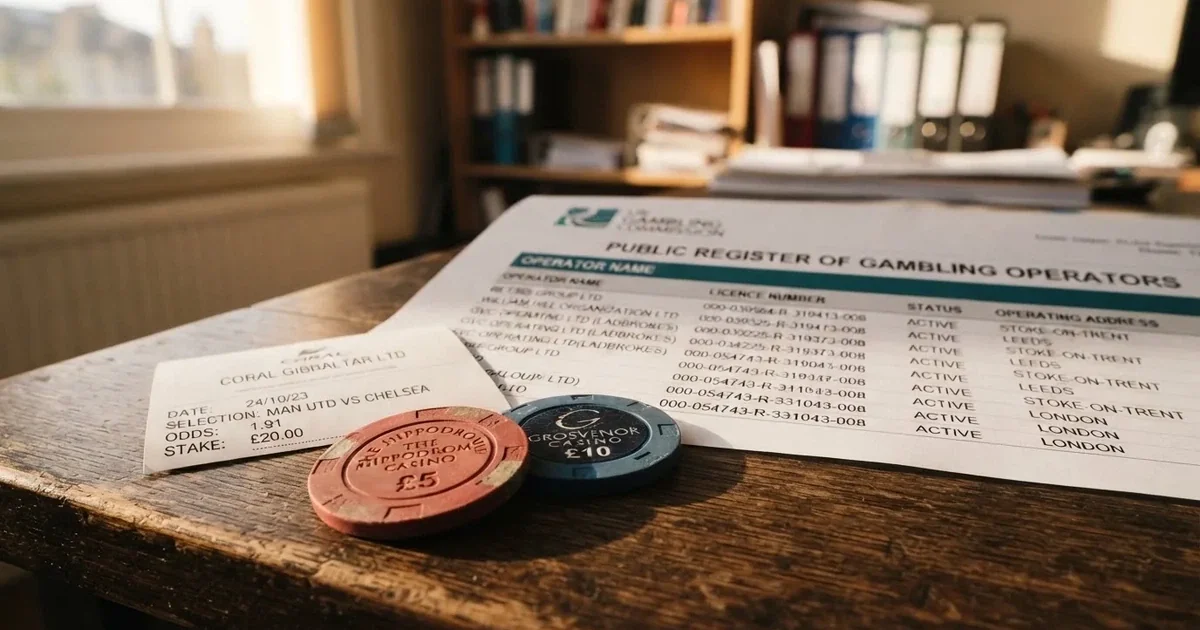
The public register of gambling businesses is the only test that matters for whether a brand is licensed to take British customers. The register can be searched online and downloaded in full as CSV or Excel, and on 18 September 2026 it listed 139 businesses holding an active remote casino operating licence. That is the universe a player is choosing from, before the question of which casino is right for them narrows the field.
Two pieces of register data matter for a brand-by-brand check. The first is the licence number, which takes the form of an account number, the letter R, a sequence number and a suffix — for example, 039411-R-319335-010. The leading six digits repeat the licence holder’s account number; the R marks the licence as remote, which is the legal term for online. The second is the domain status. Each website the register lists against a licence is logged as Active, Inactive or White Label. A white-label site trades under another company’s licence, which is a legitimate arrangement but a piece of information a player usually wants to know. On 18 September 2026 the register’s domain list held 1065 active and 361 white-label entries.
The third piece is the licence holder — the actual company the Gambling Commission has licensed, which may sit behind several brands. Ladbrokes, Coral and Gala Bingo all sit under LC International Limited. Stars Interactive Limited runs PokerStars. Hillside (UK Gaming) ENC runs bet365. Eight brands out of ten on the register are commonly run by a smaller number of holding companies than the brand list suggests, and a player choosing between two brands that share a licence holder is choosing between two products of the same operator.
What the register does not do is rank. It does not sort operators by customer service, by game choice, by withdrawal speed or by anything else a player might use to decide. It is a list of who is licensed to operate. The comparison work sits elsewhere, and the rest of this page is where it sits.
ID checks, GAMSTOP and the protected space a UK licence creates
Three protections apply to every account at a UK-licensed casino, and they apply identically whether the deposit is funded by debit card, bank transfer or e-wallet.
The first is the identity check. The Gambling Commission has required online operators to verify name, address and date of birth before the first deposit or any play since 7 May 2019. The check is not a marketing box the player ticks; it is a regulatory requirement the operator enforces. Some brands run it during sign-up, others run it at first deposit, and a handful run it before withdrawal — but the deadline the rule sets is before any gambling takes place. Anonymous play at a UK-licensed casino is not a thing that exists.
The second is the GAMSTOP self-exclusion. GAMSTOP is the national online self-exclusion scheme, and a mandatory condition of every online licence since 31 March 2020. A player who signs up to GAMSTOP chooses a period of six months, one year or five years, and cannot cancel the period once it has started. Every UK-licensed casino checks GAMSTOP at sign-up, so a self-excluded player cannot open an account at any of them. The scheme is the reason there is no licensed route out of a self-exclusion commitment, and the reason an unlicensed site — one outside the register — is the route a self-excluded player takes if they take a route at all.
The third is the complaints route. A player with a complaint against a UK-licensed operator has access to an alternative dispute resolution (ADR) provider approved by the Commission. The operator’s terms will name the ADR. A player who takes an unlicensed route has no Commission complaints route and no approved ADR — only the operator’s own terms, which an unlicensed site sets for itself.
The three protections together are what a UK licence buys a player. None of them depend on the funding method. All of them depend on the casino being licensed. The rest of the comparison — the game catalogue, the customer support, the withdrawal speed, the loyalty programme — is what sits on top of the protection, and what the comparison in the ranking below actually compares.
Bank-side blocks: how the deposit fails before it reaches the casino
A deposit to a UK-licensed casino can be blocked at three layers: the regulator, the operator and the bank. The regulator sets the ceiling on credit cards and sets the e-wallet rule. The operator sets the account-level limits the player agrees to. The bank sets a third layer that operates on the merchant category assigned to the transaction by Visa or Mastercard.
HSBC declines credit card payments it identifies as gambling based on that merchant category. The restriction applies to every HSBC credit card the bank issues, and there is no option to remove it. The bank states it cannot guarantee that every gambling transaction will be blocked, and that the customer remains liable for any that go through. A player who holds an HSBC credit card and tries to fund a casino deposit through it will usually find the transaction declined at the bank before the casino ever sees it; the player who finds the transaction go through is the exception the bank’s terms cover.
Monzo took a different route, and the first of its kind in Britain. Monzo launched an in-app gambling block in 2018, and the feature lets a customer block card payments to any merchant coded as gambling. The block runs for a cooldown period the customer chooses, from two days up to a year, and the block cannot be switched off during the cooldown. Over 275,000 Monzo customers have activated the feature. The Monzo approach differs from HSBC’s because the customer chooses to set it; the HSBC approach is on by default for credit cards and the customer cannot unset it.
The two examples sit on either side of the bank-side picture. HSBC treats the credit card block as the bank’s call; Monzo treats it as the customer’s. Both reach the same end — a deposit that does not arrive — by different paths. A player who wants the bank-side block set has, depending on the bank, either a default that is on and a way to leave it on, or a default that is off and a way to turn it on. The two are not symmetric. They have the same destination, and they have different costs.
What this page compares
Ten brands sit on the ranking below. Each holds an active remote casino operating licence on the Gambling Commission register, and each runs a publicly listed domain. The comparison is not about which operator is best — the register does not sort, and the choice depends on what a player is looking for. The comparison is about what each operator offers, what licence account runs it, where the domain sits on the register, and whether the register carries any record of credit card support on the brand.
The last of those four columns is the one a player reading the page will notice is largely empty. The register does not record payment-method support; it records licences. The actual credit-card-acceptance question is governed by the 2020 ban, and the answer to it for any UK-licensed brand is the same: the brand does not accept credit cards for gambling, and it cannot do so lawfully. What differs between brands is the rest of what they offer — the game catalogue, the support, the limits, the small print on bonuses — and the table is where the rest of the comparison lives.
| Brand | Licence holder and GB remote casino licence | Domain status on the register | Credit card support |
|---|---|---|---|
| Betfair | PPB Games Limited · 039411-R-319335-010 | Active | — |
| kwiff | Eaton Gate Gaming Limited · 044448-R-323408-017 | Active | — |
| 888casino | 888 UK Limited · 039028-R-319297-014 | Active | — |
| Grosvenor Casinos | Rank Interactive (Gibraltar) Limited · 057924-R-334666-005 | Active | — |
| Gala Bingo | LC International Limited · 054743-R-330863-014 | Active | — |
| Virgin Games | Gamesys Operations Limited · 038905-R-319430-022 | White Label | — |
| PokerStars | Stars Interactive Limited · 039108-R-319334-026 | Active | — |
| 32Red | Platinum Gaming Limited · 045322-R-324275-019 | Active | — |
| bet365 | Hillside (UK Gaming) ENC · 055149-R-331499-004 | Active | — |
| MrQ | Tek Fox Ltd · 060629-R-337532-004 | Active | — |
The fourth column reads as a row of dashes on purpose. The register does not publish payment-method coverage, and no public source on the brands above records a credit card exception to the 2020 ban. The fact that the column reads empty is the fact a player wants to know.
Brand-by-brand: what the licence buys and what the catalogue adds
Betfair
Betfair’s GB licence sits with PPB Games Limited, account 39411 on the register, and the active licence number 039411-R-319335-010. The brand is the casino side of a name better known for its exchange, and the catalogue carries the breadth a player expects from a sportsbook that has built a casino on the side. The casino’s natural centre of gravity is players who already use the exchange, and the brand’s withdrawal timetable has historically been one of the tighter ones in the licensed market, with most debit-card withdrawals clearing inside an hour once released. The exchange-style player, who values a fast payout over a wide slot catalogue, will find the brand a natural match.
kwiff
Eaton Gate Gaming Limited runs kwiff under licence 044448-R-323408-017, the second licence on the register’s account list. The brand has built its identity on a pricing mechanic that randomises how a customer’s stake is enhanced on a given wager, and the casino carries the same unpredictability into its slot play. A player who likes the surprise element of an odds boost, applied to slot play rather than sports, is the player who usually arrives at kwiff. The brand’s game catalogue is narrower than the larger names on the register, which is the trade-off a player makes for the mechanic.
888casino
888 UK Limited holds licence 039028-R-319297-014, and 888casino sits on the register as one of the brand names the parent group has run longest in the British market. The catalogue is broad, the live dealer offering runs deep, and the brand’s bonus terms have historically been some of the more detailed on the register, which is a double-edged quality depending on what the player wants to read. The 888 platform is the choice for a player who wants a long-running British licence, a deep table-game offering, and a terms document that runs to several pages.
Grosvenor Casinos
Rank Interactive (Gibraltar) Limited runs Grosvenor Casinos under licence 057924-R-334666-005, the licence that ties an online brand to one of the longest-running high-street casino names in Britain. The catalogue’s natural centre is the live dealer floor, which carries the brand’s high-street identity into the online space. A player who has walked into a Grosvenor on the high street and wants the same room to play in online is a clear target audience; the bonus terms are modest, and the loyalty programme reflects the high-street business rather than the slot-first brands.
Gala Bingo
LC International Limited holds licence 054743-R-330863-014, and Gala Bingo sits under the same holding company that runs Ladbrokes and Coral. The brand’s identity is bingo-led, and the casino sits beside the bingo rooms rather than the other way around. A player who wants bingo as the primary product and slots as the side product is the intended user for this licence; the bonus terms run along the bingo lines the brand has carried for years.
Virgin Games
Gamesys Operations Limited holds licence 038905-R-319430-022, and Virgin Games sits on the register as a white-label domain — meaning the brand trades under another company’s licence rather than holding its own. The licence holder is the same group behind several other Gamesys-licensed brands, and the Virgin brand carries the visual identity rather than the operating licence. A player who values the Virgin brand identity over the underlying licence holder is likely to find the site a strong contender; the customer-facing experience is run by the Gamesys platform.
PokerStars
Stars Interactive Limited holds licence 039108-R-319334-026, and PokerStars sits on the register under the .uk domain. The brand’s identity is poker-led, with the casino built as the side product to the main card game. A player who wants poker as the primary product and slots as the side product is the typical user for this licence; the poker client is the deepest in the licensed market.
32Red
Platinum Gaming Limited holds licence 045322-R-324275-019, and 32Red sits on the register as one of the older licensed brands still operating. The catalogue is broad, the Microgaming-led slot offering is the centre of gravity, and the brand has historically carried a smaller, more focused bonus programme than the larger names. The 32Red platform is the choice for a player who wants a long-running British licence without the scale of the largest operators.
bet365
Hillside (UK Gaming) ENC holds licence 055149-R-331499-004, and bet365 sits on the register as the casino arm of the largest British sportsbook. The catalogue is broad, the in-play infrastructure carries over from the sports side, and the brand’s withdrawal timetable has historically been one of the fastest in the licensed market. A player who values withdrawal speed above all else and who wants a sportsbook with a casino on the side is the typical candidate for this licence.
MrQ
Tek Fox Ltd holds licence 060629-R-337532-004, and MrQ sits on the register as one of the smaller licensed operators. The brand has built its identity on no-wagering bonuses, which sits against the wider market trend since the December 2025 cap, and the catalogue is narrower than the larger names. A player who values simple bonus terms above all else is the player the licence suits; the rest of the offering is built to that priority.
The 10x wagering cap and what it does to a bonus
Since 19 December 2025, the Gambling Commission has capped wagering requirements on casino bonuses at 10x. A bonus with a 10x wagering requirement means the player must wager ten times the bonus amount before any winnings become withdrawable. A £100 bonus carries £1,000 of required turnover. Mixed-product bonuses — offers that give a casino bonus in exchange for a sports wager, or vice versa — are banned.
The cap applies to bonuses at UK-licensed casinos. It does not apply to offers at unlicensed sites, which are not bound by the Commission’s rules. A player comparing a UK-licensed bonus to an offshore offer is comparing a 10x maximum to whatever the offshore operator has set, which is usually higher. The cap is the reason the licensed bonus side of the comparison has compressed since December 2025 — every operator in the licensed market now writes bonus terms within the same ceiling, and the differentiation has moved to the size of the bonus, the size of the games it covers, and the time the player has to clear it.
The cap’s other effect is on the no-wagering bonus. A bonus that carries no wagering requirement is, by definition, below the 10x cap — and MrQ has built its identity on that shape of offer. The no-wagering bonus is not a loophole in the cap; it is the cleanest version of a bonus under the cap, because the cap is the ceiling rather than the floor.
What the 10x cap means for time and cost
The required turnover a player must clear on a 10x bonus is a function of the bonus size. The time it takes to clear it is a function of the stake the player puts on each spin and the speed at which each spin runs. A £100 bonus carries £1,000 of required turnover. At a £1 stake per spin, that is 1,000 spins. At a £0.50 stake per spin, that is 2,000 spins. At a £0.20 stake per spin, that is 5,000 spins. The slot itself runs at a minimum of 2.5 seconds per spin under the Commission’s rules, so 1,000 spins at £1 takes 2,500 seconds — about 42 minutes — and 5,000 spins at £0.20 takes 12,500 seconds, or roughly three and a half hours.
The cost of clearing the bonus is a separate calculation. The expected loss from clearing £1,000 of turnover depends on the slot’s RTP. A slot with a 96% RTP returns £960 of every £1,000 wagered, on average across a long run. The remaining £40 is the expected loss. A slot with a 94% RTP returns £940, and the expected loss is £60. The slot’s volatility sits on top of the average: a low-volatility slot produces a tighter spread around that average, a high-volatility slot produces a wider one. The 10x cap does not change the slot’s RTP; it changes the bonus ceiling the player must clear to reach their winnings.
Two bonus sizes under the same 10x cap can produce very different experiences. A £20 bonus carries £200 of required turnover — 200 spins at £1, about five minutes of slot time, and an expected loss of £8 on a 96% RTP slot. A £500 bonus carries £5,000 of required turnover — 5,000 spins at £1, roughly three and a half hours, and an expected loss of £200 on the same slot. The smaller bonus clears faster and costs less in expected loss; the larger bonus takes longer and costs more. The 10x cap applies to both equally. The size of the bonus is what sits on top.
Why the offshore comparison reads the way it does
An unlicensed site — one outside the Gambling Commission register — runs on the licence the operator holds in another jurisdiction, usually Curaçao or Malta. None of the rules in §7 of the regulator’s framework apply: no £5 or £2 stake cap, no 10x wagering cap, no mandatory GAMSTOP check, no identity verification before play. The site sets its own limits, its own bonus terms, its own responsible gambling framework, and its own complaints route. It accepts credit cards because no rule prohibits it. It pays out in whatever time its own terms state, and a player with a complaint has the operator’s own ADR to go to, which the operator chose.
The trade-off is the protected space a UK licence creates. An unlicensed site offers no GAMSTOP route, no Commission complaints route and no approved ADR. The Commission can disrupt an unlicensed site — cease-and-desist notices, search-engine delisting, payment and hosting referrals — but does not have the power to block it at the ISP level. No penalty aims at the player; the player on an unlicensed site loses the protection the licensed alternative offers, and keeps the winnings (or the losses) the unlicensed site records.
The tax position is symmetric: players pay no tax on gambling winnings in the UK, licensed or unlicensed. Operators pay Remote Gaming Duty, which the Chancellor raised from 21% to 40% from 1 April 2026 — a model figure, the actual rate the player faces is the rate HMRC applies. The remote gaming duty sits on the operator side of the comparison, not on the player side.
What the comparison leaves out
Two limits sit above this page that the comparison above does not address. The first is the registered self-excluded player, who has signed up to GAMSTOP and cannot open an account at any of the ten brands above. That player’s option is the unlicensed market, and the option’s cost is the protected space a UK licence creates. The second is the player whose bank issues a credit card with a gambling block on by default — the HSBC case, where the block is on the bank’s call and the customer cannot unset it. That player can still play at a UK-licensed casino, but the funding route runs through debit, e-wallet or bank transfer, not credit.
A third limit sits below the comparison: the operator’s own pending window before a withdrawal is released. The pending window varies by brand, and a withdrawal that the operator releases in under an hour is materially different from one that the operator holds for three working days. The register does not record pending windows; the brand’s terms document does, and a player who values fast payouts reads the terms before they sign up.
Choosing between the ten
A player who wants a long-running British licence, a deep table-game offering and detailed bonus terms reads the page to 888casino. A player who wants the high-street identity runs to Grosvenor Casinos. A player who wants bingo as the primary product runs to Gala Bingo. A player who wants the Virgin brand identity over the underlying licence holder runs to Virgin Games. A player who wants poker as the primary product runs to PokerStars. A player who wants a fast payout above all else runs to bet365 or Betfair, with the catalogue depth as the tiebreaker. A player who wants surprise pricing on every wager runs to kwiff. A player who wants a long-running licence without the scale of the largest operators runs to 32Red. A player who wants no-wagering bonuses above all else runs to MrQ.
The choice between them is not about credit card support — none of them takes credit cards, and none of them lawfully can. The choice is about what sits on top of the licence the Gambling Commission has issued.
Settlements, fees and what a player actually pays
A UK-licensed casino does not charge a fee on a debit card deposit. A bank-side fee can apply if the player’s bank treats the deposit as a cash advance rather than a purchase — and a small number of banks do, which is why a player reading the small print on their own card terms matters as much as the casino’s terms. The casino’s own fee schedule is part of the terms document, and a fee on deposits is unusual in the licensed market.
E-wallet deposits can carry a fee on the e-wallet side, and that is a fee the player pays to the e-wallet provider rather than to the casino. PayPal, Skrill and Neteller charge different fee schedules, and a player moving money between funding sources should read the e-wallet’s own terms rather than the casino’s. The casino’s role is to accept the e-wallet as a funding method; the e-wallet’s role is to move the money.
Bank transfer deposits via Faster Payments do not carry a casino fee. The bank’s own transfer terms apply, and most UK banks do not charge for Faster Payments transfers within their own arrangements. A player funding a casino account through a bank transfer is paying the bank’s own terms, which are usually zero.
A withdrawal carries the same fee structure in reverse. The casino does not charge. The receiving side — the bank, the e-wallet — sets its own terms. Some e-wallets charge a small fee on receiving a transfer, and a player who plans to withdraw frequently should read the e-wallet’s receiving terms before they choose the funding route. The fastest path from casino to bank account is usually the same path the deposit took on the way in, and the slowest is the e-wallet round-trip.
Responsible gambling: what the licence requires the operator to do
A UK-licensed casino is required to run a range of responsible gambling features. Reality checks prompt the player at regular intervals during a session to confirm they want to continue. Time-out allows a short break of 24 hours to several weeks. Self-exclusion via GAMSTOP runs for six months, one year or five years, and cannot be cancelled early. Deposit limits, set at the player’s request before the first deposit, are the player’s own ceiling on what they will move into the account.
The features are mandatory; the player’s use of them is voluntary. A player who wants a deposit limit set before they fund the account can set one at sign-up, and a player who wants to take a break can take one through the operator’s responsible gambling page or through GAMSTOP. The operator’s customer support will walk a player through any of these, and the National Gambling Helpline (run by GamCare) and GambleAware sit alongside the operator as the support the player reaches for when the operator is not the right person to ask.
A self-excluded player who signs up to GAMSTOP cannot open an account at any of the ten brands above. The only route that bypasses the GAMSTOP check is the unlicensed market, and that route trades the protected space a UK licence creates for the absence of the check. The trade is a real one — the protected space is what the licence is for — and a player considering the route should read the comparison in the offshore section above before they take it.
What changes and what stays the same
The credit card ban has been in force since 14 April 2020 and shows no sign of lifting. The 10x wagering cap is in force since 19 December 2025 and applies to every licensed bonus. The £5 and £2 stake caps have been in force since April and May 2025 respectively. The £150 financial vulnerability check has been in force since 28 February 2025. The auto-play ban has been in force since 31 October 2021.
The deposit-limit prompt at first deposit has been in force since 31 October 2025. The GAMSTOP requirement has been in force since 31 March 2020. The identity check has been in force since 7 May 2019. The 21% Remote Gaming Duty rate — the one that applied to operators at the time of writing — is rising to 40% from 1 April 2026.
What changes between this page and the next version of it is the register itself. The 139 active remote casino operating licences on 18 September 2026 will move as operators enter and leave the market. The 1065 active and 361 white-label domain entries will move with them. The ten brands on the ranking above are the register’s view on that date, and a player reading this page in three months’ time should check the register again, because the brands and the licence holders are the parts of the comparison most likely to have changed. The rules, by contrast, are stable on the timescale a player’s reading sits on, and the comparison in the rule column above does not date the way the comparison in the brand column does.
Where to check the licence yourself
The Gambling Commission’s public register is searchable online and downloadable as CSV or Excel. A player who wants to verify a brand’s licence before they sign up searches the register for the brand name, reads the licence number against the licence holder’s account, and confirms the licence status is active. The licence number on the register has the form account-R-number-suffix, where the leading six digits repeat the licence holder’s account number and the R marks the licence as remote.
The register does not record payment-method support, so the credit card check is the regulatory rule rather than a register lookup. A brand on the register does not accept credit cards; a brand off the register may or may not, and the player choosing the off-register route is choosing the comparison in the offshore section above. The register tells the player who is licensed. The regulatory rule tells the player who accepts credit cards. The two together close the question this page opened with.
Frequently asked questions
Is it legal for a licensed UK casino to accept credit card?
No. The Gambling Commission banned credit card gambling on 14 April 2020, covering all forms of remote gambling plus non-remote betting. The ban includes credit cards routed through e-wallets unless the e-wallet can demonstrably prevent credit card funding at the e-wallet level. A UK-licensed casino does not accept credit cards, and a player who holds one and tries to fund a deposit through it will usually find the transaction blocked at the bank.
Is there a minimum deposit when paying with credit card?
The minimum deposit at a UK-licensed casino is set by the operator, not by the regulator, and usually sits between £5 and £20. The minimum is the same regardless of the funding method, because the credit card funding route is closed by the 2020 ban. A player funding through debit card, e-wallet or bank transfer will see the same minimum the operator has set; a player who tries to fund through credit card will not reach the deposit screen at all.
How long does a credit card deposit take to show up in my account?
The question does not apply to UK-licensed casinos, because credit card deposits are not accepted. A debit card deposit at a UK-licensed casino typically posts in seconds. A bank transfer through Faster Payments takes a few minutes on the second deposit onwards; the first deposit usually requires a one-off verification step that can take longer. The settlement time on the way in is not where the wait lives — the wait lives on the way out.
Do I need to verify my identity before depositing with credit card?
Identity verification is required at every UK-licensed casino before the first deposit or any play, and has been since 7 May 2019. The check covers name, address and date of birth, and applies regardless of the funding method. A player who tries to deposit before the check completes will see the deposit held until the check clears. The credit card funding route is closed by the 2020 ban, so the question of verifying for a credit card deposit does not arise.
Does GAMSTOP self-exclusion cover an account funded with credit card?
GAMSTOP self-exclusion covers every UK-licensed casino regardless of how the account is funded. A player signed up to GAMSTOP cannot open an account at any of the ten brands above, and the only route past the check is the unlicensed market. The funding method is irrelevant to the GAMSTOP check; the licensed-status of the casino is what matters.
Are there any fees for depositing with credit card?
UK-licensed casinos do not charge a fee on deposits, and a credit card deposit would not have reached the operator even if the funding route were open. Bank-side fees can apply if the player’s bank treats the deposit as a cash advance rather than a purchase, and a small number of banks do. A player reading the small print on their own card terms will see the bank’s treatment, not the casino’s, because the casino never receives the credit card deposit.
Created by the ”jackpotslotsuk” editorial team.