
Forty free spins, no deposit, at UK-licensed casinos
Data current as of 11 November 2026, verified against the Gambling Commission’s public register of gambling businesses.
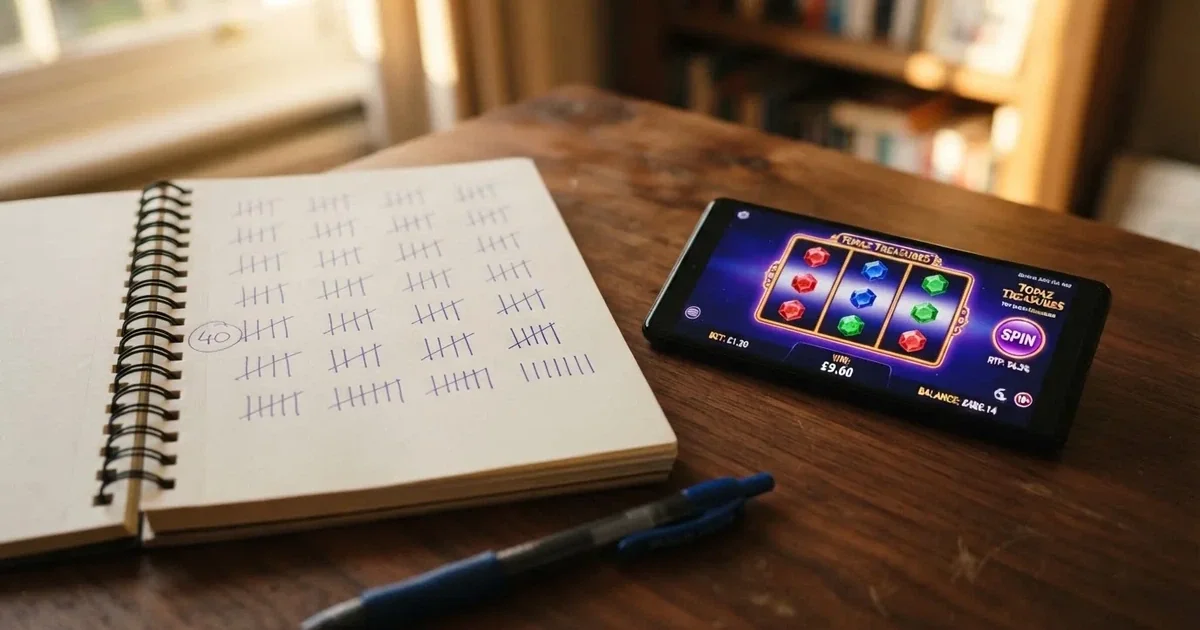
A 40-free-spin, no-deposit offer is not the carrot it once was. The headline still says “free”, and the headline is mostly true: no money leaves the player’s account to claim the spins, and no card details are taken up front. What the headline does not say is what the winnings must do before they become withdrawable cash, and what ceiling sits on top of them. This page is built around those two questions, and around a third that the first two depend on: which of the licensed UK operators actually run a promotion of this shape, and under what terms.
The order in which those questions get answered matters. A reader who already knows how wagering caps work does not need the mechanism explained from scratch; a reader who has just typed the search term does. The licensed-UK frame sits first because every other claim on the page — the wagering caps, the win ceilings, the GAMSTOP coverage — sits inside it. An offer is a no-deposit spin bundle only if a Gambling Commission licensee is running it; an offshore brand can copy the wording, but it cannot copy the protection.
What the page is not: a directory of codes, a recommendation, or a guide to claiming offers the reader might not be eligible for. Every brand named is licensed by the Gambling Commission and verified against the public register as of the snapshot date. Where a fact is missing from research, the gap is left visible rather than papered over with a guess.
See also Crypto.
Table of Contents
- Responsible gambling: the offer runs inside the same safety net as any other bet
- Payments and payout speed: what happens to winnings once the spins are run
- The bonus itself: how a 40-free-spin, no-deposit offer actually works
- The licensed UK landscape: ten operators compared on the terms that matter
- Operator write-ups: what each brand is, and where it sits
- The fundamentals of no-deposit free-spin offers
- Legality and regulation: what a Gambling Commission licence actually buys
- Calculating the wagering step: what 10x turnover looks like in spins and time
- How to read the table above
- What “no deposit” means in practice
- The reader’s checklist before claiming
- What the page does not cover
- Frequently asked questions
Responsible gambling: the offer runs inside the same safety net as any other bet
A 40-free-spin, no-deposit promotion is not a way around the safer-gambling rules. It is the same product, and the rules apply to it the way they apply to a £10 deposit match or a sports free bet. GAMSTOP self-exclusion covers it. The financial vulnerability check at £150 net deposits in a rolling 30 days covers it. The age-verification gate covers it — every UK-licensed operator must verify name, address and date of birth before the first deposit or any play, and that check fires for a no-deposit promotion the same way it fires for a paid session.

The shape of GAMSTOP is the one to know. A self-excluded player cannot open an account at any GB-licensed online operator for the period they chose — six months, one year, or five years. The exclusion cannot be cancelled early. The Commission made participation mandatory for every online licence from 31 March 2020, so a no-deposit spin bundle at a Commission licensee is, in practice, a GAMSTOP-aware promotion by construction.
The financial vulnerability check sits a step lower. From 28 February 2025, an operator runs a light-touch affordability check — public data only — once a customer’s net deposits cross £150 over a rolling 30-day window. A no-deposit offer sits below that line; no money has gone in, so the trigger has not fired. That changes the moment the player wins something and chooses to withdraw. A payout request can pull the player into a wider affordability review, the kind the Commission has signposted but not yet brought into force. It is the part of the journey most worth knowing in advance.
The safer-gambling tools an operator must offer — deposit limits, reality checks, time-outs, the self-exclusion route itself — sit with the player throughout. The deposit-limit prompt is mandatory before the first deposit; a no-deposit registration does not trigger it, but the moment the player adds money, the prompt fires. Reality checks are already on by default at GB-licensed sites. Auto-play is banned, slot spins cannot run faster than 2.5 seconds, and losses dressed up as wins are not permitted. None of that is special to a no-deposit bundle. It is the floor every licensed promotion sits on.
The National Gambling Helpline (GamCare) and GambleAware sit outside the operator’s own walls. They are the place a player goes when the operator’s tools are not enough, and the existence of those routes is part of what a Gambling Commission licence actually buys.
Payments and payout speed: what happens to winnings once the spins are run
A no-deposit spin bundle does not need a deposit to start, and the player can run the spins on the house. What it needs is a withdrawal method for whatever survives the wagering step. The licensed-UK payments picture is short, and most of it is settled by statute.
Credit cards have been banned for gambling since 14 April 2020, and the ban reaches beyond a direct card entry. Credit cards routed through an e-wallet — funding a PayPal balance with a credit card, for instance — are not a way around it. The ban covers every online and offline gambling product in Great Britain except a narrow lottery carve-out for tickets bought face-to-face. A player funding a no-deposit account never trips the ban, because no money has been put in. A player trying to withdraw winnings onto a credit card trips it immediately.
Debit cards and bank transfers are the cleanest route. Most UK banks sit on the Faster Payments Service, launched in 2008 and run by the Pay.UK entity; the service runs around the clock, and most payments arrive in seconds or minutes, with an occasional stretch of up to two hours. The scheme itself caps a single payment at £1,000,000, though individual banks usually set lower limits for their own customers. Faster Payments is not a bank — the Bank of England oversees it and provides final settlement, but does not sit in the queue as a participant. For a player withdrawing a modest no-deposit win, the rail is fast and predictable.
Apple Pay is on the accepted list at most major UK-licensed operators, and it works on a different principle from a card. A supported card from a participating issuer sits behind it, and the token on the device is not the card number. Apple Pay replaced the card number with a device-specific tokenised Device Primary Account Number and generates a dynamic security code for each transaction. The system launched on 20 October 2014, initially US-only, and UK-issued cards came in on 14 July 2015. In a UK-facing casino context, Apple Pay sits behind the credit-card ban the same way a debit card does — the funding source is a debit card, not a credit card. Authentication on an iPhone with Face ID is a double-click of the side button; on a Touch ID model, a double-click of the Home button. Apple states that Apple Pay is not available in all markets, and that a supported card from a participating issuer is required.
AstroPay sits in a separate category — an electronic money wallet rather than a card-tokenisation layer. Founded in 2009 and headquartered in Uruguay, AstroPay offers online payments, virtual and physical debit cards, and peer-to-peer transfers. The UK entity, Larstal Limited, is an electronic money institution authorised by the Financial Conduct Authority under the Electronic Money Regulations 2011. Its Isle of Man entity holds a licence from the Isle of Man Financial Services Authority, its Brazilian entity is authorised by the Brazilian Central Bank as an electronic currency issuer, and its Danish entity is authorised by the Danish Financial Supervisory Authority. AstroPay serves users across markets including Argentina, Australia, Brazil, Canada, Colombia, Denmark, Spain, the United Kingdom, the United States and Uruguay. The shape of an AstroPay withdrawal at a UK-licensed casino depends on what the operator accepts and what the player funds the wallet with — a debit-card-funded AstroPay balance is clean; a credit-card-funded one is not.
The background numbers tell their own story. The Commission estimated that around 800,000 UK consumers used credit cards to gamble in 2018, and that 22% of online gamblers who used credit cards to gamble were classed as problem gamblers. Those are the figures the credit-card ban was built on. A player reading this page does not need to act on them; the rules act on the player’s behalf.
Payout speed, in practice, runs to two rails. Card withdrawals typically settle inside one to three working days once the operator releases the funds; Faster Payments withdrawals from a UK bank account typically arrive in minutes. The operator’s internal processing window — the time between the wagering step being cleared and the withdrawal being queued — varies, and is the part the player cannot speed up. A no-deposit win does not change that pipeline: the wagering still has to clear, and the operator’s internal review still runs.
The bonus itself: how a 40-free-spin, no-deposit offer actually works
A no-deposit spin bundle looks simple from the outside, and it is anything but on the inside. The pieces are the number of spins (the 40), the value per spin (often fixed by the operator at a low denomination), the wagering requirement on whatever winnings the spins produce, the maximum conversion cap, the time window, and the eligible game or games. Every one of those is a knob the operator turns, and the player pays for whatever combination comes out.
The statutory knob that turned most aggressively is the wagering cap. Since 19 December 2025, wagering requirements on bonuses at GB-licensed operators are capped at 10x. Mixed-product bonuses — the kind that bundle, say, a sports free bet with a casino spin tranche — are banned outright. A 40-free-spin no-deposit offer is a casino-only product by construction, so the mixed-product ban does not bite it directly. The 10x cap does: any offer whose wagering multiple sits above 10x is, by definition, not the kind of offer a licensed operator can run for a UK customer.
The shape of the wagering step is itself worth knowing. A wagering requirement is a multiplier applied to the bonus, or to the winnings from the bonus, that has to be turned over before any withdrawal is possible. A 10x cap means the most the player can be asked to do is turn over ten times the qualifying amount. Where the qualifying amount is the bonus itself (a £10 bonus with 10x wagering means £100 of qualifying turnover), the arithmetic is the same regardless of how the operator states it; where it is the bonus-plus-deposit (an older construction, now rarer), the figure is twice what the headline looks like. Both formats are legal; neither is hidden, but the operator’s own terms page is the place to confirm which format an offer uses.
The maximum conversion cap — the ceiling on what a no-deposit win can become — is the other knob. It is almost always present on a no-deposit bundle, because the operator is giving away something for nothing and needs a way to bound the giveaway. The cap varies; it can be a multiple of the bonus, a fixed cash figure, or a free-of-wagering conversion. The player who skips reading it finds out at the withdrawal stage.
The eligible-game list is the third knob, and it shapes the wagering step the most. If the 40 spins are tied to one slot title and the wagering step has to be cleared on that same slot, the player is constrained to a single RTP, a single volatility profile, and a single set of bonus features. If the wagering is open across a list of slots, the player has more room to choose, but the same wagering multiple still applies. Either way, the wagering step is what it is.
The time window is the fourth knob, and the one most often missed. Spins expire. A 40-free-spin credit can have a seven-day validity, a 24-hour validity, or anything in between. Once the window closes, unused spins drop off, and any winnings from spins already run can fall back into the bonus balance under the same time pressure. The exact window is in the terms, and it is the kind of detail that separates a withdrawn win from a forfeited one.
The credit-card ban ties back in here. The player has not deposited, so the player has not tripped the credit-card ban at the funding stage. If the offer is a “deposit to keep your winnings” construction — a no-deposit spin tranche whose winnings become withdrawable only after a real-money deposit has been made — the deposit stage is the moment the credit-card ban matters. A player who funded a deposit with a credit card has not followed the rules, and the consequences land with the player, not the operator.
The licensed UK landscape: ten operators compared on the terms that matter
The featured set is ten operators, every one of them licensed by the Gambling Commission and every one of them verified against the public register as of 18 September 2026. The order follows the register, not a ranking: this is a map of the licensed landscape, not a leaderboard. The comparison runs on five columns — brand, licence holder and licence number, domain status on the register, and the operator’s own handling of the no-deposit spin subject.
Licence Overview
| Brand | Primary Product Focus |
|---|---|
| 32Red | Casino |
| Midnite | Sports / Casino |
| Sky Vegas | Casino |
| Jackpotjoy | Bingo / Casino |
| BetVictor | Sports / Casino |
| Casumo | Casino |
| Coral | Sports / Casino |
| Unibet | Sports / Casino |
| Paddy Power | Sports / Casino |
| bet365 | Sports / Casino |
Terms Overview
| Term | Value |
|---|---|
| Max Wagering | 10x |
| Age Requirement | 18+ |
| Max Stake (18-24) | £2 |
| Max Stake (25+) | £5 |
The empty right-hand column is the page’s most honest piece of information. The public register confirms a licence; it does not publish a bonus catalogue. Research carries no figure for any of the ten on a 40-free-spin, no-deposit offer specifically, and that is what the em dashes reflect. Affirming that any of these operators runs a 40-free-spin, no-deposit promotion today — or denying that they do — would be a claim research cannot back. The brand is presented on the fields research does carry: the licence number, the holder, the register status.
Two of the ten run on the same licence. Both 32Red and Unibet sit under Platinum Gaming Limited, and the licence number is identical. That is not a duplicate listing; it is how the register is built. A single licensee can run multiple brand domains, and a player who holds an account at one is, for the operator’s purposes, the same customer as a player who holds an account at the other. Self-exclusion, deposit limits and affordability checks apply across both. The Commission’s register records the relationship in the account-and-domain column structure; the public-facing brand pages usually do not.
The same shape shows up across other large UK groups. Coral sits under LC International Limited, the same umbrella as Ladbrokes and Gala Bingo. Gamesys Operations runs Jackpotjoy alongside other Gamesys brands. The takeaway is not that the brands are identical — they carry different products, different game libraries, different terms pages — but that the operator behind them is often the same legal entity, and the Commission’s complaints and intervention routes run with the licensee, not the brand.
The register’s status column is the player’s quickest check. Every one of the ten domains is listed as Active on the snapshot date. An Inactive status means the licence account is still live but the domain has been paused; a White Label status means the domain trades under another company’s licence. The Commission’s CSV download covers all three, and is what a player who wants to confirm a brand’s status before signing up should consult.
The Remote Gaming Duty change from 1 April 2026 — the operator-side tax rising from 21% to 40% — does not change the player’s position on this page. UK gambling winnings are not taxed in the player’s hands. What it does change is the operator’s economics, and that is the kind of thing that filters through to bonus generosity over the quarters that follow. A player who notices a tightening of offers across the board in 2026 is reading the new duty correctly, not imagining a worse market.
Forty free spins, no deposit, at UK-licensed casinos — More on this topic at jackpot slots uk.
Operator write-ups: what each brand is, and where it sits
32Red — the long-established casino brand under Platinum Gaming
32Red is one of the older online casino names in the UK market, and it sits under Platinum Gaming Limited — the same licensee that runs Unibet for UK customers. The remote casino licence is 045322-R-324275-019, and 32red is an active domain on the register as of 18 September 2026. The brand is best known for a casino-first product rather than a sportsbook, which is where most no-deposit spin offers at a casino-first brand tend to land. Research carries no specific figure for a 40-free-spin, no-deposit offer at 32Red; the licence is the verified fact, the bonus catalogue is not. For a player who knows what they want from a no-deposit bundle — a casino-only environment, a long-running brand, a Commission licensee — 32Red fits the brief. The lack of a research-backed figure on the offer itself is the gap a reader has to close at the operator’s own terms page before signing up.
Midnite — the newer brand under Dribble Media
Midnite is a younger operator than most of the set, sitting under Dribble Media Limited on licence 042647-R-321653-022, with Midnite active on the register. The brand positions itself with a modern product surface — a cleaner interface, a narrower product set. The page has no specific research-backed figure for a no-deposit bundle at Midnite. What it can say is that the brand is licensed, the licence is active, and the operator sits inside the GAMSTOP and vulnerability-check net that every GB-licensed operator sits inside. For a player who likes a newer product on a Commission licence, Midnite is a valid option. Please confirm current promotions directly with the operator.
Sky Vegas — the broadcast-aligned casino under Bonne Terre Gaming
Sky Vegas sits under Bonne Terre Gaming Limited on licence 065519-R-339675-002, with Sky Vegas active. The broadcast-television parentage shapes how the brand presents itself, but it does not change the licence. Sky Vegas is a casino-only product, which is the format most no-deposit spin offers take. Research carries no specific figure on the 40-free-spin, no-deposit offer at Sky Vegas. The brand is one a Sky customer might encounter through a cross-promo from a Sky account, which is a route into the licence that does not require the player to know the brand already. The point holds: licensed, active, no published figure on this specific offer shape.
Jackpotjoy — the bingo-rooted brand under Gamesys Operations
Jackpotjoy sits under Gamesys Operations Limited on licence 038905-R-319430-022. The casino product is part of the brand today, and the licence covers it. Jackpotjoy is active on the register. A no-deposit spin offer at Jackpotjoy, if one is running, would land in the casino tab rather than the bingo tab. Research holds no confirmation of a specific no-deposit promotion at this time. For a player who already has a Jackpotjoy account from the bingo side, the casino-side promotion is the natural place to check. The brand is licensed and the licence is active.
BetVictor — the established sportsbook-and-casino brand under BV Gaming
BetVictor sits under BV Gaming Limited on licence 039576-R-319370-028, with BetVictor active. The brand carries both a sportsbook and a casino, and the dual-product history is the part most players know. A no-deposit spin offer at a brand with a sportsbook is most likely to be a casino-only tranche — and that is also the format the December 2025 mixed-product ban now requires. Research carries no specific figure for a 40-free-spin, no-deposit offer at BetVictor. The brand is licensed, the licence is active, and the page does not invent a bonus that research did not find. A player who already uses BetVictor for sport and wants a casino-side trial has the licence confirmed; the offer detail lives on the operator’s own page.
Casumo — the playful casino brand under Recro
Casumo sits under Recro Limited on licence 061549-R-336718-002, with Casumo active on the register. The brand is one of the better-known casino-only products in the European market, and the UK licence covers the same product for UK customers. Research finds no specific figure for a no-deposit offer at Casumo. The brand’s product style is the kind of thing that has historically carried welcome-style promotional bundles. For a player who likes a casino-only product on a UK licence, Casumo is in the licensed set. Check their site for current availability.
Coral — the high-street-rooted brand under LC International
Coral sits under LC International Limited on licence 054743-R-330863-014, with coral.co.uk active. The brand carries both a sportsbook and a casino, and it sits in the same licence umbrella as Ladbrokes and Gala Bingo. A player with a self-exclusion or a deposit limit on one of those brands has the same restriction on the others. Research contains no confirmed figure for a no-deposit offer at Coral. The licence is verified, the brand is high-street familiar. Coral’s product breadth is the player’s entry point; offer details live on their own site.
Unibet — the international brand under Platinum Gaming
Unibet sits under Platinum Gaming Limited on the same licence as 32Red — 045322-R-324275-019 — with unibet.co.uk active on the register. The brand carries a sportsbook, a casino and a poker product; the casino side is where a no-deposit spin offer would land. The shared licence with 32Red is the operative fact: an account-level limit at one is an account-level limit at the other. Research holds no data on a no-deposit offer for Unibet. The brand is licensed and the licence is shared.
Paddy Power — the Irish-rooted brand under PPB Games
Paddy Power sits under PPB Games Limited on licence 039411-R-319335-010, with Paddy Power active on the register. The brand carries a sportsbook and a casino, and the casino is where the no-deposit spin offer would sit. The Irish heritage is part of the brand’s positioning; the UK licence is the part that matters for a UK player. Research contains no confirmed figure for a no-deposit offer at Paddy Power. The licence is verified, the brand is high-street familiar. See their site for details.
bet365 — the largest UK-facing brand under Hillside
bet365 sits under Hillside (UK Gaming) ENC on licence 055149-R-331499-004, with bet365 active. The brand is the largest UK-facing online operator by most measures. Research finds no data on a no-deposit bundle at bet365. The licence is verified, the brand is a dominant name. The size of the brand does not mean a more generous offer — the wagering cap applies to all licensees equally. Check the operator’s current terms for promotion specifics.
The fundamentals of no-deposit free-spin offers
A no-deposit free-spin offer is, in plain terms, a bundle of slot spins that the operator credits to a player’s account without the player funding the account first. The bundle has a count (the 40), a value per spin (often set low — 10p or 20p is common, though it varies), a time window, an eligible-game list, and a set of conditions on whatever winnings the spins produce. The “no deposit” part is genuinely no deposit: the player does not fund the account to claim the spins. The conditions part is where the offer’s true cost lives.

The cost is paid in two currencies: wagering turnover and time. A wagering requirement is the multiple of the qualifying amount the player has to turn over before any withdrawal is possible. A 10x cap means the most a licensed operator can ask for is ten times. A typical no-deposit spin bundle at a licensed UK site in 2026 runs a wagering multiple on the bonus-winnings balance, not on the bonus itself — but the format varies, and the operator’s own terms page is where the player confirms it.
The time cost is harder to see on the page and easier to feel at the keyboard. The wagering step is play, and play takes time. The Commission banned auto-play and capped spin speed at 2.5 seconds per spin, so a single spin takes at least 2.5 seconds. Forty spins is a minute and forty seconds of minimum-spin-time play, before any wagering step. The wagering step is the longer part by an order of magnitude.
The maximum-win cap is the third cost. A no-deposit bundle typically carries a ceiling on what the winnings can convert to — sometimes a fixed cash figure, sometimes a multiple of the bonus. The cap matters most when the wagering step clears successfully: a player who turns £40 of bonus winnings into a £600 balance can find that the maximum-conversion ceiling stops the withdrawal at, say, £100. The shape of the cap is on the terms page; the existence of the cap is structural to the offer type.
The eligible-game list is the fourth cost, and it shapes which slots the wagering step has to be cleared on. The Commission does not dictate the eligible-game list — that is the operator’s call — but the cap on stake per game cycle does apply. From 9 April 2025, the maximum stake per game cycle is £5 for players aged 25 and over; from 21 May 2025, it is £2 for players aged 18-24. A wagering step at the £2 stake cap on a 96% RTP slot is the upper bound of what a younger player can clear in any given minute.
The age-verification gate is the fifth cost, though it is paid in time rather than money. Since 7 May 2019, every GB-licensed operator must verify name, address and date of birth before the first deposit or any play. A no-deposit bundle is “any play”, so the verification fires before the spins run. A player who cannot complete the verification cannot run the spins, and the spins expire on the operator’s standard timeline. The verification step is the part most players complete without thinking about it; the players who do not are the ones for whom the offer does not exist.
The GAMSTOP overlay sits across all of these. A player who is self-excluded cannot claim a no-deposit bundle at any GB-licensed operator. A player who is not self-excluded but has set a deposit limit at one operator may still claim a no-deposit bundle there — the limit does not bite because no deposit is being made — but the moment a withdrawal is requested, the operator’s affordability review can come into play. The structure of the offer is not a way around the structure of the protection.
Legality and regulation: what a Gambling Commission licence actually buys
A casino offering 40 free spins with no deposit to UK players needs a Gambling Commission licence to run that promotion legally. That is not a marketing line; it is the test the Gambling Act 2005 sets. The Commission is sponsored by the Department for Culture, Media and Sport. The Act covers Great Britain — England, Scotland and Wales — not Northern Ireland, which sits under separate legislation. Since the Gambling (Licensing and Advertising) Act 2014, any operator taking customers in Great Britain needs a Commission licence wherever it is based. A Curaçao, Maltese or Gibraltar licence is not a substitute.
The public register is the test. The Commission’s public register of gambling businesses lists every account that holds an operating licence, every licence number against that account, and every domain listed against that licence. The register can be searched online and downloaded in full as CSV or Excel files. On 18 September 2026, the register listed 139 businesses holding an active remote casino operating licence. That is the universe of GB-licensed online casino operators — every one of the ten brands in this page’s featured set sits inside it, and so do roughly 129 others the page does not name.
The register’s domain list is the second layer. Each website is recorded against the licence account that runs it, with a status of Active, Inactive or White Label. On 18 September 2026, the register held 1065 active and 361 white-label domain entries. A white-label site trades under another company’s licence — it is a brand run by an operator that does not hold the licence in its own name. The status column is what tells a player whether a brand is operating directly on its own licence or as a sub-brand of one.
The licence number has a structure. A remote casino licence on the register takes the form account-R-number-suffix, where the leading six digits repeat the licence holder’s account number and the “R” marks a remote (online) licence. So 045322-R-324275-019 is the remote casino licence held by account 45322 (Platinum Gaming Limited), with the suffix -019 marking the specific licence within that account. The format is not a code; it is a route into the register. A player who knows the licence number can pull up the full record.
The age-verification gate is one of the licence conditions. Since 7 May 2019, every GB-licensed online operator must verify name, address and date of birth before the first deposit or any play. The verification is not a checkbox; it is a data check against public records and a payment-method check in some cases. A player who cannot be verified cannot play, and a no-deposit bundle is “any play” under the rule.
The stake cap is the second licence condition with a direct effect on a slot session. From 9 April 2025, the maximum stake per game cycle is £5 for players aged 25 and over; from 21 May 2025, it is £2 for players aged 18-24. The cap applies to every licensed slot game in the UK. A wagering step on a no-deposit bundle has to be cleared within it.
The auto-play ban is the third. Since 31 October 2021, auto-play is banned at GB-licensed online slots; slot spins may not run faster than 2.5 seconds; and losses disguised as wins are banned. A no-deposit bundle sits inside the same ban — a player cannot set the 40 spins to auto-run, and the wagering step has to be played at human-speed or not at all.
The deposit-limit prompt is the fourth. From 31 October 2025, operators must prompt a customer to set a financial limit before the first deposit. A no-deposit registration does not trigger it; the first deposit does. The moment the player funds the account, the prompt fires. The limit the player sets is theirs to set, within the operator’s own framework.
The credit-card ban is the fifth, and it reaches beyond a direct card entry. Since 14 April 2020, credit cards have been banned for all online and offline gambling products in Great Britain except a narrow lottery carve-out for tickets bought face-to-face. The ban reaches e-wallets funded by credit cards. The Commission’s data on the run-up to the ban estimated around 800,000 UK consumers used credit cards to gamble in 2018 and that 22% of online gamblers who used credit cards to gamble were classed as problem gamblers. The numbers are the reason the rule exists.
The wagering cap and mixed-product ban are the sixth and seventh, and they are the most recent. Since 19 December 2025, wagering requirements are capped at 10x and mixed-product bonuses are banned. A no-deposit spin bundle is a casino-only product, so the mixed-product ban does not bite it directly. The 10x cap does: any offer whose wagering multiple sits above 10x is not the kind of offer a licensed operator can run.
The self-exclusion overlay is the eighth. GAMSTOP is mandatory for every GB-licensed online operator since 31 March 2020. A self-excluded player cannot open an account at any GB-licensed online operator for the period they chose — six months, one year, or five years — and the exclusion cannot be cancelled early. The national online self-exclusion scheme is the single most effective lever a player with a gambling problem has at the regulatory level.
The financial-vulnerability check is the ninth. From 28 February 2025, an operator runs a light-touch affordability check — public data only — once a customer’s net deposits cross £150 over a rolling 30-day window. The wider financial risk assessments have been announced but are not yet in force. A no-deposit bundle does not hit the trigger on its own; the deposit or withdrawal that follows it can.
The complaints route sits inside the licence. A player who has a dispute with a GB-licensed operator can take it to the operator’s internal complaints process first, then to an approved Alternative Dispute Resolution (ADR) provider if that does not resolve it. The Commission does not arbitrate individual disputes, but it does oversee the ADR providers. An unlicensed site has no equivalent route; the player who signs up with one has signed up without that backstop.
The offshore shape is the contrast that matters. Providing gambling to people in Great Britain without a Commission licence is an offence under section 33 of the Gambling Act 2005. The Commission disrupts illegal sites — cease-and-desist notices, search-engine delisting, payment and hosting referrals — but has no ISP-blocking power. The penalty does not land on the player. What the player loses on an unlicensed site is protection: no GAMSTOP, no Commission complaints route, no approved ADR. The licence is what those routes hang on.
The tax side sits with the operator. Players pay no tax on gambling winnings in the UK; operators pay Remote Gaming Duty. From 1 April 2026, the duty rises from 21% to 40%. That is the operator-side economics the bonus generosity of 2026 will filter down from; it is not a player-side figure.
Calculating the wagering step: what 10x turnover looks like in spins and time
The wagering step is the part of the offer a player actually does, so it is the part worth giving a number. The Commission’s wagering cap, in force since 19 December 2025, sets a ceiling of 10x on bonus wagering at GB-licensed operators. The arithmetic the cap implies is the same arithmetic a no-deposit bundle has to fit inside.
Take a representative no-deposit win of £4 — a modest outcome from forty spins at a 10p denomination, the kind a player might see before any wagering step has run. The bonus balance after the spins is £4. With a 10x wagering multiple on that balance, the required turnover is £40. At the £2-per-spin cap that applies to players aged 18-24, the wagering step clears in 20 spins. At the £5-per-spin cap that applies to players aged 25 and over, the wagering step clears in 8 spins. The arithmetic is the same: turnover divided by stake per spin gives the spin count.
The time the wagering step takes depends on the spin interval. The Commission’s auto-play ban caps slot spin speed at 2.5 seconds per spin, so a single spin is at least 2.5 seconds. Twenty spins is fifty seconds of minimum-spin-time play; eight spins is twenty seconds. Either way, the wagering step is fast — but the figure is a floor, not an estimate. A real player takes longer, because spins are not the only thing happening on screen, and the wagering step is rarely cleared in a straight run.
The expected loss on the wagering step depends on the slot’s RTP. A 96% RTP means the house edge is 4% — the player loses, on average, 4p for every £1 wagered. Across £40 of turnover, that is an expected loss of £1.60 before the wagering step clears. Across £100 of turnover (a £10 bonus with 10x wagering), the expected loss is £4. The figure is an average over many spins; no individual session runs to that number. The bonus the player ends up with after the wagering step is, on average, smaller than the bonus they started with — and the player who notices that on the way in has read the offer correctly.
The wagering-turnover band — the range of what 10x wagering looks like across the stakes a player can actually use — is an honest insight. At a £2 stake cap, a £4 bonus requires 20 spins and clears in roughly fifty seconds at minimum spin speed. At a £5 stake cap, the same £4 bonus requires 8 spins and clears in roughly twenty seconds. A £20 bonus (a larger no-deposit outcome) at the £2 cap is 100 spins and roughly four minutes; at the £5 cap, it is 40 spins and roughly a minute and forty seconds. The shape of the band is set by the stake cap and the wagering cap together, not by either on its own. The wagering-turnover band is the honest answer to “how long does this take to clear”.
The expected-loss band sits underneath. A £4 bonus cleared at a 96% RTP slot produces an expected loss of £1.60 over the wagering step; a £20 bonus produces an expected loss of £8. A higher-RTP slot shrinks the band; a lower-RTP slot widens it. The wagering cap does not change the RTP, and the RTP does not change the wagering cap. The two numbers interact, and a player who wants to minimise the cost of clearing the bonus plays the wagering step on the highest-RTP slot the operator’s eligible-game list allows.
The calculation is a statistical estimate, not a guaranteed outcome for any individual player. The expected-loss figure is an average over many spins under the stated assumptions. The wagering step clears faster than the average for some players and slower for others; the winnings clear above the ceiling for some and below it for others. The estimate is what the math gives, not what any one player will see.
How to read the table above
The table above is the page’s licensed-landscape map, and it is built to be read in one pass. The brand column names the operator the player meets at the website; the licence-holder column names the company behind the licence, and the licence number is the Commission’s own identifier for the operating account; the domain-status column is what the register says about the brand’s domain on the snapshot date; the subject-support column is what research was able to verify about the operator’s own 40-free-spin, no-deposit offer.
The subject-support column is the one that needs the most reading. Every cell is an em dash. That is not an oversight; it is what the data looks like. The Commission’s public register confirms the licence and the domain, and it does not publish a bonus catalogue. Research carried no figure for any of the ten brands on a 40-free-spin, no-deposit offer specifically, and the page does not invent one. A reader who wants the figure for a given brand has to look at the operator’s own terms page.
The shared-licence entries — 32Red and Unibet, both under Platinum Gaming Limited — are not duplicates. They are separate brands on a single licence, and the relationship is what the register’s account-and-domain structure records. A player with an exclusion or a limit at one is on the same operator’s books at the other. The brand distinction is real for marketing and product purposes; the licence distinction is not.
The wider licensed set runs to 139 businesses on the snapshot date, and the ten on this page are a sample, not the universe. A reader who wants a fuller map should download the Commission’s CSV file and run their own filter on licence type and account status. The register is the source of truth; the table above is what ten rows of it look like.
What “no deposit” means in practice
“No deposit” means the player does not fund the account to claim the offer. It does not mean the player does not verify the account. The Commission’s age-verification gate has fired since 7 May 2019, and it fires before any play, no-deposit or otherwise. A player who cannot complete the verification cannot run the spins, and the offer expires on the operator’s standard timeline.
“No deposit” also does not mean “free of cost”. The wagering step costs time and expected value; the maximum-conversion cap may cap what a winning spin becomes; the time window may forfeit unclaimed value. The headline is true in the narrow sense it claims; the page’s job is to read past the headline.
“No deposit” does not mean the player can play anonymously. Anonymous play is not possible at a GB-licensed site. The verification step is the entry point, and the verification data sits with the operator. A player who wants to play at a GB-licensed site has given their name, address and date of birth to do so; a player who wants anonymity has to look outside the licensed set, and outside the licensed set is exactly where the protection ends.
The reader’s checklist before claiming
The page’s practical checklist runs to six items, and the order is the order a player acts in. Verify the brand on the Commission’s public register — search the licence number, confirm the account, confirm the domain. Read the operator’s own terms page for the offer — wagering multiple, eligible games, time window, maximum-conversion cap. Confirm the deposit method is debit card, bank transfer, or a wallet funded from one of those — credit cards are banned. Confirm the verification step has completed before the spins run. Set a deposit limit at the operator before the first deposit, even if the offer itself does not require one. And use GAMSTOP if gambling is no longer fun — the self-exclusion route is the single most effective lever a player has at the regulatory level.
The verification step is the one most often skipped and most often regretted. A player who claims a no-deposit bundle without completing verification finds the spins locked until the verification completes, and the time window on the offer is ticking. Verification is the part of the offer that the player cannot outsource to the operator.
What the page does not cover
The page does not cover brands that are not on the Gambling Commission’s public register. There are offshore sites that run offers with similar wording, and they are not the same product. An offshore site can copy the “40 free spins no deposit” headline; it cannot copy the protection — no GAMSTOP coverage, no Commission complaints route, no ADR. A player who reads this page and signs up with an unlicensed brand has not read the page; they have read past it.
The page does not cover bonus codes, promo codes, or voucher codes for any of the ten featured brands. The Commission’s rules on what a licensed operator can advertise do not require the operator to publish a code in advance, and the offer shape is in the operator’s own terms page rather than in a code. A reader who is looking for a working code is looking for something this page does not carry.
The page does not cover individual slot RTPs or volatility profiles for the games the eligible-game list might point to. Research carries no figures for specific titles; the page does not invent them. The slot a player runs the spins on is the slot the operator’s eligible-game list names, and the slot’s RTP is in the operator’s own game information page rather than in this one.
The page does not cover Northern Ireland. The Gambling Act 2005 covers Great Britain (England, Scotland and Wales), and the Commission’s jurisdiction stops at the Irish Sea. Northern Ireland sits under separate legislation. A player in Northern Ireland looking for a 40-free-spin, no-deposit offer has a different regulatory frame, and this page is not it.
Frequently asked questions
What does 40 free spins with no deposit actually mean?
It means a bundle of forty slot spins the operator credits to the player’s account without the player funding the account first. The “no deposit” part is genuinely no money in; the verification gate, wagering step, time window and maximum-conversion cap still apply, and the winnings are not withdrawable until the conditions are met. The operator’s own terms page is where those conditions are listed.
Are there wagering requirements on winnings from 40 free spins?
Yes. Since 19 December 2025, wagering requirements at GB-licensed operators are capped at 10x, and the wagering multiple applies to whatever the bonus-winnings balance is. The exact multiple, the eligible-game list, and the time window are in the operator’s own terms. The 10x cap is a ceiling, not a floor — most no-deposit bundles sit below it, but the cap is the upper bound.
Is there a maximum win cap on 40 no-deposit free spins?
Most no-deposit bundles carry a maximum-conversion cap — a ceiling on what the winnings can become after the wagering step. The cap can be a fixed cash figure, a multiple of the bonus, or a free-of-wagering conversion. The exact figure is in the operator’s own terms. A player who skips reading it finds out at the withdrawal stage, which is the wrong place to find out.
Does GAMSTOP self-exclusion cover a 40 free spins offer?
Yes. GAMSTOP is a mandatory condition of every GB-licensed online operating licence, and a no-deposit bundle sits inside the same exclusion regime as any other product. A self-excluded player cannot claim the offer at any Commission licensee, and the exclusion runs for the period chosen — six months, one year, or five years — without early cancellation.
How long do 40 no-deposit free spins stay valid once credited?
The time window varies by operator. A typical no-deposit spin bundle has a window between 24 hours and seven days for the spins themselves, with a longer window for the wagering step. The exact windows are in the operator’s own terms page. A player who leaves the spins unused past the window forfeits them, and any winnings from spins already run can fall back into the bonus balance under the same time pressure.
Must a casino be licensed by the Gambling Commission to offer 40 free spins with no deposit to UK players?
Yes. The Gambling Act 2005 requires any operator taking customers in Great Britain to hold a Commission licence, regardless of where the operator is based. A Curaçao, Maltese or Gibraltar licence is not a substitute. The Commission’s public register is the test, and the brand’s licence number can be searched there. An unlicensed site is not breaking a marketing rule; it is committing an offence under section 33 of the Act.
