
Best UK Casino Sign-Up Offers With No Wagering in 2026
A sign-up offer with no wagering looks like a gift: deposit, play, withdraw what you win. The fine print decides whether that promise holds. On a UK-licensed site, the question is no longer whether wagering exists but how much of it remains after the December 2025 cap, and what the offer does not cover.
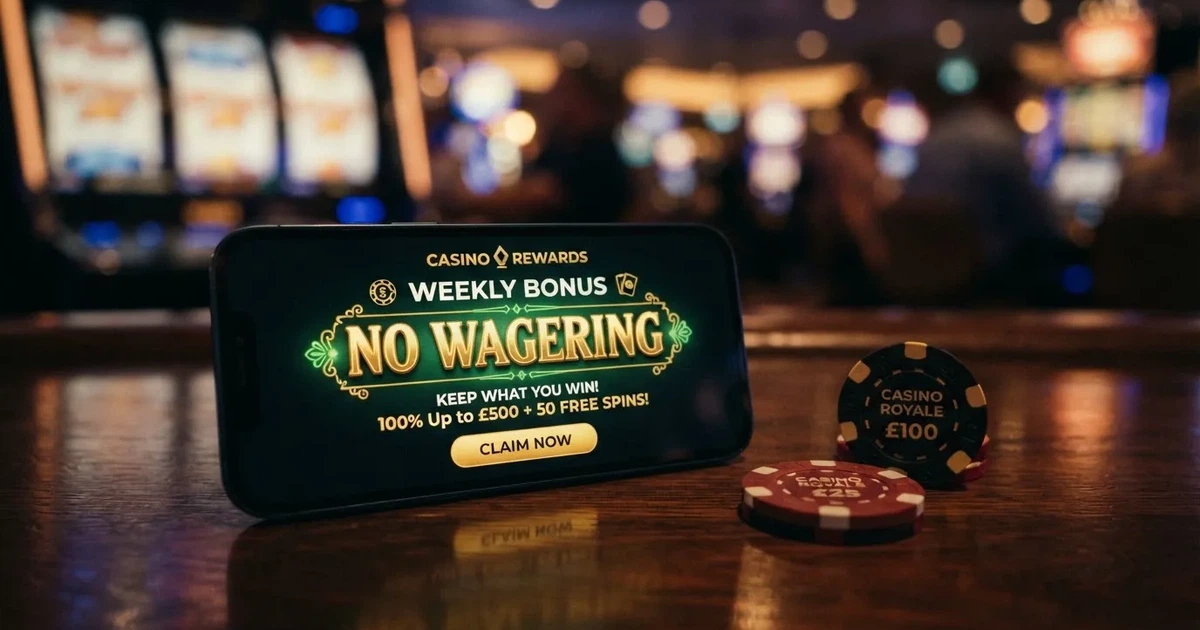
This page walks through what no-wagering sign-up offers actually deliver on a UK-licensed casino, what the Gambling Commission requires of an operator running one, and which of ten licensed brands are worth comparing side by side. The aim is not to crown a winner but to give a reader the means to choose: which operator holds which licence, which domain the public register lists as active or white-label, and which terms make one offer gentler than another.
The comparison was assembled against the Gambling Commission’s public register on 11 November 2026, with licence account numbers and remote casino licence references verified against that register.
Table of Contents
- Responsible Gambling Around a No-Wagering Offer
- Payments and How Fast a Withdrawal Lands
- How a No-Wagering Sign-Up Offer Is Structured
- What the 10x Cap Means in Practice
- The Licensed Brands Worth Comparing Side by Side
- How the Wider UK Online Casino Landscape Looks
- What Holding a UK Remote Casino Licence Obliges
- Grosvenor Casinos
- Betfred
- 32Red
- BetVictor
- William Hill
- Virgin Games
- Ladbrokes
- Paddy Power
- Betfair
- Jackpotjoy
- What the Comparison Settles and What It Leaves Open
- Reading a Licence Number on a Casino Footer
- Reading the New Bonus Regime
- Where a Reader Should Start
- Offshore Sites and the No-Licence Trade-Off
- Tax, Wins, and What the Player Keeps
- Closing the Comparison
- Frequently Asked Questions
Responsible Gambling Around a No-Wagering Offer
A no-wagering offer removes one friction between a player and a withdrawal. It does not remove the rules the Gambling Commission places around every licensed account, and those rules matter more the moment the offer ends.

Every UK-licensed casino must enrol a player in GAMSTOP, the national self-exclusion scheme, as a condition of holding an operating licence. Self-exclusion runs for six months, one year or five years and cannot be cancelled early; a player who has registered with GAMSTOP cannot open an account at any GB-licensed site for the chosen period. The scheme is mandatory and has been so since 31 March 2020. A sign-up offer does not sit outside it; if a player is mid-exclusion, the offer is simply unavailable.
Before the first deposit — and before any gameplay — the operator must verify the customer’s name, address and date of birth. This has been a Commission requirement since 7 May 2019. The point is to confirm the minimum age of 18 and to check the customer against GAMSTOP; it is not optional and it is not something a licensed site can skip because the offer is small.
Two financial protections sit closer to the offer itself. A player cannot fund a UK gambling account with a credit card; the ban has covered all online and offline gambling since 14 April 2020, including cards routed through an e-wallet. Debit cards and bank transfers remain the standard routes, alongside e-wallets where the underlying funding is not a credit card. Separately, since 31 October 2025 the operator must prompt the customer to set a deposit limit before the first deposit — not a state-set ceiling, but a customer-set one the operator has to surface before play begins.
A lighter rule, often overlooked, runs at the game level rather than the account level. Online slots carry a maximum stake per game cycle — £5 for players aged 25 and over since 9 April 2025, and £2 for players aged 18 to 24 since 21 May 2025. Auto-play has been banned since 31 October 2021, and a single spin may not resolve in under 2.5 seconds. These are not conditions on the bonus but on the play the bonus pays for; a no-wagering offer cannot lift them.
The protections layer in this order: GAMSTOP first, age and ID verification second, deposit limits third, stake and spin rules during play. A reader who knows the order knows where to push back if a site invites them to skip a step.
Payments and How Fast a Withdrawal Lands
A no-wagering offer shortens the path between a win and a payout, but the path still runs through the payment method the player used to deposit. The method determines both how fast money moves and what kind of friction the operator adds on the way out.

Bank transfers within the UK typically move through the Faster Payments Service, run by Pay UK since 2008. Most transfers arrive instantly or within a couple of minutes; the scheme’s published ceiling is two hours. Individual banks can and do set lower per-transaction limits, and the Faster Payments scheme itself caps a single payment at £1,000,000 — a ceiling no casino withdrawal comes close to, but a useful reminder that the rail is built for everyday UK transactions rather than for gambling specifically. The Bank of England does not sit inside Faster Payments as a participant; it oversees the system’s safety and provides final settlement.
Debit cards — Visa Debit, Mastercard Debit — are the other standard route. Deposits clear instantly; withdrawals go back to the same card and tend to take one to three working days once the operator has approved the transaction, depending on the issuer. A withdrawal cannot be paid back to a credit card; the 2020 ban covers funding, and operators do not pay out to a credit card even where one was used at deposit via a workaround.
Apple Pay is a separate option where the operator supports it, and it is worth understanding on its own terms. Developed and operated by Apple Inc., Apple Pay launched on 20 October 2014 in the United States and began supporting UK-issued payment cards on 14 July 2015. It works through tokenisation — the real card number is replaced by a device-specific tokenised Device Primary Account Number, with a dynamic security code generated per transaction. In a casino context, that means a deposit routes through the player’s bank via Apple Pay without the casino ever holding the underlying card number; for withdrawals the situation is less uniform, and not every operator pays out to Apple Pay. The 2024 US Consumer Financial Protection Bureau rule on large nonbank digital wallet operators, and the European Commission’s 2020 investigation into Apple NFC access, both concern Apple Pay’s broader market position rather than how it moves money at a UK casino.
AstroPay, an electronic money institution founded in 2009 and headquartered in Uruguay, is the kind of e-wallet that crops up at offshore-facing brands rather than at GB-licensed ones. Its UK entity, Larstal Limited, is authorised by the Financial Conduct Authority under the Electronic Money Regulations 2011. Where a no-wagering offer sits at a UK-licensed site, AstroPay is more often a deposit method than a withdrawal one; the operator’s own terms decide.
Two practical points follow from the rail a player chooses. First, a no-wagering offer does not change the operator’s standard withdrawal queue — what changes is that winnings are withdrawable from the first pound, not after a turnover multiple. Second, where the operator runs its own internal approval step on withdrawals, the time that step takes can dwarf the time the payment rail itself takes; a player choosing between two equally licensed sites may find that one approves payouts in hours and the other in days.
How a No-Wagering Sign-Up Offer Is Structured
A no-wagering offer is not a wagered offer with the wagering turned off. The marketing looks similar — deposit, receive bonus, play — but the mechanics underneath are built differently, and the cap that came in on 19 December 2025 sits on the mechanics rather than on the headline.
The headline rule of the new regime is a 10x cap on wagering requirements. Whatever an operator used to demand in turnover of the bonus, the maximum now is ten times the bonus amount. Mixed-product bonuses — “bet £10 on sport, get 50 casino spins” — were banned in the same package. A no-wagering offer sits below the cap: turnover is zero, or the bonus is structured as cash that can be withdrawn outright. Where a small wagering multiple survives — five times, two times — the offer is still no-wagering in spirit if the multiple is trivial, but it is not literally zero.
Three shapes recur. The first is bonus cash credited to the account with no playthrough at all: the player deposits, the bonus arrives, anything won from it is withdrawable from £1. The second is free spins whose winnings are paid as cash rather than as bonus credit; the spin stake is set by the operator and the win amount per spin is whatever the slot pays, again withdrawable from the first pound. The third is a hybrid — a small wagered deposit bonus, say 50% up to £50 at five times bonus — paired with a stack of no-wagering spins on top, which is the closest an offer usually gets to combining the two flavours.
What the offer does not cover is at least as important as what it does. Game weighting — the way some games contribute less than 100% to any turnover requirement — is largely irrelevant where turnover is zero, but the operator can still cap which slots the free spins land on, cap the maximum win from a spin offer, and cap the time window in which the bonus or spins must be used. A £10 no-wagering bonus that expires in 48 hours and is restricted to one slot is a different offer from a £10 no-wagering bonus that runs for a month across the full lobby. The headline number is the same; the experience is not.
The wagering cap has reshaped the market in two directions. At the lower end, smaller no-wagering offers have become more common because an operator that does not want to give a large bonus has a freer hand to attach nothing. At the higher end, large welcome packages have shrunk: a bonus that used to demand 35x turnover cannot now ask for 35x, and the maximum bonus that makes economic sense under a 10x cap is smaller than the maximum that made sense under the old regime. These calculations help clarify the real-world value of different offer types, and we examine the breakdown below.
What the 10x Cap Means in Practice
The 10x cap is not a flat rule. It sets a ceiling; an operator can choose any multiple up to that ceiling, including zero. A reader looking at two offers — one with 10x turnover and one with no turnover at all — is looking at offers from two different ends of the band the cap opened up. The arithmetic makes the gap visible.
Take a £50 bonus at 10x turnover. The required play is £500 — fifty pounds of bonus turned over ten times. At a typical slot stake of £1 per spin, that is 500 spins. A slot spin cannot resolve faster than 2.5 seconds under the Commission’s rules, so the minimum time to clear the bonus is 1,250 seconds, or roughly 21 minutes of pure spin time — assuming every spin lands, which is not what slots do. The expected loss on £500 of turnover at a slot returning 96% in the long run is £20 — five hundred pounds multiplied by the four-per-cent house edge.
A £25 no-wagering bonus produces a different shape. There is no required turnover, so the figure the player has to “clear” does not exist. The expected loss is whatever the player chooses to put through the slots in pursuit of any win, not a fixed figure the bonus imposes. A player who takes the £25, plays ten spins at £1, and walks away has put £25 through the slots and lost an expected £1 — the four-per-cent edge on £25. A player who treats the bonus as a ticket to a longer session has put more through and lost more, but the choice is theirs, not the bonus’s.
The band between these two is where most offers now sit. A £50 bonus at five times turnover requires £250 of play; a £50 bonus at zero times requires nothing. Both are legal under the new rules. The honest difference is that one offer asks the player to commit to £250 of slot turnover before a withdrawal, and the other asks the player only to play what they want to play. That is the trade-off the cap turned into a choice.
A reader should treat the band as a band, not a point. Two offers with the same headline can sit at different points within it, and the difference between 5x and 10x at the same bonus amount is the difference between £250 of required play and £500 of it. Where research does not pin down the exact multiple, the page gives the band and its condition rather than a single figure that may not hold for the offer the reader eventually sees.
The Licensed Brands Worth Comparing Side by Side
Ten brands sit on this page, all drawn from the Gambling Commission’s public register and all holding an active remote casino operating licence. The list is not a ranking and not a recommendation. It is the set a reader comparing licensed no-wagering offers in the UK will most often meet, and it gives the comparison its shape.
| Brand | Licence holder and GB remote casino licence | Domain status | Subject support |
|---|---|---|---|
| Grosvenor Casinos | Rank Interactive (Gibraltar) Limited · 057924-R-334666-005 | Active | No-data |
| Betfred | Petfre (Gibraltar) Limited · 039544-R-319290-010 | Active | No-data |
| 32Red | Platinum Gaming Limited · 045322-R-324275-019 | Active | No-data |
| BetVictor | BV Gaming Limited · 039576-R-319370-028 | Active | No-data |
| William Hill | WHG (International) Limited · 039225-R-319373-015 | Active | No-data |
| Virgin Games | Gamesys Operations Limited · 038905-R-319430-022 | White-label | No-data |
| Ladbrokes | LC International Limited · 054743-R-330863-014 | Active | No-data |
| Paddy Power | PPB Games Limited · 039411-R-319335-010 | Active | No-data |
| Betfair | PPB Games Limited · 039411-R-319335-010 | Active | No-data |
| Jackpotjoy | Gamesys Operations Limited · 038905-R-319430-022 | Active | No-data |
Three things the table carries, and one it deliberately does not. It carries the licence holder, the licence number, and the domain status — the three facts a reader needs to confirm that the brand is licensed at all. It does not carry a bonus figure or a wagering multiple: research does not give those for any of the ten brands, and a column with em dashes down it carries no information.
Two pairs of brands sit under one licence, and the table makes that visible. Paddy Power and Betfair share PPB Games Limited and the same remote casino licence 039411-R-319335-010; Jackpotjoy and Virgin Games share Gamesys Operations Limited and the same licence 038905-R-319430-022. A reader comparing “different brands” should know they are comparing different front doors to the same licence account. Virgin Games is a white-label domain — it trades under another company’s licence rather than running its own — while Jackpotjoy sits as an active domain of the same Gamesys account. The status affects who is named on the licence; it does not change the licence’s force.
The remaining six brands each run their own account. Grosvenor Casinos sits under Rank Interactive (Gibraltar) Limited; Betfred under Petfre (Gibraltar) Limited; 32Red under Platinum Gaming Limited; BetVictor under BV Gaming Limited; William Hill under WHG (International) Limited; Ladbrokes under LC International Limited. The “Gibraltar” in two of the holder names does not change the picture — under the Gambling (Licensing and Advertising) Act 2014, any operator taking customers in Great Britain needs a Commission licence wherever it is based, and a Gibraltar-registered holder with a GB remote licence is fully licensed for the UK market.
How the Wider UK Online Casino Landscape Looks
A no-wagering sign-up offer is one product inside a market the Gambling Commission supervises. The shape of that market frames the offer.
On 18 September 2026 the Commission’s public register listed 139 businesses holding an active remote casino operating licence. That figure counts licence holders, not the number of brands those holders run; several of the ten brands above sit on accounts whose holders run more sites than just the one featured here. The register is searchable online and downloadable as CSV or Excel, so the count is verifiable rather than estimated. The Commission maintains the register as the test of whether a brand is licensed at all; an offer on a brand not on the register is an offer on an unlicensed site, whatever the homepage says.
The same register carried 1,065 active and 361 white-label domain entries on the same date. The domain list is a record of websites rather than businesses: a single licence account can carry several active domains, and a white-label site is one that trades under another company’s licence rather than holding its own. The 361 white-label figure is the count of those trading-on-licence sites, and it gives a sense of how much of the visible UK market is not, on its own licence, an independent operator.
A licence number on the register has a fixed shape — six digits, then “R”, then a number, then a suffix. The leading six digits repeat the licence holder’s account number, and the “R” marks a remote (online) licence. So 057924-R-334666-005 is the remote casino operating licence of account 57924, Rank Interactive (Gibraltar) Limited; 039411-R-319335-010 is the remote casino operating licence of account 39411, PPB Games Limited. A reader who knows the shape can read a licence number on a casino’s footer and confirm it against the register in seconds. A reader who does not know the shape has to take the operator’s word for it.
The market the register records is not the entire UK-facing casino market. The Commission disrupts illegal sites — cease-and-desist notices, search-engine delisting, payment and hosting referrals — but does not have ISP-blocking power, and a site running without a licence but reaching UK customers is an offence under section 33 of the Gambling Act 2005 rather than an impossibility. A no-wagering offer on a site not on the register is a different object from a no-wagering offer on a site that is, and the absence of register entry is the only fact a reader needs to settle that.
What Holding a UK Remote Casino Licence Obliges
A remote casino operating licence from the Gambling Commission is not a marketing badge. It is a set of obligations, several of which touch the offer itself.
The licence comes from the Commission under the Gambling Act 2005, sponsored by DCMS. The Act covers Great Britain — England, Scotland and Wales — not Northern Ireland. Since the Gambling (Licensing and Advertising) Act 2014, any operator taking customers in Great Britain needs a Commission licence wherever it is based. A Curaçao, Maltese or Gibraltar licence on its own is not a substitute; what matters is the GB remote licence, because the player protection the offer sits inside is built on it.
The LCCP — the Licence Conditions and Codes of Practice — sets out the social responsibility code that governs how operators treat customers. The conditions relevant to a sign-up offer sit in three clusters: identity and age verification (the May 2019 rules on name, address and date of birth), self-exclusion (the GAMSTOP requirement that has been mandatory for online operators since 31 March 2020), and financial harm prevention (the deposit-limit prompt that has been mandatory since 31 October 2025). A no-wagering offer does not exempt an operator from any of these; it sits on top of them.
The Remote Technical Standards cover the technical side — the way games are built, the way randomness is certified, the way player funds are held. The relevant standard for a no-wagering offer is the segregation of player funds: a UK-licensed operator must hold customer balances in a way that protects them if the operator becomes insolvent, and the level of protection is disclosed in the terms. A no-wagering offer does not change the segregation, but a withdrawal that arrives cleanly depends on it.
A reader looking at a no-wagering offer on a licensed site should know what the licence has already done for them before the offer is even considered. The verification has happened, the GAMSTOP check has happened, the deposit limit has been set. The offer is the last layer, not the first.
Grosvenor Casinos
Grosvenor Casinos is the online face of a brand most players meet first on the high street. The online operation is licensed under account 57924, Rank Interactive (Gibraltar) Limited, holding remote casino operating licence 057924-R-334666-005. The domain Grosvenor Casinos is listed on the public register as an active site. Grosvenor’s appeal for a no-wagering offer sits in its land-based presence: a player who already has a relationship with the brand through a physical casino is meeting an online version of the same operator, with the same licence behind it.
The figure the page has not been given is the offer itself — research carries no bonus terms for Grosvenor on the no-wagering question, so the comparison above this brand stops at the licence. A reader interested in the current offer will find it on the operator’s own promotions page, and the licence number gives a way to confirm the operator before signing up.
A no-wagering offer at Grosvenor would carry the usual shape: deposit, receive, withdraw what is won. The reader-side trade-off is between an operator whose name a UK player is more likely to recognise and an offer whose exact terms require the same careful reading as at any other licensed site. For a player who values the high-street familiarity, the trade is reasonable; for a player who only cares about the headline number, the same offer may sit at another brand at a similar point.
Betfred
Betfred is one of the larger UK-facing bookmaker-and-casino brands, and the casino side is licensed under account 39544, Petfre (Gibraltar) Limited, holding remote casino operating licence 039544-R-319290-010. The domain Betfred is listed on the public register as active. Like several brands in this list, Betfred is a household name outside gambling — its presence on the high street and on the football shirt sponsorship list precedes any sign-up offer.
The licence and the brand recognition are what the page carries for Betfred; the no-wagering offer itself sits in the operator’s own terms, and research does not pin it to a figure. A reader signing up for a no-wagering offer at Betfred is signing up under the Petfre (Gibraltar) Limited licence, and the same Commission obligations apply — verification, GAMSTOP, deposit-limit prompt — as at any other licensed site.
The case for Betfred on a no-wagering offer is the same as the case for any of the larger bookmaker-casinos: an operator that runs a tight compliance operation and has more to lose from a Commission finding than a smaller brand. The case against is the same one that applies to any household name: the headline tends to be the best-marketed number on the page, and the offer behind it is no gentler than the new cap allows.
32Red
32Red sits in a slightly different position from the bookmaker-casinos above. Its online casino is the primary product rather than a side-line of a sportsbook, and the licence is held by Platinum Gaming Limited under account 45322, with remote casino operating licence 045322-R-324275-019. The site is listed as an active domain on the public register.
A casino-first brand has more freedom on the casino side of a welcome offer than a sportsbook-casino does, because there is no competing product pulling for promotional budget. A no-wagering offer at a casino-first brand can be the headline of the welcome package without a sports side-conditional attached — and the December 2025 ban on mixed-product bonuses means the offer cannot come paired with a sports bet condition in any case. The shape of the welcome package is therefore the operator’s own call.
What 32Red’s no-wagering offer looks like in current numbers is not in the research; the page cannot put a figure there. What it can say is that the licence is in place, the domain is active, and the brand is licensed as a casino-first operator — three facts that put it on the same footing as the rest of the table for the purposes of comparison.
BetVictor
BetVictor is another bookmaker-casino where the casino is a long-established product rather than an add-on. The licence is held by BV Gaming Limited under account 39576, with remote casino operating licence 039576-R-319370-028. This domain is listed on the public register as active.
For a no-wagering offer, the same points apply as for Betfred and William Hill: the licence is current, the operator has the resources to run a properly licensed operation, and the welcome offer sits under the 10x cap or below it. The brand recognition is high among UK sports bettors and lower among purely-casino players; a reader choosing between BetVictor and a casino-first brand is choosing between two different customer profiles, not between two different licence tiers.
The trade-off sits in the operator’s own terms: how long the offer runs, which games the spins (if any) land on, and what the maximum win from a spin offer is. None of those is in research, so the page stops at the licence and the brand shape. A reader who values a casino attached to a familiar sportsbook will find BetVictor’s licence in good order; a reader who values a casino-only operator will look elsewhere in the table.
William Hill
William Hill is the longest-established name on the list, and the casino side carries the same weight as the sportsbook in the public’s mind. The licence is held by WHG (International) Limited under account 39225, with remote casino operating licence 039225-R-319373-015. The register records this as an active domain.
For a no-wagering offer, William Hill’s standing on the Commission register is straightforward: the licence is active, the domain is active, the holder has been on the register for long enough that the licence’s history is a matter of public record. The brand’s longer history on the UK high street is not a guarantee of a better offer, but it is a reason a reader may be more comfortable signing up to a familiar name than to a smaller one.
The honest limit on the comparison is the same as for the other bookmaker-casinos: research does not give a current no-wagering offer for William Hill, and the page cannot put a figure where research carries none. The comparison ends at the licence. The reader’s job is to check the operator’s own current offer before signing up.
Virgin Games
Virgin Games sits in a different part of the table because its domain status on the register is white-label rather than active. The licence behind it is held by Gamesys Operations Limited under account 38905, with remote casino operating licence 038905-R-319430-022 — the same licence that covers Jackpotjoy, the tenth brand on the list. The domain Virgin Games is listed on the register as a white-label domain, meaning it trades under Gamesys’s licence rather than running its own.
A white-label arrangement does not weaken the licence; the operator behind the brand is the same operator, and the Commission obligations apply in full. What it changes is the structure of the company: a player at Virgin Games is dealing with Gamesys Operations Limited for compliance purposes, not with a separate Virgin entity. Where a no-wagering offer is concerned, that distinction usually makes no difference to the player’s experience, and the offer sits under the same 10x cap as at any other licensed site.
The Virgin brand carries recognition outside gambling — a reader may arrive at Virgin Games through a familiar name and stay for the offer, or arrive through the offer and recognise the name on the way in. Either way, the licence is in place, the domain is registered, and the comparison stops where the table stops.
Ladbrokes
Ladbrokes is one of the two big high-street bookmaker-casinos alongside William Hill. The licence is held by LC International Limited under account 54743, with remote casino operating licence 054743-R-330863-014. The register lists this domain as active. The same LC International Limited licence also covers Coral and Gala Bingo, which do not appear in this list but are part of the same licence account; a reader who has met any of these names has met the same operator.
The Ladbrokes licence is one of the longer-running GB remote licences on the register, and the holder has the compliance infrastructure that comes with that history. For a no-wagering offer, the brand offers the same proposition as the other big bookmaker-casinos: a licensed operation under the 10x cap, with the usual protections in place. The trade-off is the same — a familiar name with an offer whose exact terms require the reader’s own reading.
What Ladbrokes adds over a smaller brand is operational scale; what it does not add is a friendlier offer by default. A no-wagering offer at Ladbrokes is no-wagering because the operator has chosen to set the multiple at zero, not because the brand carries a structural advantage. The reader’s comparison should run on the offer’s terms, not on the brand’s name.
Paddy Power
Paddy Power and Betfair sit together on the same licence account, and the comparison between them is therefore a comparison between two brands under one operator rather than between two independent operators. The licence is held by PPB Games Limited under account 39411, with remote casino operating licence 039411-R-319335-010. Paddy Power is listed on the public register as an active domain.
For a no-wagering offer, the relevant fact is that the operator behind Paddy Power and the operator behind Betfair is the same company. The two brands can run different welcome offers — operators commonly run separate brand-front promotions — but the licence, the compliance operation, the GAMSTOP integration and the deposit-limit prompt are all the same underneath. A reader who has signed up to one has effectively signed up under the other’s licence, and the Commission’s protections apply identically.
Paddy Power’s brand sits in the Irish-UK bookmaker tradition; the recognisability is high among sports bettors and the casino side runs alongside. A no-wagering offer at Paddy Power is a no-wagering offer under PPB Games Limited’s licence, with no extra protection and no extra risk relative to Betfair.
Betfair
Betfair is the second of the PPB Games Limited brands and shares the same licence 039411-R-319335-010 with Paddy Power. This domain appears on the register as active. The exchange heritage of Betfair sets its customer profile apart from a conventional bookmaker — a reader arriving at Betfair from a sports-trading background meets a different lobby than a reader arriving from a slots-first direction — but the casino product itself sits under the same operator.
The no-wagering offer question runs the same way as for Paddy Power. The offer is the brand’s own call, the licence is PPB Games Limited, and the Commission obligations apply identically. Where a reader has found a no-wagering offer they like at one of the two PPB brands, the other brand is worth a glance — the same operator may run a different headline at the second front door.
The two-brand structure is itself the point. A reader who knows that PPB Games Limited runs both has the information to ask whether one brand’s offer is genuinely different from the other’s or whether the two are bookends of the same promotion. The licence number on the register settles the underlying identity; the brands’ own terms settle the offer.
Jackpotjoy
Jackpotjoy closes the list and shares its licence with Virgin Games: both sit under Gamesys Operations Limited, account 38905, with remote casino operating licence 038905-R-319430-022. The register lists this as an active domain — the only difference from Virgin Games’s status, which is white-label.
Jackpotjoy’s customer base is slots-first, and a no-wagering offer at the brand can be expected to be slots-shaped: free spins whose winnings are paid as cash, or a small bonus credited with no turnover. The licence does not change that — the operator’s product choice is independent of the Commission’s requirements. What the licence does is confirm that the offer, whatever its shape, sits inside the standard GB protections.
A reader comparing Jackpotjoy with a bookmaker-casino is comparing a casino-first brand with a sportsbook-first one, both under the Commission’s 10x cap and both subject to GAMSTOP, deposit-limit prompts and ID verification. The difference is product shape, not regulatory standing.
What the Comparison Settles and What It Leaves Open
The comparison above settles one question and leaves another open. It settles that all ten brands hold a current GB remote casino operating licence, that the domains are listed on the public register, and that each brand falls under one of five licence accounts (Rank Interactive, Petfre, Platinum Gaming, BV Gaming, WHG International, Gamesys Operations, LC International, PPB Games). A reader can take the licence numbers to the register and confirm the brand themselves; nothing on this page relies on the operator’s own footer.
It leaves open what each brand’s current no-wagering offer looks like, what the maximum win is on a free-spins offer, what the time limit is on the bonus, and which slots the spins land on. Research carries none of these figures for any of the ten brands, and the page does not invent them. A reader choosing between brands on the no-wagering question alone has the licence information; the offer information sits on the operator’s own promotions page, current as of the date the reader visits it.
The angle the comparison takes is one of paths, not one of winners. Two readers comparing the same ten brands will not arrive at the same pick — a casino-first reader looking at 32Red or Jackpotjoy will see something different from a sportsbook-first reader looking at Betfred or Paddy Power — and the comparison gives each reader the licence and the brand shape to make their own call.
Reading a Licence Number on a Casino Footer
A reader who knows the shape of a UK remote casino licence can read it on a casino’s footer in seconds, then take it to the Commission’s public register and confirm it. The shape is fixed: six digits, then “R”, then a number, then a suffix — for example, 039411-R-319335-010.
The leading six digits repeat the licence holder’s account number. So 039411 at the start means the holder is account 39411; the “R” marks a remote (online) licence; 319335 is the licence sequence number; 010 is the suffix that distinguishes this licence from any others on the same account. A footer that prints “Licence No. 039411-R-319335-010” is pointing at PPB Games Limited’s remote casino operating licence; a footer that prints “Licence No. 057924-R-334666-005” is pointing at Rank Interactive (Gibraltar) Limited’s.
Confirmation runs through the Commission’s public register. The register is searchable online and downloadable as CSV or Excel, and the domain list records each website against the licence account that runs it. A reader who finds a domain on the register that does not match the one in the footer — or a domain that is missing — has the information to ask why. The register does not lie about who is licensed; an operator that prints a valid licence but operates a different domain is worth a closer look.
Reading the New Bonus Regime
The 10x cap and the mixed-product ban that came in on 19 December 2025 changed what a UK welcome offer can look like. A reader looking at a current offer should know what the new rules allow.
A wagering requirement cannot exceed ten times the bonus amount. That is the ceiling, not the floor; an offer with five times turnover is legal, and an offer with zero times turnover is also legal. A mixed-product bonus — bet on sport, get casino spins; deposit on casino, get sports free bets — is banned. A reader who sees one of these structures on a UK-licensed site is looking at an offer that predates the new rules or at an offer that has been structured around them; the structure itself tells the reader something about when the offer was written.
The cap interacts with the no-wagering shape in a specific way. An operator that wants to give a £200 bonus has to consider what 10x of £200 looks like — £2,000 of required turnover — and decide whether that is the offer it wants to run. The result is that large bonuses with high turnover have shrunk and small bonuses with no turnover have grown. The market has rebalanced around the cap rather than disappeared into it.
The third thing to read is the small print. A no-wagering offer can still carry a maximum win cap, a time limit, a game restriction and a minimum deposit. The headline number is the same whether those are present or not; the experience is not. The 10x cap did not remove those conditions, and a careful reading of the terms remains the difference between a bonus the player can use and one the player cannot.
Where a Reader Should Start
A reader with ten minutes and a choice to make should start at the register, not at the promotions page. Confirm the licence holder, confirm the licence number, confirm the domain is on the register. Five minutes on the public register settles whether the brand is licensed at all; the offer’s terms settle everything else, and the offer’s terms change.
A reader with more time should compare two or three brands rather than all ten. The licence information above gives enough to narrow the comparison: a casino-first reader looking at 32Red, Jackpotjoy or Virgin Games; a sportsbook-first reader looking at Betfred, William Hill or Paddy Power; a brand-loyal reader looking at the licence holder they already know. Each of those cuts the comparison down to a manageable shape.
A reader who has found a no-wagering offer they like should still read the terms. The offer’s headline is the marketing layer; the offer’s mechanics sit one click further down. A maximum win cap of £50 on a free-spins offer is a different offer from one with no cap. A 48-hour expiry is a different offer from a 30-day one. The licence confirms the operator; the terms confirm the offer.
The path through the page is: confirm the licence, compare the brand shape, read the terms on the operator’s own page, and decide. The page’s job is to give the first two; the operator’s own page gives the third; the reader’s own choice gives the fourth. That division of work is the reason no single page can answer the no-wagering question on its own.
Offshore Sites and the No-Licence Trade-Off
A UK-facing casino without a GB remote licence is not licensed for the UK market, whatever its homepage says. The offer may look the same; the protection does not.
Providing gambling to people in Great Britain without a Commission licence is an offence under section 33 of the Gambling Act 2005. The Commission disrupts illegal sites — cease-and-desist notices, search-engine delisting, payment and hosting referrals — but does not have ISP-blocking power, so an unlicensed site can be reachable from a UK address. The penalty is on the operator; the player is not prosecuted for playing on one. What the player loses is the layer of protection that sits underneath the offer.
GAMSTOP does not apply. A player self-excluded through GAMSTOP can still open an account at an unlicensed site, because the site has no obligation to check. The Commission’s complaints route does not apply. The approved ADR — alternative dispute resolution — does not apply. If a withdrawal stalls or a bonus term is disputed, the player has no UK-regulated body to take the complaint to. A no-wagering offer on an unlicensed site is therefore not the same object as a no-wagering offer on a licensed one: the headline is the same, the protection underneath is not.
The register is the test. A domain not on the Commission’s register is unlicensed for the UK market; an offer on that domain is an offer without the standard protections. A reader who chooses an offshore site is choosing to opt out of GAMSTOP, of the deposit-limit prompt, of the verified-age check at the Commission’s standard, and of the complaints route. That is a real choice with real consequences, and the page puts it on the table rather than burying it.
Tax, Wins, and What the Player Keeps
Players in the UK pay no tax on gambling winnings. Whatever the no-wagering offer delivers in cash is what the player keeps, gross. Operators pay Remote Gaming Duty, which the Chancellor raised from 21% to 40% from 1 April 2026 — a change to the operator’s tax bill, not the player’s, and one the model in research names as a context rather than a settled fact a reader can rely on without checking HMRC.
A no-wagering offer makes the no-tax-on-winnings point more rather than less relevant. Where a wagered offer holds winnings as bonus credit until turnover is cleared, a no-wagering offer pays winnings as withdrawable cash from the first spin. The cash is the player’s, the tax position is unchanged, and the offer does not interact with the player’s tax affairs at all.
A reader who wins a large amount on a no-wagering offer and is unsure about the tax position can check with HMRC or take professional advice; the page’s job is to confirm the baseline rather than to give tax guidance. The baseline is: no UK tax on gambling winnings for the player, regardless of size.
Closing the Comparison
The comparison across the ten brands ends where it began: with the register and the licence. A no-wagering offer is one product on a market the Gambling Commission supervises, and the supervision is the part that does not change when an offer expires. The 10x cap has narrowed what wagered offers can ask for; the no-wagering shape has filled some of the space; the Commission’s other rules — verification, GAMSTOP, deposit-limit prompts, stake and spin limits — sit on top of the offer regardless of its shape.
A reader choosing between the ten brands has a different decision to make depending on what they care about. A casino-first reader meets 32Red and Jackpotjoy at the casino-shaped end; a sportsbook-first reader meets Betfred, William Hill and Paddy Power at the bookmaker end. A reader who values brand familiarity meets Ladbrokes and William Hill; a reader who values a single-operator licence meets Virgin Games and Betfair (both sharing PPB Games Limited) or Jackpotjoy and Virgin Games (both sharing Gamesys Operations Limited). Each reader’s pick is theirs; the comparison’s job is to give them the licence and the brand shape to make it.
The honest gap the comparison leaves is the offer itself. Research does not pin a current no-wagering bonus to any of the ten brands, and the page does not invent one. A reader signing up under any of these licences should read the operator’s current offer at the time of signing, because the offer is the part that changes and the licence is the part that does not.
Frequently Asked Questions
Key Regulatory Limits
| Rule | Requirement |
|---|---|
| Age limit | Minimum 18 years |
| Stake limit (18-24) | £2 per spin |
| Stake limit (25+) | £5 per spin |
| Deposit limit prompt | Required before first deposit |
A no-wagering offer credits the bonus or the spin winnings as cash that can be withdrawn from the first pound, rather than as bonus credit that must be turned over a set number of times before withdrawal. The 10x cap on wagering requirements that came in on 19 December 2025 sits above zero, so an offer with no turnover is legal; it is also less common than it used to be at smaller welcome packages. The licence underneath is unaffected — the offer sits inside the Commission’s usual verification, GAMSTOP and deposit-limit rules.
Which UK casino has the fastest sign-up process for claiming an offer?
The Commission requires name, address and date-of-birth verification before the first deposit and any play, and that step cannot be skipped at a licensed site. Beyond that, the operator’s own form determines the time to a claimed offer. A reader who has met ID requirements elsewhere on the operator’s network — for example, by signing up to a sister brand under the same licence — may find the second sign-up faster, but no licensed site can offer a sign-up that bypasses the verification stage.
Are no-wagering sign-up offers usually smaller than offers with wagering attached?
Yes, generally. A no-wagering offer asks the operator to give up the upside of a turnover multiple, and the offer tends to be sized accordingly. The 10x cap has not changed that — it has raised the ceiling on wagering rather than lowered the size of no-wagering offers. A reader comparing the two shapes should expect the no-wagering offer to be smaller in headline, and should weigh that against the absence of any turnover requirement.
Can a no-deposit sign-up offer also carry no wagering requirement?
Yes. A no-deposit offer — bonus or spins credited without a deposit — can be structured with no wagering attached, and the combination is legal under the current rules. Where the offer is a no-deposit free spin, the winnings are typically paid as cash; where the offer is a no-deposit bonus, the bonus is typically withdrawable from £1. The size of these offers is generally the smallest in the welcome package because the operator is giving away value without a deposit in return.
What should a player check before assuming a sign-up offer has zero wagering?
The terms page. The headline number is the marketing layer; the wagering multiple sits underneath. A “no wagering” headline can sit alongside a maximum win cap, a time limit, a minimum deposit, or a game restriction — none of which the headline discloses. A player should also check the licence on the public register, because the offer’s protections depend on the operator being licensed at all. The terms confirm the offer; the register confirms the operator.
Do UK casino sign-up offers change from month to month?
Yes. Operators rotate welcome offers as their promotional calendar shifts, and a no-wagering offer available in one month may not be available in the next. A reader who has read the comparison on this page should re-check the operator’s current terms at the time of signing up, because the page’s job is to compare the licensed brands, not to hold the offer fixed. The licence does not change; the offer does.
