
Online casino tournaments UK 2026: what a slot leaderboard actually costs the player
Tournaments sit on top of ordinary slot play, which is why the rules of one are the rules of the other. The Gambling Commission licenses the operator, the £5 stake cap governs every spin, and the 10x wagering limit set on 19 December 2025 governs every bonus that funds the prize pot. A player who enters a tournament buys nothing — entry is usually free against a qualifying stake — and wins something only if their scoreboard finish clears the rules attached to the prize.
Current as of 11 November 2026 against the Gambling Commission’s public register of remote casino operating licences.
Table of Contents
- What a slot tournament actually is
- The UK rule frame around a tournament
- Responsible play around a competitive format
- Cryptocurrency, e-wallets and how the deposit lands
- How a tournament prize reaches the player
- Where the bonus actually sits inside the tournament
- Which slot titles and studios turn up most often
- The ten licensed operators who run these tournaments
- How to read the list above
- What a player actually does with all this
- The shape of the market behind the ten brands
- What to carry forward
- Frequently asked questions
What a slot tournament actually is
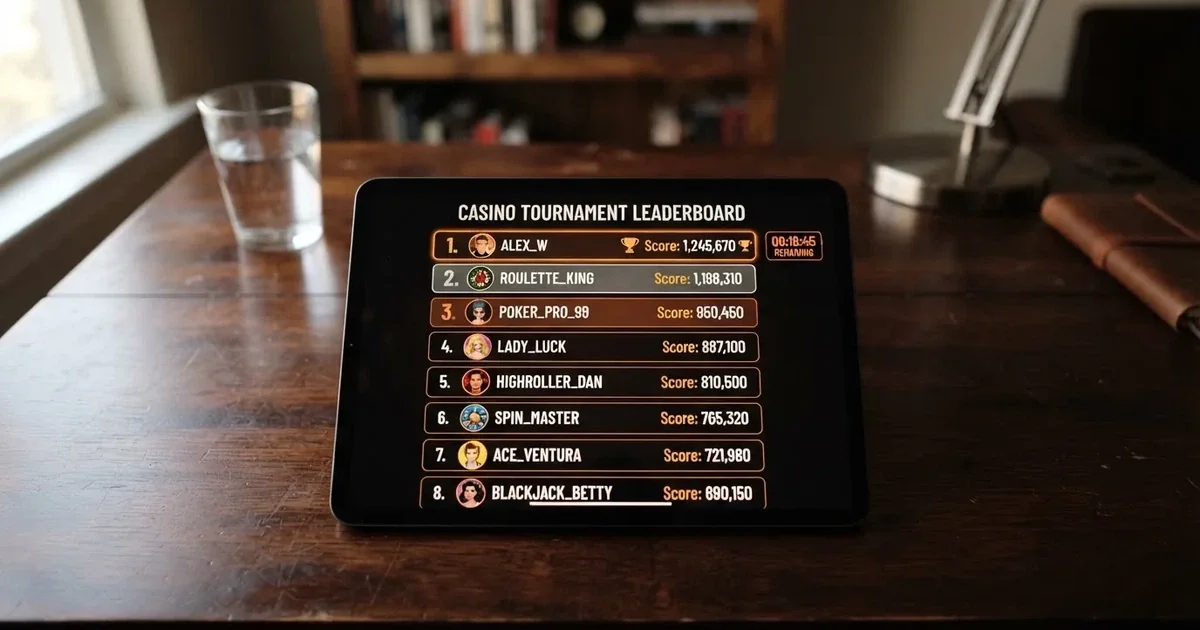
A slot tournament is a timed competition in which every entrant plays the same nominated game, and the highest scorers on the leaderboard share a prize pool that the operator has prefunded. The play itself is the slot the tournament names, on the stake the tournament sets, for the duration the tournament fixes — anything from a one-hour sprint to a week-long board. The marketing word is usually “free”, and the cost the page is about to measure is the wagering requirement the prize itself carries.
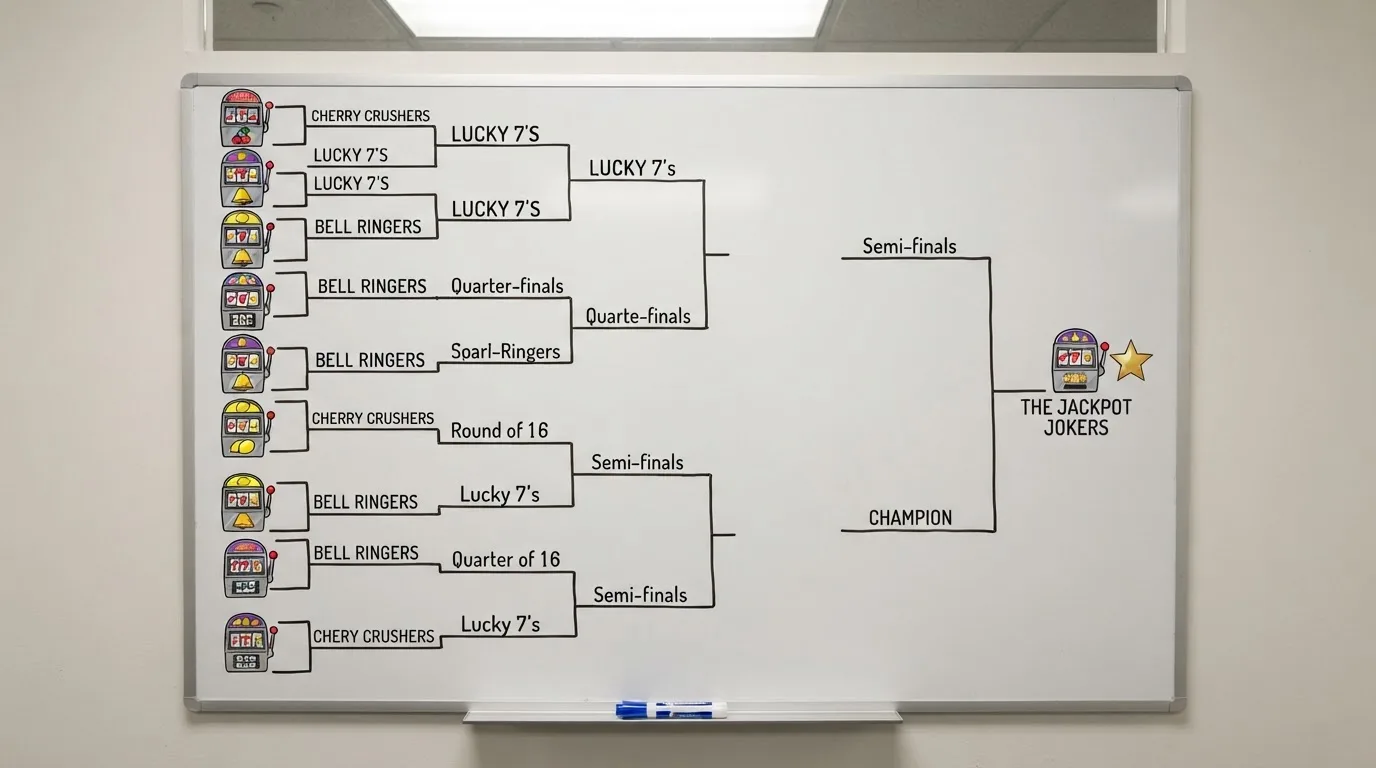
Three formats dominate the market. A buy-in tournament charges an entry fee that goes into the prize pool, alongside rebuys during the play window if the rules allow them. A freeroll costs nothing to enter but still asks for a real-money spin to qualify, which is how the operator gates out dormant accounts. A guaranteed tournament sets a minimum prize pot the operator pays out regardless of how many players turn up — a quiet promise, because the operator wears the short-fall risk if the field is thin.
Tournaments run differently from cash play in three ways the page keeps coming back to. The stake is fixed by the rules, not chosen by the player. The game is fixed by the rules, not browsed by the player. And the score is normally points, not money — calculated as a multiple of winnings, of the largest win on a single spin, or of consecutive wins. None of that changes the house edge the slot itself carries; the format changes how that edge is spread across entrants, and how much of it the operator recycles as a prize.
The point is worth saying plainly: a tournament does not pay a player for playing well. It pays a player for playing a lot. The leaderboard measures volume of play expressed as a score, which is why the typical advice is to keep the stake at the tournament’s maximum and let the spins run.
The UK rule frame around a tournament
The Commission is the regulator for every operator that takes British customers. Its public register is the test of whether a brand is licensed, and on 18 September 2026 it listed 139 businesses holding an active remote casino operating licence. That same register records each website against the licence account that runs it — 1065 active and 361 white-label domain entries on the same date — and the licence number has a fixed shape: account number-R-number-suffix, with the leading six digits repeating the account and the R marking the licence as remote. The number itself is not a marketing badge; it is what a player reads when they want to know who is on the hook for their money.

Betfred’s domain, listed on the Gambling Commission register, is under operating licence 039544-R-319290-010.
Two limits bind every tournament as surely as they bind every slot.
First, the per-spin stake cap. From 9 April 2025 the maximum stake on an online slot is £5 per game cycle for players aged 25 and over. From 21 May 2025 that ceiling falls to £2 for players aged 18 to 24. A tournament that nominates a slot as its game runs under the same cap, and a tournament’s own “max bet” instruction can only ever sit at or below it. The £2 figure is the one a young adult has to plan around, and the £5 figure is the ceiling every other tournament’s “play max” advice points at.
Second, the wagering requirement cap. Since 19 December 2025, wagering requirements on bonuses are capped at 10x and mixed-product bonuses (the “bet on sport, get casino spins” structure) are banned. Any tournament prize that arrives as bonus money — most of them do — carries a playthrough the operator has to publish in plain language, and that playthrough cannot exceed ten times the bonus value. A 10x cap is generous against an offshore market where 35x and 40x were the routine ask, and stingy against the 1x and 2x caps some of the more careful British brands run anyway.
The wider frame matters because a tournament is a slot. Auto-play is banned since 31 October 2021, every spin takes a minimum of 2.5 seconds, and the slot itself is forbidden from presenting a loss as a win. Credit cards have been banned for gambling since 14 April 2020, including credit cards routed through e-wallets — debit cards and bank transfers are unaffected. Identity verification is required before the first deposit and before any play, in place since 7 May 2019. None of this is optional, and a player on a site that asks for none of it is on a site the Commission has not licensed.
The Commission has no ISP-blocking power and no penalty aimed at the player; what a player loses on an unlicensed site is the protection — no GAMSTOP, no Commission complaints route, no approved ADR. The legal route is in the Gambling Act 2005, the licence obligation in the Gambling (Licensing and Advertising) Act 2014, and the operational rules in the LCCP and the Commission’s social responsibility code. Those three layers are why a tournament at a licensed British casino is, in practice, a slot under a different scoring rule, and why a tournament at an unlicensed site is a slot that pays out at the operator’s discretion.
Responsible play around a competitive format
A leaderboard is built to push pace. The clock is on, the next entrant is one click away, and the player who falls behind tends to chase. The Commission does not regulate a tournament’s social design as such, but it regulates the slot underneath: auto-play is banned, reality checks interrupt the session, and a player who has self-excluded through GAMSTOP is locked out of the licensed site running the tournament for six months, one year or five years. None of those exclusions can be cancelled early.
The financial-vulnerability check, in force from 28 February 2025, triggers at £150 of net deposits in a rolling 30 days and runs on public data only — the wider financial risk assessments have been announced but are not yet in force. The customer-facing limit prompt, in force from 31 October 2025, requires the operator to ask the player to set a deposit limit before the first deposit. None of this is a tournament rule; all of it is the framework a tournament runs inside, and the player who plans to enter several tournaments in a week has to plan their deposit ceiling around them.
The practical advice is the boring one: set a time limit before entering, decide in advance what to do if the leaderboard moves against you, and stop when either runs out. A tournament that pays out in bonus money and carries a 10x playthrough can extend a session long after the leaderboard closes — and a session that runs long is the kind the operator does not have to warn you about, because the wagering cap and the spin-time minimum were designed for it. GamCare’s National Gambling Helpline and GambleAware are the routes a player in trouble can use, and they are open whether the tournament ends well or not.
Cryptocurrency, e-wallets and how the deposit lands
Crypto deposits are not the route into a licensed British tournament. The Commission’s rules require identity verification before the first deposit and before any play, and the only way the operator meets that requirement is a verified payment instrument. Cryptocurrency, in its plain form, is pseudonymous — a wallet address is not a person — and the licensed operators that have started naming “crypto” in their marketing are naming e-wallets and tokenised card rails rather than on-chain coins.
A player who wants to use a digital wallet can. AstroPay, founded in 2009 and headquartered in Uruguay, runs a UK entity called Larstal Limited that the Financial Conduct Authority has authorised under the Electronic Money Regulations 2011; its Isle of Man entity sits under the Isle of Man Financial Services Authority. Apple Pay, launched on 20 October 2014, took UK-issued cards from 14 July 2015 and protects card data through tokenisation, replacing the real card number with a device-specific tokenised Device Primary Account Number and generating a dynamic security code per transaction. Both routes end at a debit card or a bank account on the player’s side, and both routes are accepted at the licensed British casino because both are debit-funded, not credit-funded.
The faster route, where it is offered, is the Faster Payments Service — launched in 2008 and run by Pay.UK, operating 24 hours a day, seven days a week, with most transfers arriving instantly or within a couple of minutes and a £1,000,000 per-transaction scheme limit, though individual banks routinely set lower ceilings. A bank transfer inside the UK moves through Faster Payments the same way a payroll payment does, and the licensed casino’s deposits page either names it or hides it behind a brand label that does the same job.
What a player cannot do is load a tournament from a credit card. The Commission’s April 2020 ban covers credit cards routed through e-wallets as well as direct credit card deposits, and the Commission’s own research before the ban found that around 800,000 UK consumers used credit cards to gamble in 2018, and that 22% of online gamblers who used credit cards to gamble were classed as problem gamblers. A tournament paid for on credit is not a tournament the Commission will license.
How a tournament prize reaches the player
Three timings matter, and they are not the same. Entry is immediate. Leaderboard settlement is at the end of the window — most operators clear it within hours, some take a day. Payout is the part that takes longest, because the prize is normally bonus money that has to be wagered before it can be withdrawn.
The wagering requirement is the gap between “you won £200” and “£200 is yours”. If the requirement is the 10x cap that has applied since 19 December 2025, a £200 bonus needs £2,000 of qualifying play before any of it becomes withdrawable cash. At the £5 stake cap that applies to over-25s, that is 400 spins; at the 2.5-second-per-spin minimum, that is 1,000 seconds, or roughly 17 minutes of slot time. A player who reads “10x” as a small number has not yet multiplied it by the bonus they are about to claim.
The arithmetic is worth doing for a band rather than a single figure, because both sides of it can move. A £50 bonus at the 10x cap needs £500 of wagering, or 100 spins at the £5 stake cap — about four minutes of slot time at the 2.5-second minimum. A £500 bonus at the same cap needs £5,000 of wagering, or 1,000 spins at £5 — about 42 minutes. The same band read at the £2 stake cap that applies to 18-to-24-year-olds needs 250 spins for the £50 bonus and 2,500 spins for the £500 one — roughly ten minutes and 104 minutes respectively at the 2.5-second minimum. The wagering cap has not changed; the spin count has, by a factor of two-and-a-half.
The following range illustrates the benefit: at the 10x cap, the same bonus takes roughly four minutes of slot time for an over-25 at £5 a spin and roughly ten minutes for an 18-to-24 at £2 a spin; at the same cap, a ten-times-larger bonus takes roughly forty minutes and roughly one hundred minutes respectively. The conditions are what make the band honest. The band is what a player can plan around.
The payout after the wagering is met goes through the same rails as the deposit. Faster Payments is the fastest in-country route and runs 24/7; card withdrawals take a working day or two; e-wallets sit in between. A player who funds the deposit via Faster Payments and clears the wagering inside a day can reasonably expect the prize the same week; a player who funds it via card and clears the wagering on a Friday afternoon is looking at the following Tuesday.
Where the bonus actually sits inside the tournament
A tournament’s headline usually says “£5,000 in prizes”. The footnote usually says “bonus money with 10x wagering”. The two statements are not in conflict, but the second is the one that determines what the first is worth, and a player who reads only the first has read the wrong one.
The marketing word that the page watches for is “free”. A freeroll costs nothing to enter, but the prize is bonus money with a playthrough, and the playthrough is the player’s cost in time and stake. A player who treats the prize as cash has misunderstood the format, and an operator that lets them misunderstand it has not done its job under the LCCP and the social responsibility code. The Commission’s plain-language rule on wagering is the reason the term sits on the page at all — a 10x cap is a hard ceiling, and the licensed brands that run their own bonuses below it are doing so because the marketing works better when the fine print is shorter.
The bigger picture is the one the page keeps returning to. Every tournament is a slot. Every slot carries a house edge. Every house edge is the operator’s revenue, and a tournament is the operator using that revenue as a marketing budget to buy the player’s attention. A player who treats the leaderboard as a chance to win money has been sold a different product than the one they are playing — the product they are playing is the operator’s house edge, returned in part as a prize, on terms the operator writes.
Which slot titles and studios turn up most often
A licensed British casino names its tournament game in the rules, and the same names recur across most of them. Pragmatic Play’s “Drops & Wins” network runs a year-long leaderboard that feeds tournaments at every licensed operator carrying the studio, with the qualifying slots rotating inside the network on a fixed schedule. NetEnt’s catalogue of branded slots — Starburst, Gonzo’s Quest, the latest branded release — sits at the centre of most short-window freerolls because the titles are familiar and the spin is fast. Gamesys’s in-house studios feed Jackpotjoy and the bingo-led sites under the same roof; Playtech does the same for the larger networked sites; Evolution runs the live-game tournaments under its own rules, with a different scoring mechanic for the live-dealer format.
The pattern is worth saying plainly: a tournament game is whatever the operator wants a leaderboard around, and the studio’s job is to make sure the slot has enough volatility to keep the scoreboard moving. A low-volatility slot pays often and keeps the leaderboard flat; a high-volatility slot pays rarely and tips the leaderboard on a single spin. The studio’s marketing word for the high-volatility case is “exciting”; the player’s word for the same case is “uneven”.
A player who wants to optimise for the leaderboard picks the highest allowed stake on a slot with enough variance to throw up a large single win, and accepts that the bulk of their qualifying spins will lose. A player who wants to optimise for the session picks the lowest allowed stake on a slot with low variance, and accepts that the leaderboard will pass them by. The two strategies answer different questions; they do not answer the same one twice.
The ten licensed operators who run these tournaments
The list below is the public register’s view of ten brands that take British customers and hold a remote casino operating licence. None of the licence entries below says what tournament formats the brand runs this month, and none of them rates one brand above another — the register is a list of who is allowed to take a deposit, not who runs the best freeroll. The comparison the player makes on top of the list is their own.
A short note on what is shared. Every GB-licensed online operator must take part in GAMSTOP, so a player who has self-excluded is locked out of every brand below for the period they chose. Every brand below runs the same 10x wagering cap on bonuses since 19 December 2025, the same per-spin stake cap (£5 for over-25s, £2 for 18-to-24s) since the April and May 2025 dates, the same minimum spin time of 2.5 seconds, and the same identity-verification requirement before the first deposit. The differences between brands are in the catalogue, the tournament schedule and the deposit rail — not in the rule frame.
Several brands sit under one licence account: Ladbrokes, Coral and Gala Bingo all run under LC International Limited. They are not three independent operators; they are three brands on one licence, and a player who moves between them is moving inside one operation.
| Brand | Licence holder and remote casino licence | Domain status on the register | Subject support |
|---|---|---|---|
| Paddy Power | PPB Games Limited · 039411-R-319335-010 | Active domain on the register | — |
| Ladbrokes | LC International Limited · 054743-R-330863-014 | Active domain on the register | — |
| MrQ | Tek Fox Ltd · 060629-R-337532-004 | Active domain on the register | — |
| Coral | LC International Limited · 054743-R-330863-014 | Active domain on the register | — |
| bet365 | Hillside (UK Gaming) ENC · 055149-R-331499-004 | Active domain on the register | — |
| Betfred | Petfre (Gibraltar) Limited · 039544-R-319290-010 | Active domain on the register | — |
| Casumo | Recro Limited · 061549-R-336718-002 | Active domain on the register | — |
| 888casino | 888 UK Limited · 039028-R-319297-014 | Active domain on the register | — |
| Jackpotjoy | Gamesys Operations Limited · 038905-R-319430-022 | Active domain on the register | — |
| Gala Bingo | LC International Limited · 054743-R-330863-014 | Active domain on the register | — |
The empty cells on the right are honest: the public register does not record which brand runs which tournament format this month, and the table does not invent the answer. The reader who needs that detail is a reader who needs the brand’s own promotions page, which is updated more often than any third-party list.
Paddy Power
PPB Games Limited runs the platform under account 39411, and the Commission’s register records Paddy Power as an active domain against licence 039411-R-319335-010. Paddy Power’s tournament schedule sits inside a sportsbook-led catalogue, and the freerolls that come up tend to be short-window leaderboards on Pragmatic Play’s network slots, with a stake instruction that sits at the £5 cap. The right reader for Paddy Power is the sports bettor who already holds an account there and is looking to repurpose their casino play for leaderboard points.
Ladbrokes
LC International Limited runs the platform under account 54743, and the register records Ladbrokes as an active domain against licence 054743-R-330863-014. Ladbrokes’s tournament schedule is the same LC International schedule that runs at Coral and at Gala Bingo, and the three brands are not three independent choices — they are three entry points to one operation. Ladbrokes appeals to the established player who prefers a brand with a strong high-street pedigree and wants a seamless experience between online and physical gaming.
MrQ
Tek Fox Ltd runs the platform under account 60629, and the register records MrQ as an active domain against licence 060629-R-337532-004. MrQ’s tournament schedule tends to run on its own slots rather than the networked Drops & Wins catalogue, and the freerolls are short. MrQ is a primary pick for players seeking a compact, self-contained library who prefer custom tournaments over the standard network options.
Coral
LC International Limited runs the platform under account 54743 — the same licence as Ladbrokes — and the register records coral.co.uk as an active domain against licence 054743-R-330863-014. The tournament schedule is the LC International schedule, and a player who enters at Coral is entering the same leaderboards they would enter at Ladbrokes or at Gala Bingo. Coral provides a tailored experience for the regular patron who prefers internal tournament promotions over those driven by external networks.
bet365
Hillside (UK Gaming) ENC runs the platform under account 55149, and the register records bet365 as an active domain against licence 055149-R-331499-004. bet365’s tournament schedule is built on a deep catalogue of in-house and third-party slots, and the freerolls tend to be long-window leaderboards with a stake instruction that does not always sit at the cap. For those requiring a massive gaming selection, bet365 is a natural home, provided the player accounts for the play requirements attached to any prizes.
Betfred
Petfre (Gibraltar) Limited runs the platform under account 39544, and the register records Betfred as an active domain against licence 039544-R-319290-010. Betfred’s tournament schedule is a smaller one than bet365’s, and the freerolls that come up are usually on the bingo-led side of the catalogue. For those seeking a high-street name, Betfred matches the familiar experience with an online structure that mirrors their retail heritage.
Casumo
Recro Limited runs the platform under account 61549, and the register records Casumo as an active domain against licence 061549-R-336718-002. Casumo’s tournament schedule is built on its own gamified layer — a level-and-rewards system that feeds the leaderboards — and the freerolls are frequent. The right reader for Casumo is one who likes the level-up structure and is happy to be measured on volume rather than on a single session.
888casino
888 UK Limited runs the platform under account 39028, and the register records 888casino as an active domain against licence 039028-R-319297-014. 888casino’s tournament schedule is one of the longest-running in the British market, and the freerolls are frequent and short. 888casino suits the player who appreciates the platform’s longevity and prefers to engage with the operator’s proprietary slot catalogue.
Jackpotjoy
Gamesys Operations Limited runs the platform under account 38905, and the register records Jackpotjoy as an active domain against licence 038905-R-319430-022. Jackpotjoy’s tournament schedule sits on the bingo-led catalogue rather than the slot-led one, and the freerolls are most often on the bingo side. The right reader for Jackpotjoy is one who came for the bingo and stays for the slot tournaments that feed off the same wallet.
Gala Bingo
LC International Limited runs the platform under account 54743 — the same licence as Ladbrokes and Coral — and the register records Gala Bingo as an active domain against licence 054743-R-330863-014. The tournament schedule is the LC International schedule, and a player who enters at Gala Bingo is entering the same leaderboards they would enter at Ladbrokes or at Coral. The right reader for Gala Bingo is one who already has an account there and wants the bingo-led side of the catalogue.
How to read the list above
The list is a licence check, not a ranking. The page does not say which brand runs the best tournament this month, because the public register does not say it, and a third-party list that did would be inventing a fact. The player who needs the up-to-date tournament schedule picks the brand they already have an account with, opens the promotions page, and reads the rules of the tournament they are about to enter — the wagering requirement, the qualifying slots, the stake instruction, the prize structure, the deadline.
The wider pattern is what the page is for. The licensed British market runs the same rule frame across every brand. The catalogue, the tournament schedule and the deposit rail differ. The 10x wagering cap holds; the £5 stake cap holds; the auto-play ban holds; the GAMSTOP exclusion holds. A player who knows the rule frame can read any brand’s promotions page and know what the fine print is going to say before they open it.
What a player actually does with all this
Three steps the page can leave the reader with, and one it cannot.
The first step is the licence check. The brand is on the Commission’s public register; the licence number matches the account number at the front; the domain is on the active list. A player who cannot find the brand on the register is on a site the Commission has not licensed, and the protections the page has been describing — GAMSTOP, ADR, identity-verified withdrawals — do not apply there.
The second step is the tournament rules. The wagering requirement is at or below 10x. The stake instruction is at or below the £5 or £2 cap that applies to the player’s age. The qualifying slots are listed; the prize structure is listed; the deadline is listed. A tournament that does not list them is a tournament whose fine print the player has to ask for, and an operator that does not provide it on request is an operator whose tournament the player should not enter.
The third step is the deposit plan. The player sets a deposit limit before the first deposit — the rule that has applied since 31 October 2025. The player picks a payment rail that fits their timeline — Faster Payments for speed, card for habit, e-wallet for the catalogue the brand supports. The player does not load the deposit on credit, because credit is banned and the ban includes credit cards routed through e-wallets.
The step the page cannot do is pick the brand. The brand’s catalogue is one of several, the tournament schedule is one of several, and the wagering requirement is one of several — none of them is a verdict, and a verdict on a third-party list would be inventing a fact. The player who has read the rule frame and the brand’s own promotions page is the player who can choose for themselves.
The shape of the market behind the ten brands
The register’s view of the British remote casino market on 18 September 2026 is 139 licence holders, 1,065 active domain entries and 361 white-label entries. A white-label site trades under another company’s licence, which is why two sites with different branding can sit on the same account. Several of the brands above sit on the same licence account; the names that do are not three independent operators, and a player who treats them as three has misunderstood what the licence is.
The market beyond those numbers is the offshore market the Commission’s enforcement team disrupts through cease-and-desist notices, search-engine delistings and payment and hosting referrals. The Commission has no ISP-blocking power and no penalty aimed at the player; what the player loses on an unlicensed site is the protection the page has been describing — no GAMSTOP, no Commission complaints route, no approved ADR. Section 33 of the Gambling Act 2005 is the offence, the operator is the defendant, and the player is the witness who cannot be paid back through the route the licensed site would have offered.
The tax position is the last frame. Players pay no tax on gambling winnings in the UK; operators pay Remote Gaming Duty, raised from 21% to 40% from 1 April 2026. A player who hears “40% tax on gambling” has heard it backwards — the tax is on the operator’s revenue, not on the prize, and a player who treats the headline as a personal liability has been sold the wrong story.
What to carry forward
A tournament at a licensed British casino is a slot under a different scoring rule. The stake cap binds; the wagering cap binds; the spin-time minimum binds; the credit-card ban binds; the GAMSTOP exclusion binds; the identity-verification rule binds. The catalogue, the tournament schedule and the deposit rail are the parts that differ between brands.
A tournament at an unlicensed site is a slot the Commission does not regulate. The fine print is the operator’s own. The payout is at the operator’s discretion. The complaints route does not exist. The page’s recommendation is the licence check, and the licence check is a search on the Commission’s public register, and the register is open to any reader who wants to look.
A player who has done both is the player who can read the rest of the page.
Frequently asked questions
How do online slot tournaments work at UK casinos?
A slot tournament is a timed competition on a nominated slot, with a fixed stake and a fixed duration, scored on a leaderboard and paid out as a prize pool. Entry is usually free against a qualifying spin, and the prize is usually bonus money with a wagering requirement. The format changes how the house edge is spread across entrants — it does not remove it.
Can I enter a slot tournament without making a deposit?
A freeroll costs nothing to enter, but the rules usually require a real-money spin to qualify. The deposit itself is not the gate; the qualifying play is. A player who wants to enter without depositing needs to find a tournament whose rules drop that requirement, and the rules are on the operator’s promotions page, not on the register.
What determines my ranking on a tournament leaderboard?
The score is normally points, not money, and the points are calculated as a multiple of winnings, of the largest win on a single spin, or of consecutive wins. The stake is fixed by the rules, not chosen by the player. The game is fixed by the rules, not browsed by the player. The leaderboard measures volume of play expressed as a score.
How quickly are tournament prizes paid out?
Leaderboard settlement runs from a few hours to a day. Payout runs through the deposit rail, and Faster Payments is the fastest in-country route at 24/7 operation with most transfers arriving instantly. The prize is usually bonus money with a 10x wagering requirement, and the wagering is the gap between “you won” and “the money is yours”.
Do crypto deposits count towards tournament entry the same as card payments?
A licensed British casino does not accept cryptocurrency in its plain form, because the rules require identity verification before the first deposit. The “crypto” routes that have appeared in marketing are e-wallets and tokenised card rails, and they end at a debit card or a bank account on the player’s side. Credit cards are banned for gambling, including credit cards routed through e-wallets.
What tips help with slot tournament strategy?
The leaderboard measures volume expressed as a score, and the highest allowed stake is the stake that produces the most points per qualifying spin. A high-volatility slot tips the leaderboard on a single win; a low-volatility slot keeps the leaderboard flat. The two strategies answer different questions — they do not answer the same one twice.
